


Local governments across China have borrowed billions of dollars to build bridges, apartments and shopping malls, leaving many insolvent and endangering the country’s financial system, analysts say.
While the central government in Beijing is in good financial shape — it has a relatively small budget deficit, a huge trade surplus and the world’s largest foreign exchange reserves — it is a different picture outside the capital.
Local governments had borrowed 10.7 trillion yuan (US$1.7 trillion) — 27 percent of GDP — by late 2010, according to official data, though ratings agency Moody’s believes the figure is underestimated by 3.5 trillion yuan.
Several provinces have since published reports showing their debt-to-GDP ratio was higher than the national figure.
Moody’s believes that between 8 percent and 10 percent of loans made by Chinese banks will never be recouped.
“Debt across the board is rising very quickly,” weakening the banking system, said Michael Pettis, a specialist in Chinese financial markets at Peking University. “But any attempts to slow its growth results in a rapid reduction of investment and [economic] growth.”
China’s total public debt — including the central and local governments — stands at 68 percent of GDP, well below Italy’s ratio of 120 percent or Japan’s, which stands at more than 200 percent.
However, when it comes to local authorities, the key concern is repayment.
To meet their commitments, local governments need to generate income from land sales, which is fueling unrest in the world’s second-largest economy as residents increasingly complain that land is being unlawfully seized.
Such corruption allegations have culminated in protests, such as the one in Wukan, Guangdong Province, last month, where villagers staged a revolt against authorities they said had been stealing their land for years.
Another source of income is from infrastructure projects, many of which are not profitable or legal.
Investment in highways, shopping malls and apartment buildings has been a key driver of the economy in recent years, especially since the 2008 global crisis, when Beijing ordered banks to open the credit valves to spur activity.
“Over the past couple of years, more than half of Chinese GDP has been generated by investment in fixed assets” such as factories and roads, Tsinghua University economics professor Patrick Chovanec said.
There are “things that make economic sense, but are not commercially viable” such as roads or hospitals that should have been funded by taxpayer money, he said.

Showcasing phallus-shaped portable shrines and pink penis candies, Japan’s annual fertility festival yesterday teemed with tourists, couples and families elated by its open display of sex. The spring Kanamara Matsuri near Tokyo features colorfully dressed worshipers carrying a trio of giant phallic-shaped objects as they parade through the street with glee. The festival, as legend has it, honors a local blacksmith in the Edo Period (1603-1868) who forged an iron dildo to break the teeth of a sharp-toothed demon inhabiting a woman’s vagina that had been castrating young men on their wedding nights. A 1m black steel phallus sits in the courtyard of
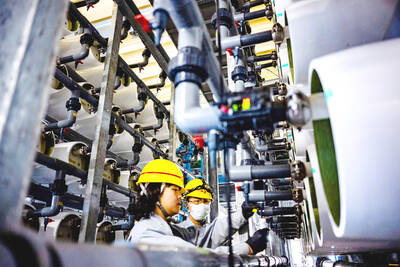
HIGH HOPES: The power source is expected to have a future, as it is not dependent on the weather or light, and could be useful for places with large desalination facilities A Japanese water plant is harnessing the natural process of osmosis to generate renewable energy that could one day become a common power source. The possibility of generating power from osmosis — when water molecules pass from a less salty solution to a more salty one — has long been known. However, actually generating energy from that has proved more complicated, in part due the difficulty of designing the membrane through which the molecules pass. Engineers in Fukuoka, Japan, and their private partners think they might have cracked it, and have opened what is only the world’s second osmotic power plant. It generates

JAN. 1 CLAUSE: As military service is voluntary, applications for permission to stay abroad for over three months for men up to age 45 must, in principle, be granted A little-noticed clause in sweeping changes to Germany’s military service policy has triggered an uproar after it emerged that the law requires men aged up to 45 to get permission from the armed forces before any significant stay abroad, even in peacetime. The legislation, which went into effect on Jan. 1 aims to bolster the military and demands all 18-year-old men fill out a questionnaire to gauge their suitability to serve in the armed forces, but stops short of conscription. If the “modernized” model fails to pull in enough recruits, parliament will be compelled to discuss the reintroduction of compulsory service, German

Hundreds of Filipinos and tourists flocked to a sun-bleached field north of Manila yesterday, on Good Friday, to witness one of the country’s most blood-soaked displays of religious fervor, undeterred by rising fuel prices. Scores of bare-chested flagellants with covered faces walked barefoot through the dusty streets of Pampanga Province’s San Fernando as they flogged their backs with bamboo whips in the scorching heat. Agence France-Presse (AFP) journalists said they saw devotees deliberately puncturing their skin with glass shards attached to a small wooden paddle to ensure their bleeding during the ritual, a way to atone for sins and seek miracles from


 RSS
RSS