


The Nigerian Islamist group Boko Haram, which claimed a wave of Christmas bombings that left at least 35 people dead, has carried out scores of attacks that have grown increasingly sophisticated.
The group is believed to include different factions with varying aims, including those with political links as well as a hard-core Islamist cell that has drawn supporters from young people in the deeply impoverished north.
While it initially sought the creation of an Islamic state in the north of Nigeria, Africa’s most populous nation with 160 million people, some people claiming to speak on its behalf have since issued a range of demands.
It was long considered a domestically focused group targeting symbols of Nigerian authority, but an August suicide bombing of UN headquarters in the capital Abuja intensified concerns about Boko Haram’s ambitions.
There has been intense speculation over whether it has formed links with outside extremist groups, such as al-Qaeda’s north African branch and Somalia’s al-Shabab rebels.
Diplomats say there have long been reports of Boko Haram members receiving training in foreign countries, but there has been no proof so far of operational links between the group and other extremist organizations.
An early version of the group formed in 2004, initially made up of university graduates and dropouts from wealthy and middle-class families and going by the name the “Nigerian Taliban.”
Drawing inspiration from the Afghan Taliban, a group of about 200 sect members set up camp in the village of Kanamma on the border with Niger.
The camp was dubbed “Afghanistan,” and from there it launched attacks on police stations, killing policemen and carting away ammunition.
It came to be led by a charismatic figure named Mohammed Yusuf, who convinced young people to join him despite seeming to have only elementary knowledge of the Koran, according to one professor who has studied the sect.
His fiery speeches, sold on audiotapes and DVDs in Nigeria’s north, condemned the military and corrupt leaders. Yusuf had at one point claimed to have 3,000 students, but it is difficult to find a reliable estimate of the group’s numbers.
As Yusuf’s rhetoric grew more militant, the military and police assigned a task force to track Boko Haram, which means “Western education is sin” in local dialect.
A confrontation between authorities and sect followers seeking to attend a funeral for Boko Haram members killed in a road accident in 2009 led to an escalation in violence. The group then decided to launch an uprising, leading to nearly a week of fighting that ended with a military assault that left about 800 dead and the sect’s mosque and headquarters in the northeastern city of Maiduguri in ruins.
Yusuf was captured during the assault and later killed when police said he was trying to escape.
The sect went dormant for more than a year before re-emerging last year with a series of assassinations. Bomb blasts have since become frequent and increasingly deadly.
Yusuf’s deputy, Abubakar Shekau, is widely believed to currently lead the main Islamist cell of Boko Haram.
The group has said it wants to be known by a different name, roughly translated as “People Committed to the Prophet’s Teachings for Propagation and Jihad.”
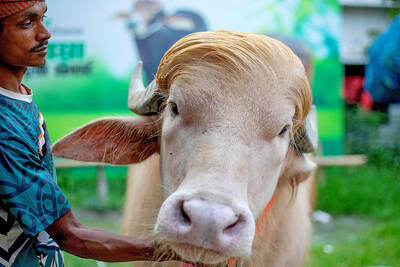
Crowds in Bangladesh are flocking to snap photographs with an unlikely social media star — an albino buffalo with flowing blond hair nicknamed “Donald Trump” that is due to be sacrificed within days. Owner Zia Uddin Mridha, 38, said his brother named the 700kg bull over its flowing helmet of hair resembling the signature look of the US president. “My younger brother picked this name because of the buffalo’s extraordinary hair,” he said at his farm in Narayanganj, just outside the capital, Dhaka. Mridha said that a constant stream of curious visitors — social media fans, onlookers and children — have come throughout

It began as a satirical online project. Now millions of young people in India are flocking to it as an outlet for their frustration. A parody political party called the Cockroach Janta Party, with the insect as its symbol, has exploded across India’s social media by turning absurdist humor into protest. Memes and short videos mocking corruption, joblessness and political dysfunction have flooded social media sites, where millions of users are embracing the cockroach — known for its ability to survive harsh conditions — as a tongue-in-cheek symbol of endurance. The online movement’s rise has been unusually rapid. The Cockroach Janta Party (CJP)
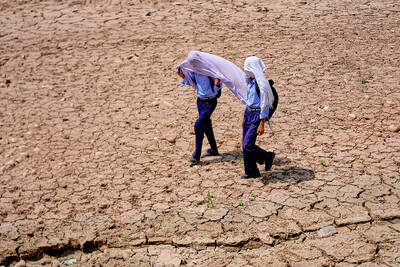
HOTTER: While Indians are accustomed to summer heat, climate change has caused northwestern India to warm faster than other parts of the country, an academic said Roads and markets have emptied during afternoons and some farmers have switched to nighttime work to avoid scorching temperatures as a heat wave grips large parts of India. The India Meteorological Department forecast maximum temperatures for yesterday of about 45°C in the capital, New Delhi, where authorities have opened temporary “cooling zones” to help people cope. The weather department warned that conditions would likely persist across several northern regions in the coming days, with temperatures staying well above seasonal averages. Authorities urged people to stay indoors during the hottest hours and take precautions against heat-related illnesses. India declares a heat wave whenever maximum temperatures
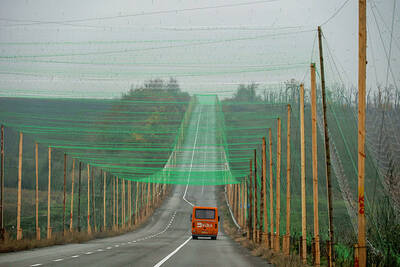
BIGGER ROLE: Beijing has said it maintains an impartial stance on the war in Ukraine, but by training Russian troops, China is far more involved than previously known China’s armed forces secretly trained about 200 Russian military personnel in China late last year, and some have since returned to fight in Ukraine, according to three European intelligence agencies and documents seen by Reuters. While China and Russia have held a number of joint military exercises since Moscow’s full-scale invasion of Ukraine in 2022, Beijing has repeatedly said that it is neutral in the conflict and presents itself as a peace mediator. The covert training sessions, which predominantly focused on the use of drones, were outlined in a dual-language Russian-Chinese agreement signed by senior Russian and Chinese officers in Beijing on


 RSS
RSS