


China roundly condemned the US for its “debt addiction” and “short-sighted” political wrangling and said the world needed a new stable global reserve currency.
In a harshly worded commentary by the Xinhua news agency yesterday, China gave its first official comments on the US losing its gilded “AAA” long-term credit rating from Standard & Poor’s.
“China, the largest creditor of the world’s sole superpower, has every right now to demand the United States address its structural debt problems and ensure the safety of China’s dollar assets,” Xinhua said.
China also urged the US to apply “common sense” to “cure its addiction to debts” by cutting military and social welfare expenditure.
“The US government has to come to terms with the painful fact that the good old days when it could just borrow its way out of messes of its own making are finally gone,” Xinhua wrote.
China also said further credit downgrades would very likely undermine the world economic recovery and trigger fresh rounds of financial turmoil.
“International supervision over the issue of US dollars should be introduced and a new, stable and secured global reserve currency may also be an option to avert a catastrophe caused by any single country,” Xinhua said.
Chinese economists said the US credit rating downgrade posed a great risk to financial markets and they expected it to prompt China, the world’s biggest holder of US Treasuries, to accelerate the diversification of its holdings.
S&P cut the US’ rating to “AA-plus” on concerns over the government’s budget deficits and rising debt burden. The move is likely to raise borrowing costs eventually for the US government, companies and consumers.
“There would be chaos in international financial markets at least in the short term. The most direct impact for China would be the hit on its reserves. The value of China’s dollar investments will fall and the shrinking effect may be great,” said Li Jie (李傑), a director at the Reserves Research Institute at the Central University of Finance and Economics.
Earlier this week, China had urged Washington to act responsibly to deal with its debt issues, saying uncertainty in the US Treasuries market would undermine the global monetary system and hamper global growth.
Beijing has repeatedly urged Washington to protect its US dollar investments, estimated by analysts to account for about two-thirds of its US$3.2 trillion in foreign exchange reserves, the world’s largest.
“China will be forced to consider other investments for its reserves. US Treasuries aren’t as safe anymore. There is a class of assets out there that are more risky than ‘AAA,’ but less risky than ‘AA+.’ China didn’t consider these investments before, but now it would be forced to do so,” Li said.
Earlier this week, the US narrowly avoided a default after lawmakers from across the political divide came together to hammer out a deal that would raise the country’s borrowing authority -after weeks of rancorous partisan battles.
S&P’s downgrade may also push the US to ease monetary policy further, causing even more uncertainty in global markets, said Ding Yifan (丁一凡), a deputy director at the Development Research Center, a think tank under the Chinese State Council.
“I think the chance of the United States launching another round of quantitative easing is rising, as outside investors may try to avoid dollar assets, leaving the Fed with no choice but to buy their own Treasuries,” Ding said. “If the United States really introduces QE3, it will definitely add more uncertainties to the global economy and could push up the prices of global commodities.”
The US Federal Reserve holds its next policy-setting meeting on Tuesday. Economists see little chance that the Fed will announce another round of bond purchases then.


PHISHING: The con might appear convincing, as the scam e-mails can coincide with genuine messages from Apple saying you have run out of storage For a while you have been getting messages from Apple saying “your iCloud storage is full.” They say you have exceeded your storage plan, so documents are no longer being backed up, and photos you take are not being uploaded. You have been resisting Apple’s efforts to get you to pay a minimum of £0.99 (US$1.33) a month for more storage, but it seems that you cannot keep putting off the inevitable: You have received an e-mail which says your iCloud account has been blocked, and your photos and videos would be deleted very soon. To keep them you need
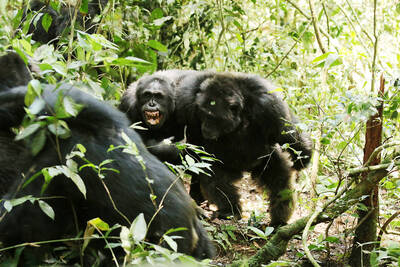
For two decades, researchers observed members of the Ngogo chimpanzee group of Kibale National Park in Uganda spend their days eating fruits and leaves, resting, traveling and grooming in their tropical rainforest abode, but this stable community then fractured and descended into years of deadly violence. The researchers are now describing the first clearly documented example of a group of wild chimpanzees splitting into two separate factions, with one launching a series of coordinated attacks against the other. Adult males and infants were targeted, with 28 deaths. “Biting, pounding the victim with their hands, dragging them, kicking them — mostly adult males,

The Israeli military has demolished entire villages as part of its invasion of south Lebanon, rigging homes with explosives and razing them to the ground in massive remote detonations. The Guardian reviewed three videos posted by the Israeli military and on social media, which showed Israel carrying out mass detonations in the villages of Taybeh, Naqoura and Deir Seryan along the Israel-Lebanon border. Lebanese media has reported more mass detonations in other border villages, but satellite imagery was not readily available to verify these claims. The demolitions came after Israeli Minister of Defense Israel Katz called for the destruction of

SUPERFAN: The Japanese PM played keyboard in a Deep Purple tribute band in middle school and then switched to drums at university, she told the British rock band Legendary British rock band Deep Purple yesterday made Japanese Prime Minister Sanae Takaichi’s day with a brief visit to their high-profile superfan as they returned to the nation they first toured more than half a century ago. Takaichi’s reputation as an amateur drummer, and a fan of hard rock and heavy metal has been well documented, and she has referred to Deep Purple as one of her favorite bands along with the likes of Black Sabbath and Iron Maiden. “You are my god,” a giddy Takaichi said in English to Deep Purple drummer Ian Paice, presenting him with a set of made-in-Japan


 RSS
RSS