


Afghan commander Maqim Sediqi has spent more than half of his life on battlefields, but he says that these days he is more preoccupied fighting for respect than firing his gun.
The army captain leads about 100 men battling alongside US forces to keep control of the critical Arghandab Valley in southern Kandahar Province, where a surge of US troops last year has seen some successes against a trenchant insurgency, but this year’s traditional summer fighting season comes as thousands of US troops prepare to leave Afghanistan, putting the fledgling force under pressure to show what they can do for themselves.
While commanders cite gains in the outlying areas of the province, the birthplace of the Taliban, a string of political assassinations in Kandahar a few kilometers south has brought fresh fears of an insurgent comeback.
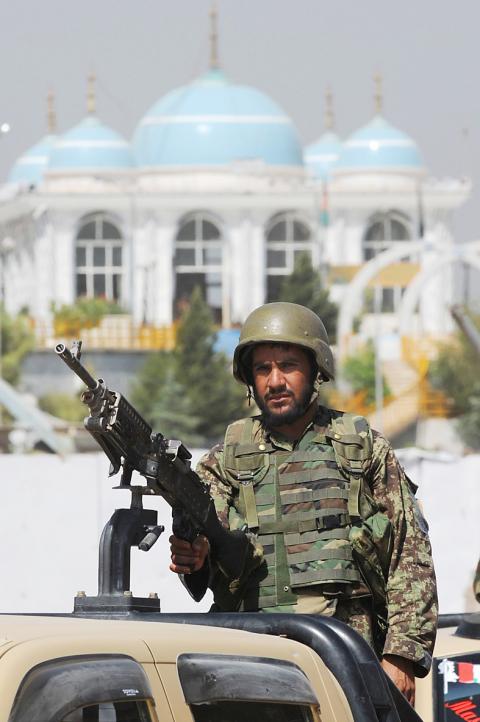
Photo: AFP
Sediqi said his men were ready to fight, “but we need good equipment, logistics. We have no good weapons and we lack ammunition.”
Sediqi, who like many of his men gained his battlefield experience fighting with the US-backed mujahidin against the Soviet invaders in the 1980s, blamed infighting in the political corridors of Kabul for the lack of support.
“I want them to have pride in their army,” he said.
While US soldiers patrol in regulation desert boots, some of their Afghan counterparts wear sandals out in the streets, and while the US force drives around in heavily-armored vehicles, the local force has pick-up trucks.
Sediqi’s equipment concerns are echoed by commanders across the country, and officials have expressed fears over how the Afghan army and police will be funded after a withdrawal of all foreign combat troops in three years’ time.
Still, 50-year-old Sediqi says the greatest threat to his men comes from homemade Taliban bombs, which litter the surrounding fields.
“There has been no face-to-face fighting,” he said.
A Pentagon war report in April said that across Afghanistan three-quarters of army units were judged “effective” when backed by an adviser or assistance from coalition troops, but no single army unit could yet operate independently.
Sediqi’s men are under the tight lead of their US comrades and he says he hopes their military trainers stay on longer to help them, but there are some successes — the Afghan National Army and police set up check points along a highway alone and on one recent mission they recovered a heavy weapon buried by insurgents.
“My men are willing. They are being trained by the Americans. With the Americans, we believe we can defeat them,” said Sediqi, although he later added: “I really can’t say whether they can be defeated or not.”
Lieutenant Colonel Michael Simmering, commander of the 1st Battalion, 67 Armored Regiment leading coalition efforts in the area, teaches his men to praise the Afghan soldiers for any small accomplishments to build their morale.
“What we’re trying to do is create a force that is capable of standing on its own,” Simmering told his men after awarding certificates of recognition to Afghan troops. “Right now, they’re not.”
Although talk of the transition from foreign to Afghan forces is high, no such handover is likely in Kandahar soon.
“The bottom line is, once we’re out of here, this whole place is going to be taken over again by the Taliban,” said a military defense contractor and former army officer, speaking on condition of anonymity, who had done three previous tours. “You just can’t teach people to take care of their own country if they are less willing to do so.”
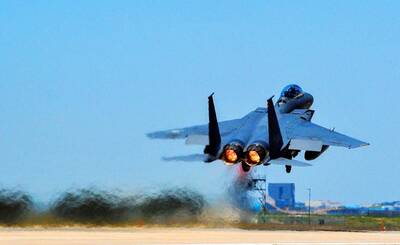
South Korea’s air force yesterday apologized for a 2021 midair collision involving two fighter jets, a day after auditors said the pilots were taking selfies and filming during the flight and held them responsible for the accident. “We sincerely apologize to the public for the concern caused by the accident that occurred in 2021,” an air force spokesman told a news conference, adding that one of the pilots involved had been suspended from flying duties, received severe disciplinary action and has since left the military. The apology followed a report released on Wednesday by the South Korean Board of Audit and Inspection,

Young Chinese, many who fear age discrimination in their workplace after turning 35, are increasingly starting “one-person companies” that have artificial intelligence (AI) do most of the work. Smaller start-ups are already in vogue in Silicon Valley and elsewhere, with rapidly advancing AI tools seen as a welcome teammate even as they threaten layoffs at existing firms. More young people in China are subscribing to the model, as cities pledge millions of dollars in funding and rent subsidies for such ventures, in alignment with Beijing’s political goal of “technological self-reliance.” “The one-person company is a product of the AI era,” said Karen Dai

About 240 Indians claiming descent from a Biblical tribe landed at Tel Aviv airport on Thursday as part of a government operation to relocate them to Israel. The newcomers passed under a balloon arch in blue and white, the colors of the Israeli flag, as dozens of well-wishers welcomed them with a traditional Jewish song. They were the first “bnei Menashe” (“sons of Manasseh”) to arrive in Israel since the government in November last year announced funding for the immigration of about 6,000 members of the community from the states of Manipur and Mizoram in northeast India. The community claims to descend from

‘TROUBLING’: The firing of Phelan, who was an adviser to a nonprofit that supported the defense of Taiwan, was another example of ‘dysfunction’ under Trump, a US senator said US Secretary of the Navy John Phelan has been fired, a US official and a person familiar with the matter said on Wednesday, in another wartime shakeup at the Pentagon coming just weeks after US Secretary of Defense Pete Hegseth ousted the Army’s top general. The Pentagon announced his departure in a brief statement, saying he was leaving the administration “effective immediately,” but it did not provide a reason or say whether it was his decision to go. The sources, who spoke on condition of anonymity, said Phelan was dismissed in part because he was moving too slowly to implement reforms to


 RSS
RSS