


US Secretary of State Hillary Rodham Clinton called for deeper regional security cooperation and trade ties in talks with Indian leaders yesterday, held in the shadow of triple bomb blasts in Mumbai.
India’s concerns over the US troop drawdown in Afghanistan and New Delhi’s renewed peace talks with arch-rival Pakistan were expected to figure in the “strategic dialogue” under way in the Indian capital.
Clinton held talks with India’s national security adviser and foreign minister and was later to meet Indian Prime Minister Manmohan Singh, before flying today to the southern city of Chennai.

Photo: AFP
She said there were three areas where the countries could deepen what Washington considers “a defining partnership of the 21st century,” namely trade and investment, security cooperation and civil nuclear technology.
Progress has been made, Clinton said in a speech alongside Indian Foreign Minister S.M. Krishna, “but there is still a great deal more room for our countries to make progress together.”
Her visit follows the blasts in Mumbai last week that killed 19 people and injured more than 130.
No one has claimed responsibility, but relations between India and Pakistan have been undermined in the past by militant strikes that New Delhi blames on Pakistan-based groups.
“We believe there’s been some good progress between India and Pakistan in the last few months,” a senior US administration official said, adding that Clinton was keen to help sustain that momentum.
India suspended its peace dialogue with Pakistan after the 2008 attacks in Mumbai and talks between the nuclear-armed neighbors only resumed earlier this year.
Washington’s own relations with Pakistan — a crucial counterterrorism ally — have deteriorated since US commandos shot and killed al-Qaeda leader Osama bin Laden on May 2 in a Pakistani garrison town, sowing distrust on both sides.
Earlier this month, Washington suspended almost a third of the US$2.7 billion in security assistance it provides each year to Islamabad.
Clinton said that there was room for widening US-India cooperation on maritime security and counterterrorism, as well as -military-to-military contacts.
India is wary of the US troop withdrawal from Afghanistan, fearing that Islamist elements within Pakistan could take advantage of a power vacuum in the war-torn country.
Clinton’s two-day trip follows US President Barack Obama’s visit in November — a courtship of India that reflects the rapid growth in the country’s economy and a shift in power to emerging nations as a result of the global financial crisis.
While economic ties have -improved significantly in recent years, they are still seen as falling short of their potential.
A landmark deal between the two countries in 2008 that allowed India to buy nuclear reactors and fuel was meant to lead to major contracts for US firms, but those hopes have been undermined by legal obstacles and uncertainty.
Clinton stated in her speech that “we need to resolve those issues that still remain so we can reap the rewards of a robust energy partnership.”
French and Russian state-run firms have signed deals to sell nuclear reactors to India, but privately run US firms have so far failed to make headway, largely because of regulatory concerns.
The US was also deeply disappointed in April when its bidders were dropped from the US$12 billion competition to provide India with 126 combat aircraft, one of the largest military contracts of recent years.
In other areas, commerce has been booming, with bilateral trade up by 30 percent to nearly US$50 billion last year.

Kouri Richins, a Utah mother who published a children’s book about grief after the death of her husband is to serve a life sentence for his murder without the possibility of parole, a judge ruled on Wednesday. Richins was convicted in March of aggravated murder for lacing a cocktail given to her husband, Eric Richins, with five times the lethal dose of fentanyl at their home near Park City in 2022. A jury also found her guilty of four other felonies, including insurance fraud, forgery and attempted murder for trying to poison her husband weeks earlier on Feb. 14, 2022, with a

‘PERSONAL MISTAKES’: Eileen Wang has agreed to plead guilty to the felony, which comes with a maximum sentence of 10 years in federal prison A southern California mayor has agreed to plead guilty to acting as an illegal agent for the Chinese government and has resigned from her city position, officials said on Monday. Eileen Wang (王愛琳), mayor of Arcadia, was charged last month with one count of acting in the US as an illegal agent of a foreign government. She was accused of doing the bidding of Chinese officials, such as sharing articles favorable to Beijing, without prior notification to the US government as required by law. The 58-year-old was elected in November 2022 to a five-person city council, from which the mayor is selected

DELA ROSA CASE: The whereabouts of the senator, who is wanted by the ICC, was unclear, while President Marcos faces a political test over the senate situation Philippine authorities yesterday were seeking confirmation of reports that a top politician wanted by the International Criminal Court (ICC) had fled, a day after gunfire rang out at the Philippine Senate where he had taken refuge fearing his arrest. Senator Ronald “Bato” dela Rosa, the former national police chief and top enforcer of former Philippine president Rodrigo Duterte’s “war on drugs,” has been under Senate protection and is wanted for crimes against humanity, the same charges Duterte is accused of. “Several sources confirmed that the senator, Senator Bato, is no longer in the Senate premises, but we are still getting confirmation,” Presidential
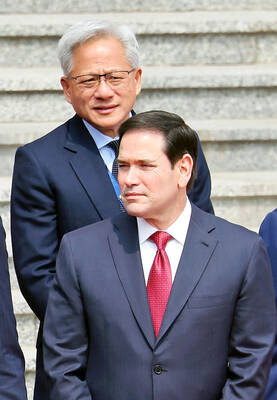
HELP DENIED? The US Department of State said that the Cuban leadership refuses to allow the US to provide aid to Cubans, ‘who are in desperate need of assistance’ US Secretary of State Marco Rubio on Wednesday said that Cuba’s leadership must change, as Washington renewed an offer of US$100 million in aid if the communist nation agrees to cooperate. Cuba has been suffering severe economic tumult led by an energy shortage that plunged 65 percent of the country into darkness on Tuesday. Cuba’s leaders have blamed US sanctions, but Rubio, a Cuban American and critic of the government established by Fidel Castro, said the system was to blame, including corruption by the military. “It’s a broken, nonfunctional economy, and it’s impossible to change it. I wish it were different,” he told


 RSS
RSS