


An agitated Libyan leader Muammar Qaddafi lashed out on Friday at those seeking to push him from power, warning in an audio message broadcast on state TV that NATO and his other enemies would be trampled “under the feet of the Libyan masses.”
In the capital of Tripoli, meanwhile, thousands rallied in the main square for mass prayers and a show of support for Qaddafi. The gathering in the Green Square came a week after another large pro-government demonstration there, showing that Qaddafi can still muster significant support.
Qaddafi has not been seen publicly in recent weeks, apparently keeping himself hidden so as not to be targeted by NATO airstrikes. After the broadcast of his speech on Friday evening, bursts of gunfire — presumably in celebration — were heard in Tripoli.
In his message, Qaddafi warned that all those challenging his regime would be defeated.
“The enemies of the masses will fall under the feet of the masses, under the marching of the masses,” said the embattled leader, his voice rising to a shout. “The collaborators and traitors will fall — east and west — and NATO will fall under the feet of the Libyan masses, under the feet of the free Libyan people.”
An imam urged Libyans to stop fighting one another, and said Western nations had intervened in Libya’s civil war because they were after the country’s oil.
“Pray for a victory over NATO,” he told worshipers, adding that “God will punish those who brought NATO here” — an apparent reference to rebel leaders based in the eastern city of Benghazi.
Friday is the Muslim day of rest. With many people off work, it is generally the day the Middle East witnesses its biggest protests.
After the prayers finished, many worshippers began waving the green national flag and -chanting pro-Qaddafi slogans as government minders rushed visiting journalists to a rooftop overlooking the square for a better view.
While thousands of supporters rallied, many other worshippers dodged the political slogans by streaming out of the square as soon as prayers finished.
In Brussels, the EU said that European Commission President Jose Manuel Barroso, would meet on Wednesday with a delegation of the rebels’ National Transitional Council headed by its diplomatic chief Mahmoud Jibril.
In May, EU foreign affairs chief Catherine Ashton opened a diplomatic office in Benghazi and pledged support for a democratic Libya.
The Libyan rebel delegation is also scheduled to visit NATO and meet with NATO Secretary-General Anders Fogh Rasmussen.
In an interview with The Associated Press in Naples, Italy, Rasmussen said opposition forces trying to topple Qaddafi are making progress, but he emphasized that political progress is needed because “there is no military solution to the conflict solely.”
NATO began airstrikes against Libya in March. The coalition and its Arab allies are operating under a UN mandate to protect civilians.
Libya’s rebels have consolidated power over much of eastern Libya. They also hold pockets in the west, including the port city of Misrata and a string of towns in the Nafusa mountains southwest of Tripoli, but have struggled to mount a major push toward the capital.
Government troops shelled rebel positions west of Misrata on Friday, killing five rebels and injuring others, activist Mohammed Slim said via Skype.
It was unclear if any government troops were killed.

Australians were downloading virtual private networks (VPNs) in droves, while one of the world’s largest porn distributors said it was blocking users from its platforms as the country yesterday rolled out sweeping online age restriction. Australia in December became the first country to impose a nationwide ban on teenagers using social media. A separate law now requires artificial intelligence (AI)-powered chatbot services to keep certain content — including pornography, extreme violence and self-harm and eating disorder material — from minors or face fines of up to A$49.5 million (US$34.6 million). The country also joined Britain, France and dozens of US states requiring
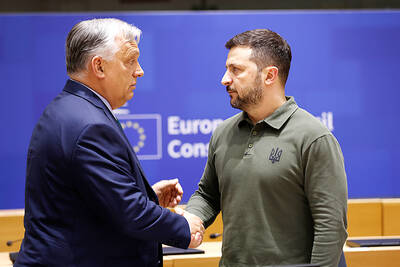
Hungarian authorities temporarily detained seven Ukrainian citizens and seized two armored cars carrying tens of millions of euros in cash across Hungary on suspicion of money laundering, officials said on Friday. The Ukrainians were released on Friday, following their detention on Thursday, but Hungarian officials held onto the cash, prompting Ukraine to accuse Hungary’s Russia-friendly government of illegally seizing the money. “We will not tolerate this state banditism,” Ukrainian Minister of Foreign Affairs Andrii Sybiha said. The seven detained Ukrainians were employees of the Ukrainian state-owned Oschadbank, who were traveling in the two armored cars that were carrying the money between Austria and
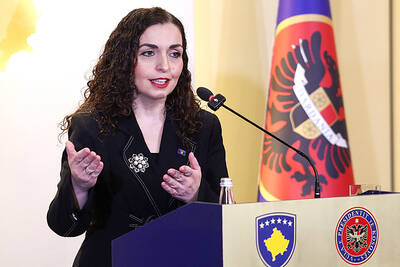
Kosovar President Vjosa Osmani on Friday after dissolving the Kosovar parliament said a snap election should be held as soon as possible to avoid another prolonged political crisis in the Balkan country at a time of global turmoil. Osmani said it is important for Kosovo to wrap up the upcoming election process and form functional institutions for political stability as the war rages in the Middle East. “Precisely because the geopolitical situation is that complex, it is important to finish this electoral process which is coming up,” she said. “It is very hard now to imagine what will happen next.” Kosovo, which declared

ACTIONABLE ADVICE: The majority of chatbots tested provided guidance on weapons, tactics and target selections, with Perplexity and Meta AI deemed to be the least safe From school shootings to synagogue bombings, leading artificial intelligence (AI) chatbots helped researchers plot violent attacks, according to a study published on Wednesday that highlighted the technology’s potential for real-world harm. Researchers from the nonprofit watchdog Center for Countering Digital Hate and CNN posed as 13-year-old boys in the US and Ireland to test 10 chatbots, including ChatGPT, Google Gemini, Perplexity, Deepseek and Meta AI. Eight of the chatbots assisted the make-believe attackers in more than half the responses, providing advice on “locations to target” and “weapons to use” in an attack, the study said. The chatbots had become a “powerful accelerant for


 RSS
RSS