


The family of Libyan leader Muammar Qaddafi could have billions of US dollars of funds hidden away in secret bank accounts in Dubai, southeast Asia and the Persian Gulf, much of it likely to have come from Libya’s vast oil revenues, according to analysis by leading Middle East experts.
Professor Tim Niblock, a specialist in Middle Eastern politics at the University of Exeter, England, has identified a “gap” of several billion dollars a year between the amount Libya makes from its oil reserves and government spending — a shortfall he expects has contributed greatly to the wealth of Qaddafi and his nine children.
“It is very, very difficult to work out with any degree of certainty just how much they have because the ruling elite hides it in all sorts of places, but at the very least it would be several billion [US] dollars, and it could be a lot higher,” Niblock said.
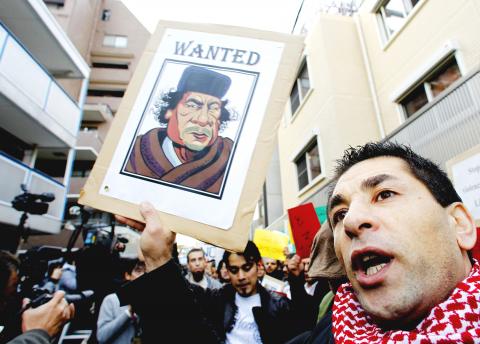
Photo: Reuters
Alistair Newton, senior political analyst at Nomura, the Japanese bank, agreed that it was difficult to establish the extent of the Qaddafis’ wealth, but said he “would be surprised if it didn’t run into billions.”
Where the Qaddafis have hidden their vast funds is anybody’s guess, although Niblock expects that most of it is “in bank accounts and liquid assets in Dubai, the Gulf and southeast Asia” rather than in relatively transparent countries such as the UK.
Libyan has invested in London properties and in companies such as Pearson Group.
In addition to squirreling away much of their income, the Qaddafis have spent fortunes over the years “propping up” various African regimes, with Zimbabwean President Robert Mugabe widely acknowledged to be among the biggest recipients, Niblock said.
In the 1990s Qaddafi is thought to have given money to the Zaghawan tribe in Darfur, “and I suspect some of them are among the African mercenaries fighting the civilians in Libya,” Niblock said.
Libya’s growth has enabled the country to build up myriad investments overseas. In addition to the Qaddafis’ private holdings, the state is thought to have invested close to US$100 billion across the globe.
Their investments in the UK include an eight-bedroom home in Hampstead, north London, with a swimming pool and suede-lined cinema room that Saif al-Islam Qaddafi, the Libyan leader’s second son, bought in 2009 for £10 million (US$16 million).
Most of the state’s investments are made by the Libyan Investment Authority (LIA), a so-called sovereign wealth fund set up in 2006 to spend the country’s oil money, which has an estimated US$70 billion of assets. LIA bought 3 percent of Pearson last year for £224 million making it one of the group’s biggest shareholders.
The Libyan leader famously enjoys a warm personal relationship with Italian Prime Minister Silvio Berlusconi, and partly as a result has recently brokered at least two direct investment projects in the south of country, both of which involve water bottling plants.
Experts say if Qaddafi is overthrown, the investments made by Libya’s various state funds would probably be unaffected, since any new government would have far more pressing matters to attend to, and any sudden movements could damage their reputation for the future.
However, it is thought likely that a new regime in Libya could look to freeze the assets of the Qaddafi family, as the new government in Egypt did with the assets of ousted Egyptian president Hosni Mubarak and his family.
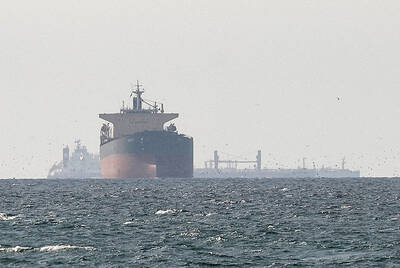
A ship that appears to be taking on the identity of a scrapped gas carrier exited the Strait of Hormuz on Friday, showing how strategies to get through the waterway are evolving as the Middle East war progresses. The vessel identifying as liquefied natural gas (LNG) carrier Jamal left the Strait on Friday morning, ship-tracking data show. However, the same tanker was also recorded as having beached at an Indian demolition yard in October last year, where it is being broken up, according to market participants and port agent’s reports. The ship claiming to be Jamal is likely a zombie vessel that

Cannabis-based medicines have shown little evidence of effectiveness for treating most mental health and substance-use disorders, according to a large review of past studies published in a major medical journal on Monday. Medical use of cannabinoids has been expanding, including in the US, Canada and Australia, where many patients report using cannabis products to manage conditions such as anxiety, post-traumatic stress disorder and sleep problems. Researchers reviewed data from 54 randomized clinical trials conducted between 1980 and May last year involving 2,477 participants for their analysis published in The Lancet. The studies assessed cannabinoids as a primary treatment for mental disorders or substance-use
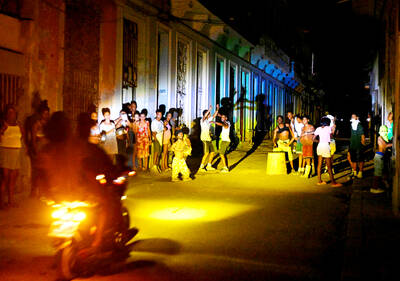
NATIONWIDE BLACKOUT: US President Donald Trump cut off Venezuelan oil shipments to Cuba, strangling the Caribbean island’s already antiquated grid Cuba’s national electric grid collapsed on Monday, the nation’s grid operator said, leaving about 10 million people without power amid a US-imposed oil blockade that has crippled the already obsolete generation system. Grid operator UNE on social media said that it is investigating the causes of the blackout, the latest in a series of widespread outages that last for hours or days and that this weekend sparked a rare violent protest in the communist-run nation. Officials ruled out a major power plant failure, but had still not pinpointed the root cause of the grid collapse, suggesting a problem with transmission. Officials said that
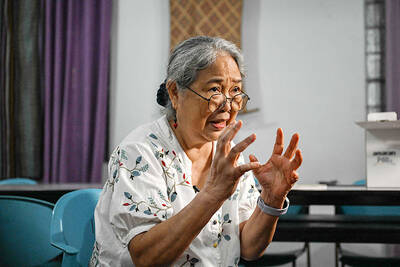
‘HEALTH ISSUE’: More than 250 women are hospitalized every day due to complications from unsafe abortions, and about three die, a study showed Jane had been bleeding heavily for days before finally seeking help, not from a hospital, but from the man who sold her the pills meant to end her six-week pregnancy. Abortions are strictly outlawed in the mainly Catholic Philippines, forcing women to turn to a patchwork of providers operating in the online shadows. While rare in practice, Philippine law allows for prison terms of up to six years for abortion patients and providers, leaving thousands of Filipinas to search for solutions in online forums where unlicensed sellers promote abortifacients. “It was very painful, as if my abdomen was being twisted,” said Jane, whose


 RSS
RSS