

For the second time in less than a week, US forces were embroiled in deadly fighting against insurgents — a reminder of the ongoing dangers those forces face well after US President Barack Obama declared a formal end to combat.
With a persistent insurgency, ongoing sectarian tensions and no agreement on a new government after six months of wrangling, stabilizing Iraq before all US forces leave still seems a distant dream.
The raid on Wednesday, in which at least six people were killed, took place in the former insurgent stronghold of Fallujah — highlighting the persistent danger that al-Qaeda-linked militants still pose despite years of efforts by both Iraqi and US forces to root them out.
Insurgents seem to have redoubled their efforts this summer to target Iraqi security forces taking over from the departing US — nine Iraqi soldiers died on Wednesday in a roadside bombing while two police officers in Baghdad were shot and killed. The militants are trying to undermine the so-called “Sons of Iraq” — the anti-al-Qaeda militia that was instrumental in reducing violence.
The anger with which Fallujah officials reacted to the raid — conducted by Iraqi troops from Baghdad instead of local forces — spotlights another persistent threat to Iraq’s security: deep divisions between the minority Sunnis in places like Fallujah and the Shiite majority that rules the country.
Details of the raid were murky. US officials described it as an Iraq-led mission targeting al-Qaeda-linked militants with the US in an advisory capacity. Officials in Anbar Province railed against the raid, calling it a heavy-handed attack that left civilians dead.
US troops were helping Iraqi forces hunt down a senior al-Qaeda operative when militants opened fire on Iraqi security forces as they and the US soldiers approached a building in which the suspect was hiding, US Major Rob Phillips said.
He said Iraqi forces killed four suspected militants as well as two residents in nearby houses who came out of their homes with weapons drawn.
He did not know if the US forces ever opened fire or the exact role they played, but he said as long as the Iraqi forces that the US are advising are at risk, “we’re still in as much danger as they are.”
A White House spokesman referred requests for comment to local US military officials.
DIFFERENT STORY
Officials in Fallujah and Anbar Province portrayed the raid in a different light.
Fallujah police chief Brigadier General Mahmoud al-Essawi said local police did not take part and were told by commanders of the joint US-Iraqi unit that their help was not needed.
Iraqi forces sometimes bring in troops from outside an area to do raids or make arrests because they worry that the local forces, especially police, can be infiltrated by insurgents.
The city’s municipal council criticized the raid and said in a statement that seven civilians were killed, “including old men and children.”
Five people were injured, the statement said, adding that the raiding force faced no resistance. Hospital officials confirmed the death toll.
“The people of Fallujah denounce this terrorist operation ... motivated by the deep hatred of this city and its people,” the statement said, referring to the distrust between the Shiite majority and the Sunni city.
In the early years of the war, Fallujah was synonymous with the insurgency, drawing in people from Saudi Arabia and Yemen who wanted to fight the US.
In 2004, US troops faced some of the most intense urban combat since Vietnam, but the city has become more peaceful in recent years, largely due to the rebellion of many Iraqis against their former militant allies.
Persistent attacks against the Sons of Iraq and efforts by al-Qaeda to lure the militia members back into the insurgency by paying them has raised questions about whether the group will remain a strong force against militants.
The militia members have also been angered by what they describe as neglect by the Shiite government.
The incident in Fallujah follows a battle in Diyala Province in which US troops helped Iraqi security forces battle suspected al-Qaeda militants for two days.
US drones, attack aircraft, artillery fire and ground forces took part in what appeared to be the most extensive fighting since the US ended its major combat role in Iraq.
US forces also took part in a brief firefight against militants attacking a Baghdad military headquarters early this month and two US soldiers died after being shot by a Kurdish member of the Iraqi army while they visited an Iraqi military facility.
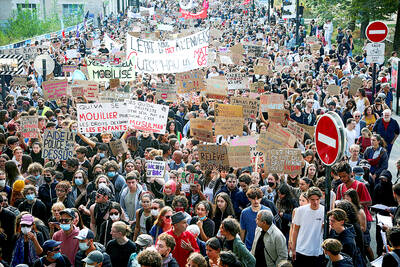
VIOLENT STANDOFFS: The government said 215 students have been injured since the start of the movement last month, including a teenager who lost a hand on Monday Thousands of demonstrators yesterday massed under heavy police surveillance in Paris and cities across France, as unions and teachers joined high-school students who for days have been demanding better conditions in protests punctuated by violent clashes. Students have blocked the entrances to hundreds of high schools for 15-to-17-year-olds since late last month, complaining of missing teachers, overloaded schedules, dilapidated classrooms and buildings that cannot cope with rising temperatures. In the Paris suburb of Creteil, where the protests started last month, students piled barriers outside the Saint-Exupery high school. “We are here to make our voice heard, all too often forgotten,” student Abderrahmane Abdelkader

As shark attack survivor Mel Ismail fought the predator that severed his leg, he noticed something odd. “I saw its eye ... a big black eye,” Ismail said. “But it was winking back at me — I was trying to get my fingers in its eye and just pushing its eye as I was being dragged.” When the shark swam off, he managed to struggle back to shore, the surfer and professional firefighter said in an Australian Broadcasting Corp interview broadcast on Thursday. He was surfing at Glenfield Beach near Geraldton on Australia’s west coast when he was attacked on Sept. 14. He

A Tuvalu government adviser yesterday said it felt like Australia had “taken over” the tiny country’s sovereignty during a visit by leaders to the Pacific island. The official — a senior government adviser who asked to remain anonymous because they were not authorized to speak to the media — said they were disappointed in Australia’s handling of the visit. The comments came during a visit by Australian Prime Minister Anthony Albanese and other leaders to Tuvalu, which has become a symbol of the existential threat posed by rising seas and is a key partner in Canberra’s Pacific strategy. “Just because we signed the

Halfway around the world from Russia, in a Caribbean tourism hot spot, men young and old are being lured by Moscow with tantalizing job offers, only to find themselves en route to the front lines in Ukraine. Moscow and Kyiv have recruited thousands of foreign nationals into their armies since Russia launched its invasion of Ukraine in 2022. Moscow is accused, in some cases, of using fake job ads to hoodwink men from deprived backgrounds in Africa, Asia and Latin America into traveling to Russia and then forcing them to fight on arrival. From countries such as India, Kenya, Equatorial Guinea, Colombia and


 RSS
RSS