


When the order came to evacuate the Totia high school, hundreds of girls ran from their desks clutching handkerchiefs and their headscarves over their mouths. School bags were abandoned as some leapt out of the ground floor windows of their dilapidated two-story school block rather than trying to push their way through a melee of teenage girls all rushing to get out to fresh air.
Teachers tried to organize an orderly departure, but their efforts were in vain amid rising panic that the school had become the latest in Afghanistan to be hit by an apparent poison gas attack.
A total of 46 students and nine teachers were treated in hospital after what Mohammad Asif Nang, an official at the education ministry, described as “an apparent poisoning” attack by “the enemies of women’s education.”
According to staff, parents and onlookers, girls began fainting in the school’s main classroom block at about 10:30am on Wednesday, during the first of three daily shifts designed to triple the number of girls at the school.
Some victims had to be carried out, while others stumbled to the school gates, where about 18 slumped to the ground unconscious, said Abdul Haq, a 15-year-old boy who witnessed the incident.
Many were taken to hospital and most quickly recovered, but some girls remained unconscious for several hours, doctors said. Others were vomiting and complaining of nausea.
The symptoms matched those of other cases reported around the country. Opinions are divided between those who denounce the incidents as malicious attacks by social conservatives who disapprove of female education and skeptics who think the culprit is more likely to be mass hysteria.
At the Boost hospital, the head doctor, Abdullah Abid, said four of the 22 girls admitted remained unconscious for at least two hours.
He said that after studying psychiatry for a year in Pakistan he had become acutely aware of the power of hysteria and its ability to cause physiological responses, but he did not think that was the cause of the latest incident.
“I think three of them were just suffering from shock from seeing their friends become ill. But something else must have happened to the others,” he said.
Education ministry officials said five similar cases had been dealt with in Kabul this year alone and 11 more around the country.
The Taliban banned girls’ education when it was in power from 1996 to 2001 and it continues to target women and girls’ schools in the areas they control.
One of its intimidation techniques is the so-called “night letters” dropped off at homes and schools. In one case in a northern province in February a letter, which was handed to Human Rights Watch, said the school was misleading “pure and innocent girls.”
With Taliban violence surging across the country, the fear of insurgent attacks is becoming a bigger concern for ordinary Afghans.
The existence of such fears can trigger mass hysteria accompanied by actual physical illness, experts say.
Lal Mohammad, Totia school’s caretaker, said nothing untoward had been found so far. The only thing unusual was a nauseating smell, apparently similar to that of human sewage, which greeted the students when they arrived in the morning.
“It was so bad that the head said we must tell the neighboring houses that they should only clear out their shit at the night time,” Mohammad said.
Western medical experts have taken blood samples from alleged victims while investigating previous incidents, but have been unable to find clear evidence of poisoning. They have also questioned how such an apparently powerful gas could be spread with such apparent ease round large school buildings.

‘CROSSING THE LINE’: China’s embassy in Seoul criticized US Forces Korea Commander General Xavier Brunson, asking if his ‘hostile’ remarks were authorized by Washington South Korea and the US are in talks over recent public remarks by the commander of US Forces Korea, Seoul’s presidential office said yesterday, after the comments drew sharp criticism from China. In a recent podcast interview, US Forces Korea Commander General Xavier Brunson described South Korea as “the dagger in the heart of Asia” from China’s east coast, prompting the Chinese embassy in Seoul to say that he had “truly crossed the line.” The interview came amid growing speculation that Washington might seek to expand the role of US Forces Korea in countering the growing regional influence of China, a key

Through the noise of rushing papers and whirring belts at a print factory in Kyoto, two creators watch their photo essay come to life in broadsheet form — part of an effort to win new audiences in the age of artificial intelligence (AI). Despite the decline of the publishing industry, self-publication and handmade “zine” magazines are growing in popularity in Japan, reflecting the nation’s enduring love of paper in the digital era. While speaking to Agence France-Presse at the plant, his hands black with ink, one of the creators, Kazuma Obara, said: “I think [paper] is a medium that engages all five

Australian researchers have trained lab-grown brain cells on a silicon computer chip to play the 1990s shooter game Doom and said they are just scratching the surface of what the neurons could be capable of doing. It is the science-fiction work of biotech boffins at Cortical Labs, who researched and developed the technology that harnesses the workings of the brain’s networking system. Each so-called “biological computer” contains about 200,000 living human brain cells, grown from stem cells that were harvested from blood donations. Having mastered the simple computer game Pong, where a paddle is moved up and down to send a ball
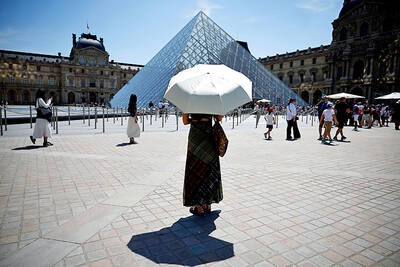
France experienced its hottest spring on record, the French weather service said on Tuesday, after an exceptional early heat wave that also broke highs for the season in England and Wales. Meteo-France said the average nationwide temperature over March to May was 13.8°C — about 1.7°C above the norm, and surpassing records set in 2011 and 2020. “The warmest spring since records began in 1900,” it said in a bulletin. All three months were warmer than average, but the onset of an “unprecedented heatwave” late last month pushed the mercury to highs typically seen at the height of the summer. “Our country had never


 RSS
RSS