


Gunmen killed at least 37 people in Pakistan’s largest city after a prominent lawmaker’s assassination set off a cycle of revenge attacks, officials said yesterday. Dozens of vehicles and shops were set ablaze as security forces struggled to regain control of Karachi.
The southern city of more than 16 million has a history of political, ethnic and religious violence, and has long been a hide-out for al-Qaeda and Taliban militants. Its stability is important for Pakistan because it is the country’s main commercial hub.
The unrest came after Raza Haider, a provincial lawmaker, was shot dead with his bodyguard in a mosque on Monday in Nazimabad area.
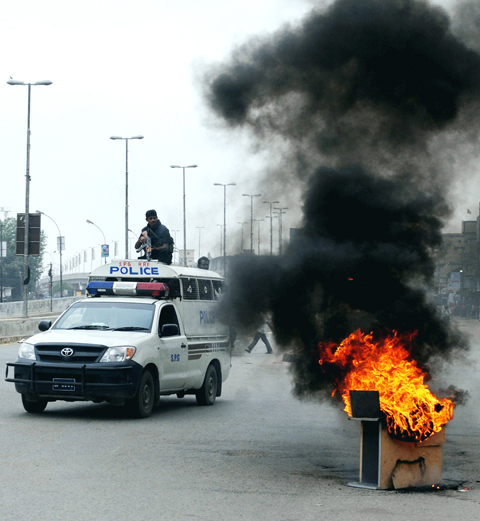
PHOTO: AFP
Haider was a member of the Muttahida Qaumi Movement (MQM), the political party that runs the city and represents descendants of migrants from India who settled in Pakistan when it was created in 1947.
The MQM’s main nemesis is the Awami National Party, a secular nationalist party whose main power center is Pakistan’s northwest and whose base is the ethnic Pashtun community.
Independent analysts say followers of all political parties in Karachi are heavily involved in criminal activities such as protection rackets and illegal land dealings. In certain neighborhoods, armed men linked to political parties stand guard at checkpoints.
Officials from different hospitals put the total death toll by yesterday morning at 37. Eighty additional people had suffered gunshot wounds, they said. A furniture market was among the places set ablaze.
Sindh Province spokesman Jamil Soomro said at least 10 people were arrested, and police and Army Rangers were dispatched throughout the city to impose order, but gunfire could still be heard yesterday morning and fires were still being set in some areas.
Schools and colleges in Karachi and other urban centers in the province were ordered to stay closed by the government yesterday. Some officials blamed unspecified “invisible hands” for the violence.
“It is very sad, and we believe that it is the work of those forces who want to destabilize the elected government,” Soomro said.

FRAUD ALLEGED: The leader of an opposition alliance made allegations of electoral irregularities and called for a protest in Tirana as European leaders are to meet Albanian Prime Minister Edi Rama’s Socialist Party scored a large victory in parliamentary elections, securing him his fourth term, official results showed late on Tuesday. The Socialist Party won 52.1 percent of the vote on Sunday compared with 34.2 percent for an alliance of opposition parties led by his main rival Sali Berisha, according to results released by the Albanian Central Election Commission. Diaspora votes have yet to be counted, but according to initial results, Rama was also leading there. According to projections, the Socialist Party could have more lawmakers than in 2021 elections. At the time, it won 74 seats in the

EUROPEAN FUTURE? Albanian Prime Minister Edi Rama says only he could secure EU membership, but challenges remain in dealing with corruption and a brain drain Albanian Prime Minister Edi Rama seeks to win an unprecedented fourth term, pledging to finally take the country into the EU and turn it into a hot tourist destination with some help from the Trump family. The artist-turned-politician has been pitching Albania as a trendy coastal destination, which has helped to drive up tourism arrivals to a record 11 million last year. US President Donald Trump’s son-in-law, Jared Kushner, also joined in the rush, pledging to invest US$1.4 billion to turn a largely deserted island into a luxurious getaway. Rama is expected to win another term after yesterday’s vote. The vote would

CANCER: Jose Mujica earned the moniker ‘world’s poorest president’ for giving away much of his salary and living a simple life on his farm, with his wife and dog Tributes poured in on Tuesday from across Latin America following the death of former Uruguayan president Jose “Pepe” Mujica, an ex-guerrilla fighter revered by the left for his humility and progressive politics. He was 89. Mujica, who spent a dozen years behind bars for revolutionary activity, lost his battle against cancer after announcing in January that the disease had spread and he would stop treatment. “With deep sorrow, we announce the passing of our comrade Pepe Mujica. President, activist, guide and leader. We will miss you greatly, old friend,” Uruguayan President Yamandu Orsi wrote on X. “Pepe, eternal,” a cyclist shouted out minutes later,

A Croatian town has come up with a novel solution to solve the issue of working parents when there are no public childcare spaces available: pay grandparents to do it. Samobor, near the capital, Zagreb, has become the first in the country to run a “Grandmother-Grandfather Service,” which pays 360 euros (US$400) a month per child. The scheme allows grandparents to top up their pension, but the authorities also hope it will boost family ties and tackle social isolation as the population ages. “The benefits are multiple,” Samobor Mayor Petra Skrobot told reporters. “Pensions are rather low and for parents it is sometimes


 RSS
RSS