

It has been called the Big Freeze, the Last Blast of the Ice Age or — to use the scientific name — the Younger Dryas, and for climate experts it is one of the big mysteries of their field.
About 12,900 years ago, Earth was on a steadily warming trend.
For nearly 100,000 years, the planet had been gripped in glaciation. Ice sheets placed a swathe of the northern hemisphere under a dead hand, extending their thrall as far as south as New England and Wales.
But just as the glaciers were beginning to retreat, and an easier life at last beckoned for Earth’s small population of humans, everything went into reverse.
Temperatures fell dramatically by up to 8°C, heralding a cruel winter that would last 1,300 years.
But what caused it? Crunching powerful equations and weighing fresh evidence, an astrobiologist in Britain is pointing the finger at an unusual culprit.
Earth collided with debris from a vast comet, measuring 50km to 100km across, that had wandered into the inner Solar System 30,000 years ago before breaking up, said Bill Napier, a professor at Cardiff University’s Astrobiology Centre.
The impact unleashed a firestorm that blanketed the atmosphere with ash and dust, reducing heat and light from the Sun, Napier said in Monthly Notices, a journal of the Royal Astronomical Society.
What is worrying, said Napier, is that our planet still crosses the path of the remaining orbiting cometary rubble, a well-observed, although still enigmatic, phenomenon called the Taurid Complex.
Many of these fragments are tiny and their burnup in the atmosphere causes pretty shooting stars. Other pieces, though, may not be so enchanting.
They are not big enough to inflict global extinctions like the event 62 million years ago that is thought to have wiped out the dinosaurs, but they could still devastate entire regions.
“It [the Taurid Complex] includes at least 19 of the brightest near-Earth objects,” Napier said. “Sub-kilometer bodies [objects measuring 1,000m across or less] in meteor streams may present the greatest regional impact hazard on timescales of human concern.”
Previous research buttresses Napier’s theory that only an impact could explain the plunge in temperature, as opposed to a natural quirk in Earth’s orbit or drop in the Sun’s heat output.
At 15 sites in North America, archeologists have uncovered a thin layer of soot deposited at the time of the Younger Dryas.
It includes microscopic hexagonal “nano-diamonds,” imbedded within melted plant resin, which elsewhere have only ever been found in meteorite craters.
Then there is evidence of a die-out. If the fossil record is a guide, at least 33 mammals abruptly disappeared, including types of mammoth, horse and camel as well as birds and smaller mammals.
Under some scenarios, an asteroid or comet measuring 4km across smashed into the 2km-thick Laurentide ice sheet covering present-day Canada and part of the northern US.
Other astronomers, though, have railed at this theory.
At the time, they say, the Solar System had been largely cleansed of the monster rocks of its infancy, and the chance of a collision with an object of this magnitude was a thousand to one against.
And the heat unleashed by the rising fireball would be constrained by the curvature of the horizon, and this would not explain why wildfires erupted across the continent.
But Napier says the riddle can be explained.
According to his model, Earth ran into a swarm of fragments, not a single vast chunk.
For one hellish hour, North America was bombarded by thousands of impacts, each releasing the energy of a megaton-class nuclear bomb, and this explains why the fires were so extensive.
“A large comet has been disintegrating in the near-Earth environment for the past 20,000 to 30,000 years, and running into thousands of fragments from this comet is a much more likely event than a single large collision,” Napier said.

The US Department of Agriculture and the FBI were breached by hackers in cyberattacks, US media reported on Friday, as concerns deepened over the recent spate of tech outages at key US institutions. The incidents were first reported by NBC News and CNN respectively, and it remained unclear whether they were related and who was responsible. Major outages over the past few weeks have disrupted travel, communications and e-commerce for countless users across the US, even affecting a top-secret network at the US National Security Agency. US President Donald Trump has sought to calm the public and urged people to
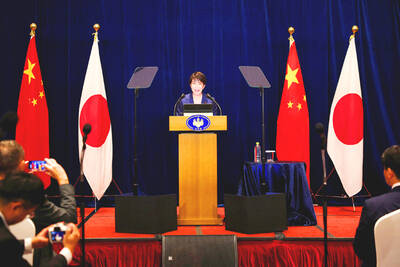
Japan must “correct its wrong words” on Taiwan and change its “attitude,” China said yesterday, after Chinese President Xi Jinping (習近平) snubbed Japanese Prime Minister Sanae Takaichi at a regional meeting in Shenzhen, China. “For the Japanese side, the most urgent task is to correct its wrong words and actions on the Taiwan issue as soon as possible,” Chinese Ministry of Foreign Affairs spokesman Guo Jiakun (郭嘉昆) told a briefing. “The important thing is to adopt a correct attitude on historical issues, and fundamentally, truly achieve an objective and rational understanding of China.” Takaichi’s China trip this week was her first since

’VIVA BUKELE’: Supporters urged the Salvadoran leader to do whatever it takes to end the violence in Haiti that has resulted in 4,595 deaths so far this year, the UN says Haiti on Tuesday announced that it formalized a “cooperation agreement” with El Salvador, the same day thousands of Haitians showed support in the streets of Port-au-Prince for soldiers sent by Salvadoran President Nayib Bukele to confront armed gangs in the capital. “The Council of Ministers has approved the Cooperation agreement between the Republic of Haiti and the Republic of El Salvador,” Bukele wrote on Facebook, calling it “a new stage in strengthening bilateral relations and cooperation.” Signs carried by the demonstrators on Tuesday read “Thank you, Bukele,” and “Long live Bukele.” “Bukele, the country belongs to you. Do whatever you want with it,”
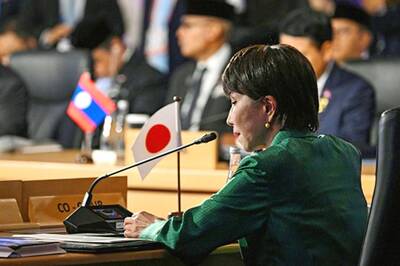
Japan yesterday said that Southeast Asian nations would be able to access its crude oil storage facilities as part of efforts to prepare the region for a future energy crisis. The announcement came as ASEAN leaders met in Manila, where energy security has been high on the agenda. Addressing regional leaders, Japanese Prime Minister Sanae Takaichi said her country’s “hydro-tanks” would be available for use under the proposed initiative for cooperation on oil stockpiling. ASEAN members have been grappling with fuel shortages and price hikes after the Middle East conflict squeezed the flow of crude to the region. The regional bloc has


 RSS