

The number of exiles from Tibet has declined because China is stepping up border control in the region, a senior envoy to the Tibetan spiritual leader the Dalai Lama said on Friday.
“Normally until 2008, every year we had on average between 2,500 and 3,000 people who escaped from Tibet. But since the demonstration in March 2008, that number has fallen,” said Tempa Tsering, the chief representative of the Buddhist monk who has been based in India since fleeing his Himalayan homeland in 1959.
“Last year about 600 have come out,” he said. “That’s [because] firstly, the restriction in Tibet” by the Chinese authorities became tougher and “secondly, in all the mountain paths, guarding is strengthened,” he said.
“And thirdly in the Nepali government, the Chinese are now training Nepali army to guard the border, saying we’ll train your personnel, we’ll equip your police,” he said in an interview with a group of reporters.
The comments came after Chinese security forces last month stepped up a crackdown in Tibet’s capital, Lhasa, two years after protests marking a failed 1959 uprising erupted in deadly violence.
More than 400 people have reportedly been rounded up so far in the “strike hard storm” campaign, which has worried residents on edge since the March 2008 unrest in the remote Himalayan region.
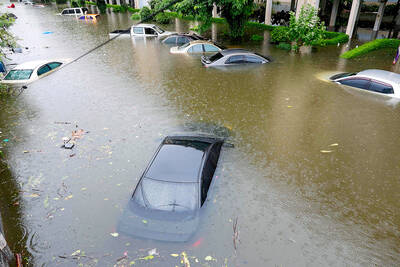
Several areas of Thailand’s capital city Bangkok were inundated by continuous rain from Thursday afternoon to yesterday morning that has disrupted traffic and forced some residents to evacuate. Major canals in Bangkok filled with accumulated rainfall exceeding 20cm, officials said yesterday. Floodwaters spread across the city, particularly in the central and eastern parts, blocking roads and stopping traffic. The Thai Meteorological Department warned that the heavy rain would continue in most parts of the country through today, citing a strong low-pressure system over the central region and strengthening southwest monsoon conditions. More than 84,000 people in 21 provinces nationwide were
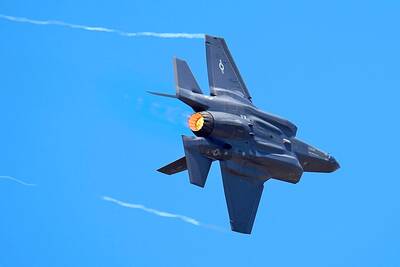
BAD TIMING: The disclosure of the incident, which is under investigation by at least two congressional committees, comes as Xi was to meet with Trump The Pentagon is investigating how parts of the US’ most advanced fighter jet ended up in Hong Kong, with a news outlet on Wednesday reporting that China has obtained the F-35 equipment. The F-35 Joint Program Office said in a statement that it and the US Department of Defense are aware of “a shipment issue” with F-35 components. “We are actively working with US authorities and industry partners to retrieve these components, investigate the incident and place safeguards to avoid a future occurrence,” the office said. UPS was shipping a cockpit canopy and weapons-bay door from an Australian military F-35 that was being

Yemen’s Saudi-led coalition early yesterday said it had intercepted two ballistic missiles and two drones launched by the Iran-backed Houthis toward the kingdom. The coalition said in posts on social media that the missiles were headed towards Khamis Mushait and the drones toward the capital, Riyadh, adding that it was monitoring the missile threat and drones launched at the kingdom, without providing further details. The Saudi Civil Defense had sent alerts overnight for Khamis Mushait and Abha, but not for Riyadh. The Houthis, who control the most populous parts of Yemen and much of the north, have been launching attacks

IN DEFENSE: Australia said it takes the protection of classified and export-controlled tech extremely seriously amid concerns over reverse engineering A US House of Representatives committee that oversees defense policy is investigating the diversion of potentially sensitive F-35 jet components this year from Australia to Hong Kong, a spokesperson said. “The committee is aware of this issue and we’ve received multiple briefings on it,” House Committee on Armed Services spokesperson Heather Vaughan said, adding that the group is “continuing to look into the incident and conduct oversight.” The Pentagon’s F-35 program office said in a statement that “we are aware of a shipment issue of unserviceable F-35 components and we are actively working with US authorities and industry partners to retrieve these


 RSS
RSS