


Any criminals dumb enough to brag about their exploits on social networking sites have now been warned: the next Facebook “friend” who contacts you may be an FBI agent.
US federal law enforcement agents have been using social networking sites — including Facebook, LinkedIn, MySpace and Twitter — to search for evidence and witnesses in criminal cases, and in some instances, track suspects, a newly released US Department of Justice memo says.
FBI agents have created fake personalities — in apparent contravention of some of the sites’ rules — in order to befriend suspects and lure them into revealing clues or confessing, access private information and map social networks.
LAWSUIT
The new online efforts were revealed in a justice department document obtained by the Electronic Frontier Foundation, a San Francisco-based legal advocacy group.
The document, a 33-page slideshow prepared by two justice department lawyers, was obtained in a lawsuit the group filed against the department, seeking information on its social network policies.
Law enforcement agencies have long used internet chatrooms to lure child pornography traffickers and suspected sex predators and, with a warrant, can seize suspects and defendants’ e-mail records.
However, Facebook, MySpace and other social networking sites provide a wealth of additional information, in photographs, status updates and friend lists.
In many cases, the information is publicly accessible.
In a section entitled “utility in criminal cases,” the document says agents can scan suspects’ profiles to establish motives, determine a person’s location, and tap into personal communication, for instance through Facebook status updates.
CHECKING ALIBIS
Agents can examine photographs for guns, jewelry and other evidence of participation in robbery or burglary, and can compare information on Facebook status updates and Twitter feeds with suspects’ alibis.
Friend lists can yield witnesses or informants.
The document advises agents that Facebook is now used in private background checks. It indicates that Facebook often cooperates with emergency law enforcement requests.
In one section on working undercover on social networking sites, the document poses but does not answer the question: “If agents violate terms of service, is that ‘otherwise illegal activity?’”
Facebook rules bar users from providing false information or creating an account for anyone other than yourself without permission, and says that users should “provide their real names.”
RULES NEEDED
Marc Zwillinger, a former US cyber-security prosecutor, said federal investigators working online should be able to go undercover as much as they do in the real world, but said rules need to be developed.
“This new situation presents a need for careful oversight so that law enforcement does not use social networking to intrude on some of our most personal relationships,” Zwillinger said.

PRECARIOUS RELATIONS: Commentators in Saudi Arabia accuse the UAE of growing too bold, backing forces at odds with Saudi interests in various conflicts A Saudi Arabian media campaign targeting the United Arab Emirates (UAE) has deepened the Gulf’s worst row in years, stoking fears of a damaging fall-out in the financial heart of the Middle East. Fiery accusations of rights abuses and betrayal have circulated for weeks in state-run and social media after a brief conflict in Yemen, where Saudi airstrikes quelled an offensive by UAE-backed separatists. The United Arab Emirates is “investing in chaos and supporting secessionists” from Libya to Yemen and the Horn of Africa, Saudi Arabia’s al-Ekhbariya TV charged in a report this week. Such invective has been unheard of

US President Donald Trump on Saturday warned Canada that if it concludes a trade deal with China, he would impose a 100 percent tariff on all goods coming over the border. Relations between the US and its northern neighbor have been rocky since Trump returned to the White House a year ago, with spats over trade and Canadian Prime Minister Mark Carney decrying a “rupture” in the US-led global order. During a visit to Beijing earlier this month, Carney hailed a “new strategic partnership” with China that resulted in a “preliminary, but landmark trade agreement” to reduce tariffs — but
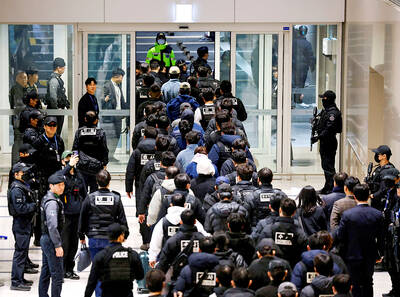
SCAM CLAMPDOWN: About 130 South Korean scam suspects have been sent home since October last year, and 60 more are still waiting for repatriation Dozens of South Koreans allegedly involved in online scams in Cambodia were yesterday returned to South Korea to face investigations in what was the largest group repatriation of Korean criminal suspects from abroad. The 73 South Korean suspects allegedly scammed fellow Koreans out of 48.6 billion won (US$33 million), South Korea said. Upon arrival in South Korea’s Incheon International Airport aboard a chartered plane, the suspects — 65 men and eight women — were sent to police stations. Local TV footage showed the suspects, in handcuffs and wearing masks, being escorted by police officers and boarding buses. They were among about 260 South

Chinese President Xi Jinping’s (習近平) purge of his most senior general is driven by his effort to both secure “total control” of his military and root out corruption, US Ambassador to China David Perdue said told Bloomberg Television yesterday. The probe into Zhang Youxia (張又俠), Xi’s second-in-command, announced over the weekend, is a “major development,” Perdue said, citing the family connections the vice chair of China’s apex military commission has with Xi. Chinese authorities said Zhang was being investigated for suspected serious discipline and law violations, without disclosing further details. “I take him at his word that there’s a corruption effort under


 RSS
RSS