


Big on spit and polish and parades but short on experience, new technology and force coordination, China’s military has far to go before its bite begins to approach its increasingly loud, and for some fearsome, bark.
China has invested billions of dollars in its armed forces and is developing advanced fighters and missiles, considering building its first aircraft carrier and is trying to slim its bloated ranks down to a lean, high-tech military. The new defense budget unveiled last week was 7.5 percent higher than last year, a modest rise by China’s recent standards, but impressive compared to other big powers.
Those rises have raised alarm in Taiwan, the rest of the region, and especially in the US.
In a report to Congress published last month, the Pentagon said it was concerned by China’s missile buildup and increasingly advanced capabilities in the Pacific region.
Yet while the People’s Liberation Army (PLA) looks increasingly fierce on paper, analysts — and even Chinese army officers — say it will be a long time before the country has the means to effectively challenge US power, if ever.
“What is their readiness level? How effective are these things they’ve developed themselves?” said Drew Thompson, of the Nixon Center, a think tank in Washington.
“Is their indigenous technology really working, or does it simply exist like a lot of things in the Chinese system, on paper? I would posit it probably leans more towards the latter,” he said.
After a spike in tension that has stoked nationalist Chinese calls for a hard shove back against US influence, some PLA officers are also trying to discourage chest-thumping.
“There’s no way China can threaten the United States,” Lieutenant General Li Dianren (李殿仁), a professor at the National Defense University, said on the sidelines of the National People’s Congress.
“Anyone with even a bit of common sense knows that our capabilities do not come even close to matching those of the US. In terms of economics, technology and the military, the gap is huge. How can we threaten them?” he said.
To be sure, China’s military is becoming increasingly assertive, as seen by occasional tiffs at sea and in the air, notably in 2001 when a US spy plane made an emergency landing on Hainan after a collision with a Chinese fighter jet.
Last March, the Pentagon said five Chinese ships harassed a US Navy ship, the Impeccable, an unarmed ocean surveillance vessel, in international waters off Hainan. China says the US ship was carrying out an illegal survey.
PLA showmanship is also grand. A military parade last Oct. 1 marking 60 years since the founding of the People’s Republic of China featured an array of new weapons, all domestically developed.
“China and the United States are rivals. That’s a fact,” said Liu Mingfu (劉明福), author of a book calling for China to develop a military so powerful Washington will not dare challenge it.
“In the past, US presidents didn’t call China a rival, and Chinese presidents never have. But that’s strategic hypocrisy, because each side knows the other is a rival,” he said.
Many practical hurdles could hamper Liu’s goal. China not renowned for producing high quality goods, as a series of product safety scandals in recent years has shown.
“If you go to the PLA and they show you some fantastic new missile on display at an air show, yes they have a missile system, but does it work? Does it work repeatedly and does it work in combat conditions?” Thompson said. “Until you know that for sure you simply assume they’ve got one heck of an interesting platform that might do us some harm ... but the reality might be far different.”
One problem is the US and EU arms embargo against China following the 1989 Tiananmen Square Massacre, and there is little sign they will lift it any time soon.
There’s also inexperience. Unlike the US, China has not engaged in full battle for three decades. Its last major confrontation was with Vietnam in 1979, and that was hardly a glorious victory. Chinese forces crossed the border to punish Hanoi for invading its ally Cambodia, but Vietnam’s battle-hardened troops gave the Chinese a bloody nose.
China has made some impressive technological advances. The successful missile “kill” of an old satellite in 2007 represented a new level of ability. In January, it successfully tested emerging technology aimed at destroying missiles in mid-air.
Integrating such advances into the country’s vast armed forces could be problematic though.
“The [Sichuan] earthquake in 2008 showed their weakness in joint operations,” said Chong-Pin Lin (林中斌), a professor at Tamkang University’s Graduate Institute of International Affairs and Strategic Studies and former vice defense minister.
After the quake, Chinese soldiers involved in rescue efforts struggled with shortages and bottlenecks magnified by poor coordination between forces and units.
However, China’s military edge over technology powerhouse Taiwan is growing.
Even then, not everyone is convinced China could easily overpower Taiwan, despite its advancing weaponry.
“The point is to make the US military stay at a distance,” said Hsu Yung-ming (徐永明), a political science professor at Soochow University, referring to China’s military modernization.

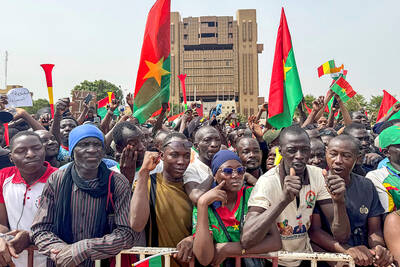
Kehinde Sanni spends his days smoothing out dents and repainting scratched bumpers in a modest autobody shop in Lagos. He has never left Nigeria, yet he speaks glowingly of Burkina Faso military leader Ibrahim Traore. “Nigeria needs someone like Ibrahim Traore of Burkina Faso. He is doing well for his country,” Sanni said. His admiration is shaped by a steady stream of viral videos, memes and social media posts — many misleading or outright false — portraying Traore as a fearless reformer who defied Western powers and reclaimed his country’s dignity. The Burkinabe strongman swept into power following a coup in September 2022
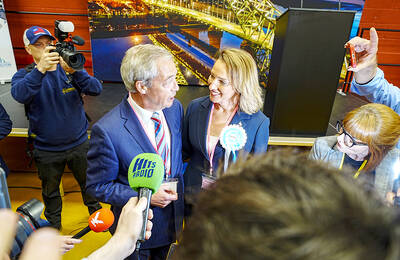
‘FRAGMENTING’: British politics have for a long time been dominated by the Labor Party and the Tories, but polls suggest that Reform now poses a significant challenge Hard-right upstarts Reform UK snatched a parliamentary seat from British Prime Minister Keir Starmer’s Labor Party yesterday in local elections that dealt a blow to the UK’s two establishment parties. Reform, led by anti-immigrant firebrand Nigel Farage, won the by-election in Runcorn and Helsby in northwest England by just six votes, as it picked up gains in other localities, including one mayoralty. The group’s strong showing continues momentum it built up at last year’s general election and appears to confirm a trend that the UK is entering an era of multi-party politics. “For the movement, for the party it’s a very, very big
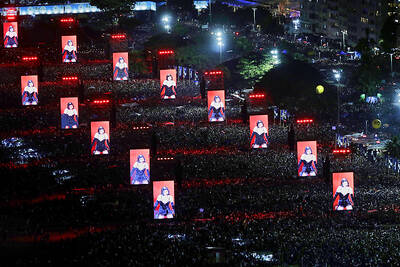
ENTERTAINMENT: Rio officials have a history of organizing massive concerts on Copacabana Beach, with Madonna’s show drawing about 1.6 million fans last year Lady Gaga on Saturday night gave a free concert in front of 2 million fans who poured onto Copacabana Beach in Rio de Janeiro for the biggest show of her career. “Tonight, we’re making history... Thank you for making history with me,” Lady Gaga told a screaming crowd. The Mother Monster, as she is known, started the show at about 10:10pm local time with her 2011 song Bloody Mary. Cries of joy rose from the tightly packed fans who sang and danced shoulder-to-shoulder on the vast stretch of sand. Concert organizers said 2.1 million people attended the show. Lady Gaga

SUPPORT: The Australian prime minister promised to back Kyiv against Russia’s invasion, saying: ‘That’s my government’s position. It was yesterday. It still is’ Left-leaning Australian Prime Minister Anthony Albanese yesterday basked in his landslide election win, promising a “disciplined, orderly” government to confront cost-of-living pain and tariff turmoil. People clapped as the 62-year-old and his fiancee, Jodie Haydon, who visited his old inner Sydney haunt, Cafe Italia, surrounded by a crowd of jostling photographers and journalists. Albanese’s Labor Party is on course to win at least 83 seats in the 150-member parliament, partial results showed. Opposition leader Peter Dutton’s conservative Liberal-National coalition had just 38 seats, and other parties 12. Another 17 seats were still in doubt. “We will be a disciplined, orderly


 RSS
RSS