


A federal judge on Friday drastically reduced a nearly US$2 million verdict against a woman found guilty last year of sharing 24 songs over the Internet, calling the jury’s penalty “monstrous and shocking.”
US District Judge Michael Davis reduced the US$1.92 million penalty a jury imposed against Jammie Thomas-Rasset to US$2,250 per song, or about US$54,000.
“The need for deterrence cannot justify a US$2 million verdict for stealing and illegally distributing 24 songs for the sole purpose of obtaining free music,” Davis wrote.
Davis also denied Thomas-Rasset’s request for a new trial. He gave the Recording Industry Association of America (RIAA) seven days to either accept the smaller penalty or to ask for another trial to set new damages.
Cara Duckworth, spokeswoman for the RIAA, said the group’s attorneys were still analyzing the ruling and would have no immediate comment.
Reached on her cellphone, Thomas-Rasset said the ruling was positive but that her attorneys are planning an attempt to get it lowered further.
“Whether it’s US$2 million or US$54,000, I’m a mom with four kids and one income and we’re not exactly rolling in that kind of dough right now,” she said.
Kiwi Camara, one of Thomas-Rasset’s attorneys, said he was pleased with Davis’ decision. Now, he said, the only question is whether the remaining damages are constitutional — an issue he could appeal to the 8th Circuit.
This case was the only one of more than 30,000 similar lawsuits to make it all the way to trial. The vast majority of people targeted by the music industry had settled for about US$3,500 each.
The recording industry has said it stopped filing such lawsuits and is instead working with Internet service providers to fight the worst offenders.
Under federal law, the recording companies are entitled to US$750 to US$30,000 per illegally downloaded song — but the law allows the jury to raise that to as much as US$150,000 per track if it finds the infringements were willful.
That’s led to other large verdicts, including one against Rhode Island graduate student Joel Tenenbaum, who last year was fined US$675,000 for downloading and distributing 30 songs. His lawyers are seeking a new trial or reduced damages.
Davis wrote that he arrived at the US$54,000 figure by tripling the US$750 minimum, thus arriving at US$2,250 per song. He wrote that were it his decision, he might have reduced it even further.
“It was the jury’s province to determine the award ... and this Court has merely reduced that award to the maximum amount that is no longer monstrous and shocking,” he wrote.

Australians were downloading virtual private networks (VPNs) in droves, while one of the world’s largest porn distributors said it was blocking users from its platforms as the country yesterday rolled out sweeping online age restriction. Australia in December became the first country to impose a nationwide ban on teenagers using social media. A separate law now requires artificial intelligence (AI)-powered chatbot services to keep certain content — including pornography, extreme violence and self-harm and eating disorder material — from minors or face fines of up to A$49.5 million (US$34.6 million). The country also joined Britain, France and dozens of US states requiring

Hungarian authorities temporarily detained seven Ukrainian citizens and seized two armored cars carrying tens of millions of euros in cash across Hungary on suspicion of money laundering, officials said on Friday. The Ukrainians were released on Friday, following their detention on Thursday, but Hungarian officials held onto the cash, prompting Ukraine to accuse Hungary’s Russia-friendly government of illegally seizing the money. “We will not tolerate this state banditism,” Ukrainian Minister of Foreign Affairs Andrii Sybiha said. The seven detained Ukrainians were employees of the Ukrainian state-owned Oschadbank, who were traveling in the two armored cars that were carrying the money between Austria and
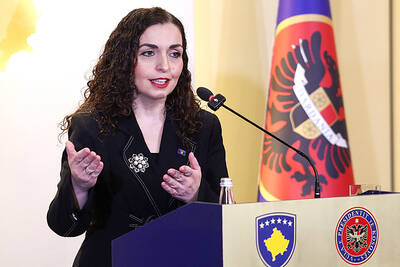
Kosovar President Vjosa Osmani on Friday after dissolving the Kosovar parliament said a snap election should be held as soon as possible to avoid another prolonged political crisis in the Balkan country at a time of global turmoil. Osmani said it is important for Kosovo to wrap up the upcoming election process and form functional institutions for political stability as the war rages in the Middle East. “Precisely because the geopolitical situation is that complex, it is important to finish this electoral process which is coming up,” she said. “It is very hard now to imagine what will happen next.” Kosovo, which declared

MORE BANS: Australia last year required sites to remove accounts held by under-16s, with a few countries pushing for similar action at an EU level and India considering its own ban Indonesia on Friday said it would ban social media access for children under 16, citing threats from online pornography, cyberbullying, online fraud and Internet addiction. “Accounts belonging to children under 16 on high-risk platforms will start to be deactivated, beginning with YouTube, TikTok, Facebook, Instagram, Threads, X, Bigo Live and Roblox,” Indonesian Minister of Communications and Digital Meutya Hafid said. “The government is stepping in so that parents no longer have to fight alone against the giants of the algorithm. Implementation will begin on March 28, 2026,” she said. The social media ban would be introduced in stages “until all platforms fulfill their


 RSS
RSS