


A month before a Nigerian man whom US intelligence suspected of terrorist ties tried to blow up a Detroit-bound jetliner, Indonesian authorities successfully used a US watch list to pick out an arriving passenger.
The arrest of Filipino Abdul Basir Latip is an example of effective counterterrorism intelligence-sharing at a time when the aviation community is examining security failures that enabled Umar Farouk Abdulmutallab to board a plane with explosives-laden underwear.
US President Barack Obama has ordered new terror watch list guidelines in the wake of the attempted attack — though Abdulmutallab was in an intelligence database, he was not on a no-fly list — but analysts say such lists are only one small part of successful counterterrorism. Information-sharing and proper analysis of data is key.
“Lists are valuable in making sure governments around the world are able to track individuals,” said John Harrison, an aviation security specialist. “But you don’t want to put too much emphasis on these lists. It’s an overstatement to say: ‘OK, now we are safe.”’
While lists are a valuable intelligence tool, they cannot be solely relied upon to prevent terrorists from boarding flights, Harrison said. Even though Abdulmutallab, 23, was not on a watch list, his behavior should have triggered alarms that would have led to his capture anyway, he said.
Abdulmutallab apparently bought his ticket in cash, was flying the same day, had no check-in luggage and purchased a one way fare.
Together, those details should have tripped a standard international security procedure, Computer Assisted Passenger Screening or CAPS, Harrison said.
US officials have said at least part of their failure to stop Abdulmutallab was because they had not put all the puzzle pieces together.
Alain Chouet, former chief of the security intelligence service at France’s counterintelligence agency, DGSE, estimates that roughly 600,000 names provided by national authorities are circulating on lists worldwide.
But he says the way those names are gathered is faulty. He estimated such lists are only 10 percent reliable.
“These are idiotic lists,” he said, adding some people are blacklisted based on anonymous accusations. “We don’t know how these lists are made.”
In the Philippines, most of the approximately 100 people on a watch list have been charged with or sought by authorities in connection with previous violent crimes. In Indonesia, the names include hundreds of convicts, known associates of terrorists and individuals identified by intelligence agencies as suspicious.
Latip was wanted for alleged involvement in the 1993 kidnapping of a Christian missionary by Abu Sayyaf militants who had eluded capture for years, Ric Diaz, a senior Philippine counterterrorism official said.
The Indonesians were acting on a tip from Interpol, which was sharing information from a US watch list, when they nabbed him on Nov. 21 at Soekarno-Hatta international airport with the help of photographs provided by the FBI.
This coordination is key to successful security, analysts said, more than the watch lists themselves.

HISTORIC: After the arrest of Kim Keon-hee on financial and political funding charges, the country has for the first time a former president and former first lady behind bars South Korean prosecutors yesterday raided the headquarters of the former party of jailed former South Korean president Yoon Suk-yeol to gather evidence in an election meddling case against his wife, a day after she was arrested on corruption and other charges. Former first lady Kim Keon-hee was arrested late on Tuesday on a range of charges including stock manipulation and corruption, prosecutors said. Her arrest came hours after the Seoul Central District Court reviewed prosecutors’ request for an arrest warrant against the 52-year-old. The court granted the warrant, citing the risk of tampering with evidence, after prosecutors submitted an 848-page opinion laying out
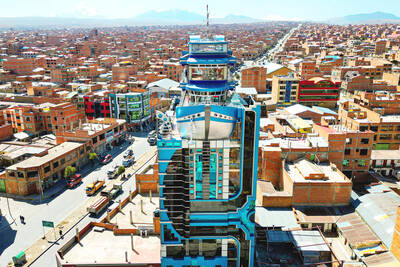
STAGNATION: Once a bastion of leftist politics, the Aymara stronghold of El Alto is showing signs of shifting right ahead of the presidential election A giant cruise ship dominates the skyline in the city of El Alto in landlocked Bolivia, a symbol of the transformation of an indigenous bastion keenly fought over in tomorrow’s presidential election. The “Titanic,” as the tallest building in the city is known, serves as the latest in a collection of uber-flamboyant neo-Andean “cholets” — a mix of chalet and “chola” or Indigenous woman — built by Bolivia’s Aymara bourgeoisie over the past two decades. Victor Choque Flores, a self-made 46-year-old businessman, forked out millions of US dollars for his “ship in a sea of bricks,” as he calls his futuristic 12-story
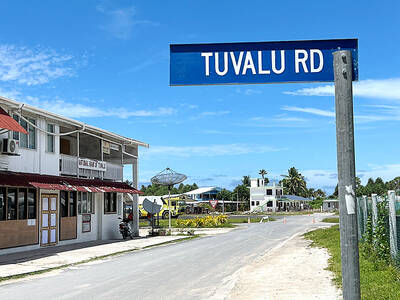
FORUM: The Solomon Islands’ move to bar Taiwan, the US and others from the Pacific Islands Forum has sparked criticism that Beijing’s influence was behind the decision Tuvaluan Prime Minister Feletei Teo said his country might pull out of the region’s top political meeting next month, after host nation Solomon Islands moved to block all external partners — including China, the US and Taiwan — from attending. The Pacific Islands Forum (PIF) leaders’ meeting is to be held in Honiara in September. On Thursday last week, Solomon Islands Prime Minister Jeremiah Manele told parliament that no dialogue partners would be invited to the annual gathering. Countries outside the Pacific, known as “dialogue partners,” have attended the forum since 1989, to work with Pacific leaders and contribute to discussions around

END OF AN ERA: The vote brings the curtain down on 20 years of socialist rule, which began in 2005 when Evo Morales, an indigenous coca farmer, was elected president A center-right senator and a right-wing former president are to advance to a run-off for Bolivia’s presidency after the first round of elections on Sunday, marking the end of two decades of leftist rule, preliminary official results showed. Bolivian Senator Rodrigo Paz was the surprise front-runner, with 32.15 percent of the vote cast in an election dominated by a deep economic crisis, results published by the electoral commission showed. He was followed by former Bolivian president Jorge “Tuto” Quiroga in second with 26.87 percent, according to results based on 92 percent of votes cast. Millionaire businessman Samuel Doria Medina, who had been tipped


 RSS
RSS