


Some Democratic lawmakers who support closing the prison at Guantanamo Bay, Cuba, say the US should reconsider whether to repatriate suspected terrorists from Yemen, given al-Qaeda’s activity in the poor Arab nation.
US President Barack Obama’s top counterterrorism adviser, John Brennan, said on Sunday the transfers would continue if the administration deems them warranted.
Six Yemenis returned last month were released after the government there determined they were not a threat, officials in Yemen said.
Obama has said an al-Qaeda group operating in Yemen apparently was behind the plot to bring down a US-bound airliner on Christmas Day. The US and Britain closed their embassies in Yemen on Sunday in response to threats from al-Qaeda.
Although Republicans have criticized the transfers to Yemen, some Democrats, including Senate Intelligence Committee Chairman Dianne Feinstein of California, have also urged a halt.
Representative Jane Harman of California, a member of the Homeland Security Committee, said on Sunday that officials should review the transfers.
She does support plans to close the prison and open one in Illinois for terrorism suspects.
“I think it is a bad time to send the 90 or so Yemenis back to Yemen,” Harman said.
Senator Joe Lieberman, a Connecticut independent who has opposed closing Guantanamo, said transferring any of the Yemeni detainees back home would be irresponsible.
“We know from past experience that some of them will be back in the fight against us,” Lieberman said.
US officials believe two Saudis released from Guantanamo, one in 2006 and the other in 2007, may have played significant roles in al-Qaeda activities in Yemen.
An estimated 90 Yemenis are held at Guantanamo Bay and about half are set to be sent to Yemen. Those who remain in US custody will be prosecuted in criminal or military courts, Brennan said.
“Some of these individuals are going to be transferred back to Yemen at the right time and the right pace and in the right way,” Brennan said. “We’re making sure that the situation on the ground is taken into account, that we continue to work with the Yemeni government, and we do this in a very commonsense fashion because we want to make sure that we are able to close Guantanamo.”
Yemen has freed the six Yemenis who were released from Guantanamo Bay and returned to the country on Dec. 20, security officials and a lawyer for the men said.
The lawyer, Ahmed al-Arman, said the six were freed from Yemeni custody over the last week, with the last two freed on Saturday night.
They were handed over to their families.
Security officials held the six for questioning and investigation since their handover by the US, but they found no evidence of involvement in terrorism or other crimes, Yemeni security officials said.
The six gave guarantees that they would not leave the country, would not associate with terror groups and would report regularly to the police, the officials said, speaking on condition of anonymity because they were not authorized to talk to reporters.
Brennan spoke on Fox News Sunday, NBC’s Meet the Press, ABC’s This Week and CNN’s State of the Union.
Harman and Lieberman appeared on ABC.


When a hiker fell from a 55m waterfall in wild New Zealand bush, rescuers were forced to evacuate the badly hurt woman without her dog, which could not be found. After strangers raised thousands of dollars for a search, border collie Molly was flown to safety by a helicopter pilot who was determined to reunite the pet and the owner. A week earlier, an emergency rescue helicopter found the woman with bruises and lacerations after a fall at a rocky spot at the waterfall on the South Island’s West Coast. She was airlifted on March 24, but they were forced to
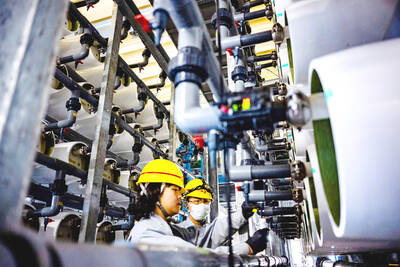
HIGH HOPES: The power source is expected to have a future, as it is not dependent on the weather or light, and could be useful for places with large desalination facilities A Japanese water plant is harnessing the natural process of osmosis to generate renewable energy that could one day become a common power source. The possibility of generating power from osmosis — when water molecules pass from a less salty solution to a more salty one — has long been known. However, actually generating energy from that has proved more complicated, in part due the difficulty of designing the membrane through which the molecules pass. Engineers in Fukuoka, Japan, and their private partners think they might have cracked it, and have opened what is only the world’s second osmotic power plant. It generates

Showcasing phallus-shaped portable shrines and pink penis candies, Japan’s annual fertility festival yesterday teemed with tourists, couples and families elated by its open display of sex. The spring Kanamara Matsuri near Tokyo features colorfully dressed worshipers carrying a trio of giant phallic-shaped objects as they parade through the street with glee. The festival, as legend has it, honors a local blacksmith in the Edo Period (1603-1868) who forged an iron dildo to break the teeth of a sharp-toothed demon inhabiting a woman’s vagina that had been castrating young men on their wedding nights. A 1m black steel phallus sits in the courtyard of

Hundreds of Filipinos and tourists flocked to a sun-bleached field north of Manila yesterday, on Good Friday, to witness one of the country’s most blood-soaked displays of religious fervor, undeterred by rising fuel prices. Scores of bare-chested flagellants with covered faces walked barefoot through the dusty streets of Pampanga Province’s San Fernando as they flogged their backs with bamboo whips in the scorching heat. Agence France-Presse (AFP) journalists said they saw devotees deliberately puncturing their skin with glass shards attached to a small wooden paddle to ensure their bleeding during the ritual, a way to atone for sins and seek miracles from


 RSS
RSS