


Iran put off until next week a formal response to a UN-backed plan to ship much of its uranium to Russia for enrichment, the nation’s nuclear envoy said on Friday. The West sees the proposal as a way to curb Tehran’s alleged efforts to make nuclear weapons.
Ali Asghar Soltanieh, Iran’s representative to the International Atomic Energy Agency (IAEA), said Tehran was still studying the proposal and would inform the UN nuclear watchdog “next week about our evaluation.”
“We are working and elaborating on all the details of this proposal,” Soltanieh told state Press TV.
The plan was put forth on Wednesday after three days of talks between Iran and world powers in Vienna. The US, Russia and France endorsed the deal on Friday, when an official response from Tehran had been expected.
Iran’s acquiescence would be a boost to efforts by US President Barack Obama’s administration to curtail Tehran’s nuclear program and ease Western fears about its potential to make nuclear weapons.
The US Department of State expressed mild disappointment that Iran withheld a decision and said it was unhappy Iran was not ready to embrace the proposal.
The plan is attractive to the US because it would consume a large amount of Iran’s stockpile of low-enriched uranium, thereby limiting the potential for Tehran to secretly convert it into uranium suitable for a nuclear weapon. Iran denies it has any intention of making a weapon, saying its nuclear program is for generating power.
State Department spokesman Ian Kelly said that the US still hoped Iran would go along with the IAEA option.
“This is a real opportunity for Iran to help address some of the real concerns of the international community about its nuclear program and at the same time still provide for the humanitarian needs of the Iranian people,” Kelly said. “We hope that they will next week provide a positive response.”
Alireza Nader of the RAND Corp said if Iran rejected the deal, it would “lead to increased tensions” and a possible new set of UN sanctions.
Nader said the UN proposal was “problematic for Iran’s hardline factions.”
“Accepting it would indicate a compromise with world powers, and Tehran has repeatedly said it would not compromise,” Nader said.
Soltanieh’s statement came on the eve of a visit by UN nuclear experts to Iran to inspect a recently disclosed uranium enrichment facility near the holy city of Qom.
The visit, which started late yesterday, was an indication that Tehran was making good on some of its promises to the West.
The IAEA said on Friday that Iran told agency chief Mohamed ElBaradei it was “considering the [UN] proposal in depth and in a favorable light, but needs time until the middle of next week to provide a response.”
Just hours earlier, Iranian state TV quoted an unidentified official close to the Iranian nuclear negotiating team as saying that Tehran wants to buy nuclear fuel it needs for a research reactor, rather than accept the UN plan.
The TV quoted the official as saying Tehran was waiting for a response from world powers to its own proposal to buy the 20 percent-enriched uranium it needs for its Tehran reactor that produces medical isotopes. The US-built reactor has been producing medical isotopes for more than three decades.
While the TV report was not an outright rejection of the UN proposal, it raised concerns since Iran has often used counterproposals as a way to draw out nuclear talks with the West.

VAGUE: The criteria of the amnesty remain unclear, but it would cover political violence from 1999 to today, and those convicted of murder or drug trafficking would not qualify Venezuelan Acting President Delcy Rodriguez on Friday announced an amnesty bill that could lead to the release of hundreds of prisoners, including opposition leaders, journalists and human rights activists detained for political reasons. The measure had long been sought by the US-backed opposition. It is the latest concession Rodriguez has made since taking the reins of the country on Jan. 3 after the brazen seizure of then-Venezuelan president Nicolas Maduro. Rodriguez told a gathering of justices, magistrates, ministers, military brass and other government leaders that the ruling party-controlled Venezuelan National Assembly would take up the bill with urgency. Rodriguez also announced the shutdown
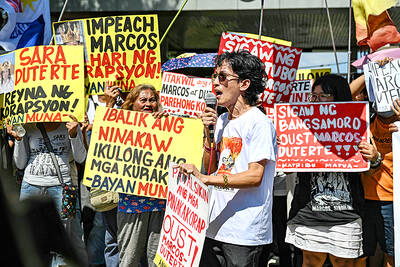
Civil society leaders and members of a left-wing coalition yesterday filed impeachment complaints against Philippine Vice President Sara Duterte, restarting a process sidelined by the Supreme Court last year. Both cases accuse Duterte of misusing public funds during her term as education secretary, while one revives allegations that she threatened to assassinate former ally Philippine President Ferdinand Marcos Jr. The filings come on the same day that a committee in the House of Representatives was to begin hearings into impeachment complaints against Marcos, accused of corruption tied to a spiraling scandal over bogus flood control projects. Under the constitution, an impeachment by the
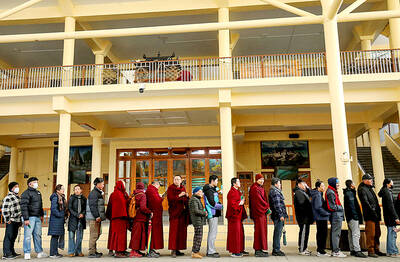
Exiled Tibetans began a unique global election yesterday for a government representing a homeland many have never seen, as part of a democratic exercise voters say carries great weight. From red-robed Buddhist monks in the snowy Himalayas, to political exiles in megacities across South Asia, to refugees in Australia, Europe and North America, voting takes place in 27 countries — but not China. “Elections ... show that the struggle for Tibet’s freedom and independence continues from generation to generation,” said candidate Gyaltsen Chokye, 33, who is based in the Indian hill-town of Dharamsala, headquarters of the government-in-exile, the Central Tibetan Administration (CTA). It
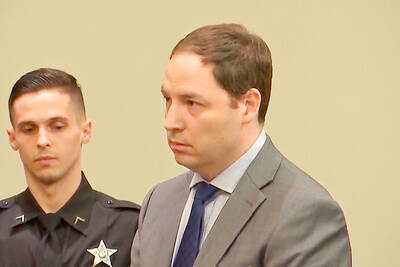
A Virginia man having an affair with the family’s Brazilian au pair on Monday was found guilty of murdering his wife and another man that prosecutors say was lured to the house as a fall guy. Brendan Banfield, a former Internal Revenue Service law enforcement officer, told police he came across Joseph Ryan attacking his wife, Christine Banfield, with a knife on the morning of Feb. 24, 2023. He shot Ryan and then Juliana Magalhaes, the au pair, shot him, too, but officials argued in court that the story was too good to be true, telling jurors that Brendan Banfield set


 RSS
RSS