


Israeli President Shimon Peres yesterday was given a clean bill of health and left a hospital where he had spent the night under observation after fainting at a Tel Aviv conference.
The 86-year-old Nobel laureate did not address reporters as he left the Tel Hashomer hospital in Jerusalem in a convoy.
Tests performed on Israel’s elder statesman showed no cause for alarm and the president was expected to meet George Mitchell as planned at the start of the US Middle East envoy’s latest tour of the region, officials said.
“All tests came back normal,” said a statement from his office.
Hospital director Zeev Rotshein said that “the president is in very good health for an individual of his age. The clinical tests showed no heart attack or stroke.”
But Rotshein said doctors were recommending that the veteran octogenarian politician cut down on his busy work schedule over the next few days.
Peres fainted as he was giving a speech late on Saturday in Tel Aviv.
“He fainted for at most a dozen seconds before regaining consciousness and at first had refused to go to the hospital,” his spokeswoman Ayelet Frisch told reporters.
Peres’ personal physician, Rafi Valdan, told the Ynet news Web site that the octogenarian was feeling fine after the incident.
“It was simply very hot and he stood up for a long time and felt dizzy. He fainted for a few seconds,” his personal physician, Rafi Valdan was quoted as telling the Ynet news Web site.
Peres, who keeps to a busy public schedule despite his advanced age, is Israel’s veteran statesman who was awarded the Nobel Peace Prize in 1994, alongside then prime minister Yitzhak Rabin and Palestinian leader Yasser Arafat, for his role in negotiating the 1993 Oslo accords.
He was elected by parliament to the largely ceremonial post of Israeli president in 2007, crowning a career spanning five decades during which he has held just about every major national office, twice serving as prime minister.
Born in Poland in 1923, he emigrated to Palestine when he was 11. He joined the Zionist struggle in the 1940s and met Israel’s founding father, David Ben Gurion, while hitchhiking.
At 29, he became director general of the nascent defense ministry and is considered the founding father of Israel’s undeclared nuclear program.
Peres, who once hawkishly rejected any compromise with hostile Arab states, says he was converted after 1977, when former Egyptian president Anwar Sadat made a historic visit to Jerusalem, leading to the first Arab-Israeli peace treaty.
In 2005 he left the Labor party to join the new centrist Kadima headed by Ariel Sharon, an alliance that ensured Israel withdrew troops and settlers from the Gaza Strip after 38 years of occupation.
Although widely admired abroad, Peres is known for being an electoral liability as much as an asset and has never been such a hit at home.
The one-time foreign, defense and finance minister was defeated in Israeli general elections in 1977, 1981, 1984, 1988 and 1996. He never led Labor to victory.
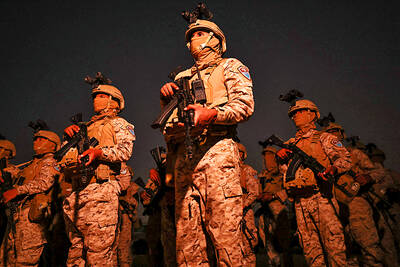
PRECARIOUS RELATIONS: Commentators in Saudi Arabia accuse the UAE of growing too bold, backing forces at odds with Saudi interests in various conflicts A Saudi Arabian media campaign targeting the United Arab Emirates (UAE) has deepened the Gulf’s worst row in years, stoking fears of a damaging fall-out in the financial heart of the Middle East. Fiery accusations of rights abuses and betrayal have circulated for weeks in state-run and social media after a brief conflict in Yemen, where Saudi airstrikes quelled an offensive by UAE-backed separatists. The United Arab Emirates is “investing in chaos and supporting secessionists” from Libya to Yemen and the Horn of Africa, Saudi Arabia’s al-Ekhbariya TV charged in a report this week. Such invective has been unheard of
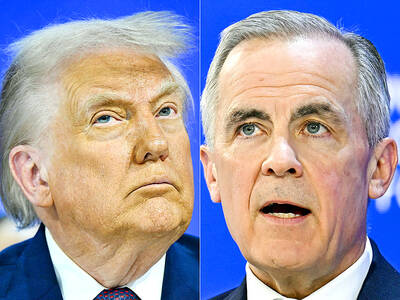
US President Donald Trump on Saturday warned Canada that if it concludes a trade deal with China, he would impose a 100 percent tariff on all goods coming over the border. Relations between the US and its northern neighbor have been rocky since Trump returned to the White House a year ago, with spats over trade and Canadian Prime Minister Mark Carney decrying a “rupture” in the US-led global order. During a visit to Beijing earlier this month, Carney hailed a “new strategic partnership” with China that resulted in a “preliminary, but landmark trade agreement” to reduce tariffs — but
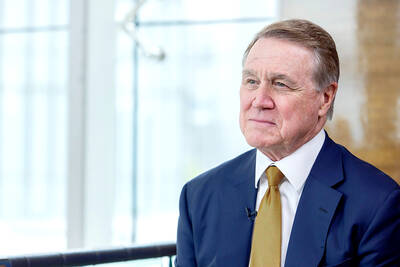
Chinese President Xi Jinping’s (習近平) purge of his most senior general is driven by his effort to both secure “total control” of his military and root out corruption, US Ambassador to China David Perdue said told Bloomberg Television yesterday. The probe into Zhang Youxia (張又俠), Xi’s second-in-command, announced over the weekend, is a “major development,” Perdue said, citing the family connections the vice chair of China’s apex military commission has with Xi. Chinese authorities said Zhang was being investigated for suspected serious discipline and law violations, without disclosing further details. “I take him at his word that there’s a corruption effort under
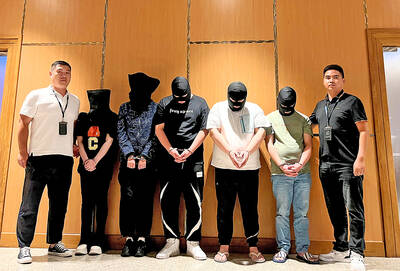
China executed 11 people linked to Myanmar criminal gangs, including “key members” of telecom scam operations, state media reported yesterday, as Beijing toughens its response to the sprawling, transnational industry. Fraud compounds where scammers lure Internet users into fake romantic relationships and cryptocurrency investments have flourished across Southeast Asia, including in Myanmar. Initially largely targeting Chinese speakers, the criminal groups behind the compounds have expanded operations into multiple languages to steal from victims around the world. Those conducting the scams are sometimes willing con artists, and other times trafficked foreign nationals forced to work. In the past few years, Beijing has stepped up cooperation


 RSS
RSS