


An American on trial for secretly entering the house of Burmese democracy leader Aung San Suu Kyi has been hospitalized after suffering seizures, hospital sources said yesterday.
John Yettaw, 53, was admitted to Yangon’s main hospital on Monday, but his condition is improving, said the sources, who spoke on condition of anonymity for fear of reprisals in the military-run nation.
Yettaw faces up to five years in prison on charges he helped violate the terms of Aung San Suu Kyi’s house arrest by swimming uninvited to her lakeside residence and staying two nights.
A court is to deliver a verdict next week in the case, which charges Aung San Suu Kyi with violating the terms of her detention. The 64-year-old Nobel Peace Prize laureate could also be imprisoned for five years along with two companions who resided with her.
Yettaw, of Falcon, Missouri, testified that he swam to Aung San Suu Kyi’s house to warn her that he had had a vision that she would be assassinated.
He reportedly suffers from epilepsy, diabetes and other health problems, including post traumatic stress disorder from his time in the US military. His lawyer Khin Maung Oo said earlier that Yettaw had been kept in the hospital of Insein prison, so authorities could monitor his health.
US embassy spokesman Richard Mei said that the embassy’s consular officer, Colin Furst, visited Yettaw at the hospital on Monday morning. He would not comment on Yettaw’s condition.
While there has been little speculation about the court’s verdict in Yettaw’s case, many diplomats expect Aung San Suu Kyi to be found guilty and she herself has said the court’s decision was already “painfully obvious.”
Aung San Suu Kyi’s full testimony in the closed-door trial was released on Monday for the first time by the National League for Democracy.

PRECARIOUS RELATIONS: Commentators in Saudi Arabia accuse the UAE of growing too bold, backing forces at odds with Saudi interests in various conflicts A Saudi Arabian media campaign targeting the United Arab Emirates (UAE) has deepened the Gulf’s worst row in years, stoking fears of a damaging fall-out in the financial heart of the Middle East. Fiery accusations of rights abuses and betrayal have circulated for weeks in state-run and social media after a brief conflict in Yemen, where Saudi airstrikes quelled an offensive by UAE-backed separatists. The United Arab Emirates is “investing in chaos and supporting secessionists” from Libya to Yemen and the Horn of Africa, Saudi Arabia’s al-Ekhbariya TV charged in a report this week. Such invective has been unheard of

US President Donald Trump on Saturday warned Canada that if it concludes a trade deal with China, he would impose a 100 percent tariff on all goods coming over the border. Relations between the US and its northern neighbor have been rocky since Trump returned to the White House a year ago, with spats over trade and Canadian Prime Minister Mark Carney decrying a “rupture” in the US-led global order. During a visit to Beijing earlier this month, Carney hailed a “new strategic partnership” with China that resulted in a “preliminary, but landmark trade agreement” to reduce tariffs — but

Chinese President Xi Jinping’s (習近平) purge of his most senior general is driven by his effort to both secure “total control” of his military and root out corruption, US Ambassador to China David Perdue said told Bloomberg Television yesterday. The probe into Zhang Youxia (張又俠), Xi’s second-in-command, announced over the weekend, is a “major development,” Perdue said, citing the family connections the vice chair of China’s apex military commission has with Xi. Chinese authorities said Zhang was being investigated for suspected serious discipline and law violations, without disclosing further details. “I take him at his word that there’s a corruption effort under
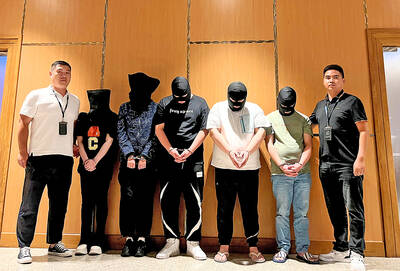
China executed 11 people linked to Myanmar criminal gangs, including “key members” of telecom scam operations, state media reported yesterday, as Beijing toughens its response to the sprawling, transnational industry. Fraud compounds where scammers lure Internet users into fake romantic relationships and cryptocurrency investments have flourished across Southeast Asia, including in Myanmar. Initially largely targeting Chinese speakers, the criminal groups behind the compounds have expanded operations into multiple languages to steal from victims around the world. Those conducting the scams are sometimes willing con artists, and other times trafficked foreign nationals forced to work. In the past few years, Beijing has stepped up cooperation


 RSS
RSS