


Authorities in military-run Myanmar detained dozens of opposition party members yesterday as they returned from ceremonies marking the death of the father of jailed pro-democracy leader Aung San Suu Kyi, witnesses said.
The arrests came after riot police set up barricades around the Martyrs’ Mausoleum where the official ceremony took place to commemorate the death of General Aung San, the country’s independence hero.
At least 50 members of the opposition National League for Democracy (NLD) party were walking in small groups when they were arrested, witnesses said on condition of anonymity for fear of official reprisal.
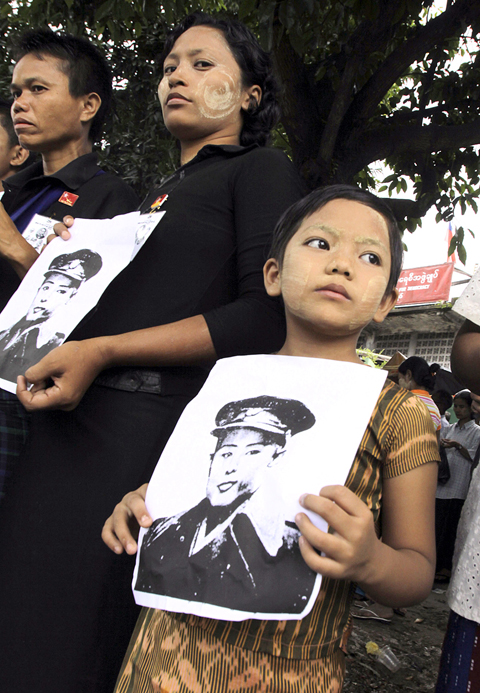
PHOTO: AP
It was not immediately clear why police detained them.
Some of the NLD members had been attending a ceremony at party headquarters to mark General Aung San’s death 62 years ago, while others had been at the official commemoration.
“Some members were roughly taken into trucks, and those who ran away were chased,” a witness said.
Some who ran onto public buses were dragged out and taken away.
General Aung San and other government leaders were assassinated by gunmen during a Cabinet meeting on July 19, 1947, shortly after Britain granted independence to the Southeast Asian colony.
Nobel Peace Prize laureate Aung San Suu Kyi marked the anniversary of her father’s death inside Yangon’s Insein prison. She is on trial on charges of violating the terms of her house arrest by giving shelter to an uninvited American man who swam to her lakeside home in May.
If convicted, she faces up to five years in prison. Her trial is to resume on Friday.
Earlier yesterday, hundreds of riot police erected barricades secured with barbed wire and blocked streets leading to the Martyrs’ Mausoleum. More than two dozen trucks carrying riot police and four prison vans were parked near the monument, located near the famed Shwedagon pagoda.
Flags were flown at half-staff at the mausoleum as officials placed flowers at the tomb, and families of the slain leaders joined the tightly guarded wreath-laying ceremony.
Suu Kyi, 64, who used to attend the official ceremony, was absent for a sixth consecutive year and instead marked the day by donating food to patients at the hospital inside the prison, said Nyan Win, a spokesman for her party.
Martyrs’ Day was an important event on Myanmar’s calendar for years, but has been gradually downgraded as Suu Kyi has become more popular, particularly since a 1988 pro-democracy uprising that was crushed by the junta.
Myanmar, also known as Burma, has been under military rule since 1962.
Suu Kyi has been under detention for 14 of the past 20 years. Her opposition party won national elections in 1990, but Myanmar’s generals refused to relinquish power.
Her trial has drawn condemnation from the international community and her supporters within Myanmar, who worry that the ruling junta has found an excuse to keep her detained through elections planned for next year.
Myanmar is likely to face renewed pressure over its trial of Aung San Suu Kyi when foreign ministers and diplomats from Asia, Washington and Europe meet this week.
The ruling junta has defied international outrage about her trial and dealt a humiliating snub to UN chief Ban Ki-moon by refusing to allow him to visit the opposition figurehead when he visited the country earlier this month.
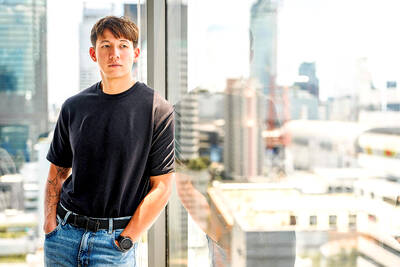
SPEAKING OUT: After Siranudh Scott’s allegations surfaced, celebrities and public figures took to social media to share their own experiences of sexual misconduct and abuse A high-profile alleged sexual abuse case within a wealthy Thai beer brewing family has prompted a wave of painful accounts from survivors of unconnected abuse in the conservative nation. Siranudh Scott, a member of the billionaire Thai family that founded the ubiquitous Singha beer brand, posted an emotional video this month accusing his elder brother Sunit of repeatedly abusing him when he was a teenager. Sunit, who is in his 30s, later denied the allegations in a video posted online, but Singha parent Boonrawd dismissed him from his executive role with the company on Tuesday last week. “I felt I needed to speak

‘CROSSING THE LINE’: China’s embassy in Seoul criticized US Forces Korea Commander General Xavier Brunson, asking if his ‘hostile’ remarks were authorized by Washington South Korea and the US are in talks over recent public remarks by the commander of US Forces Korea, Seoul’s presidential office said yesterday, after the comments drew sharp criticism from China. In a recent podcast interview, US Forces Korea Commander General Xavier Brunson described South Korea as “the dagger in the heart of Asia” from China’s east coast, prompting the Chinese embassy in Seoul to say that he had “truly crossed the line.” The interview came amid growing speculation that Washington might seek to expand the role of US Forces Korea in countering the growing regional influence of China, a key

SEEKING ORDER: Rodrigo Paz said that ‘anyone who wants to destroy the nation will have to deal with this president and the full force of the constitution’ Bolivian President Rodrigo Paz on Wednesday said that the nation was at a “breaking point” after nearly a month of protests that have caused shortages of food, fuel and medicine. Paz, who took office six months ago amid the worst economic crisis there in four decades, is battling a groundswell of fury over his policies. The political capital, La Paz, has been besieged by low-income workers and members of the indigenous majority calling for his resignation. “The country needs order and is reaching breaking point,” the 58-year-old said at a public event in La Paz, renewing his appeal for dialogue. On Tuesday, the Bolivian

Forecasters in Europe yesterday warned of exceptional heat as record temperatures driven by a “heat dome” push temperatures well above seasonal norms across the continent. The surge follows a record-breaking Monday, with France logging its hottest day in the month of May on record, its weather agency said, and the UK also posting unprecedented highs. A so-called “heat dome” of warm air from northern Africa trapped under a high-pressure system over western Europe is behind the high temperatures not usually seen until high summer. Restrictions on outdoor work were imposed in parts of Italy, beaches in southwest France filled earlier than usual and


 RSS
RSS