


Mustapha Shaalan yearns for the days when he would go out to sea and haul in 40kg of fish in the blink of an eye.
Nowadays, like most fishermen in this southern Lebanese coastal town and elsewhere in the country, he says he is lucky if he reels in one or two kilos on a good day.
Over-fishing, pollution and dynamite fishing have all but wiped out marine life in the Mediterranean waters off the 220km long Lebanese coast, leaving many of the country’s estimated 8,000 fishermen destitute.
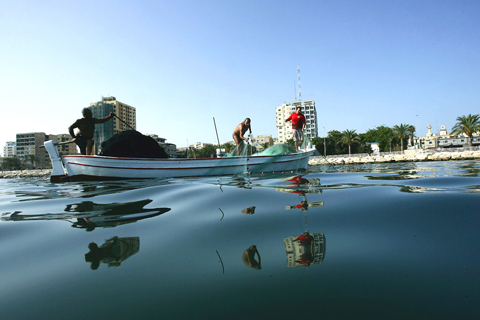
PHOTO: AFP
“The sea back in the 1960s, 70s and 80s was thick with fish and we were the envy of the town,” 68-year-old Shaalan wistfully recalls, sitting on the quay of the picturesque port of Tyre.
“Our reputation extended worldwide,” said the father of seven who began fishing at age 10 and has a deeply creased, suntanned face from years spent at sea. “My pockets were always full and I traveled a lot. Now, look at us.”
Some 2,000 families live from fishing in Tyre, a city of 100,000 located near the border with Israel, says Khalil Taha, head of the local fishermen’s syndicate.
In the city’s heyday, a fisherman would easily earn US$500 a week, but that figure is now closer to US$200 for an entire month, well below the minimum wage of US$333, Taha said.
“The fishermen of Tyre used to do so well that when they would be offered jobs elsewhere they would turn them down,” he said. “My father used to earn enough from the trade that he was able to put me and my nine brothers and sisters through private school.”
”We used to go and buy our clothes at Nouveautes Khater, an upscale department store,” said Taha, 49, who has two children and is expecting a third. “Now even the cheapest place is expensive for us.”
Taha partly blames the fishermen themselves for their plight but also consecutive governments, which he said have done nothing to protect the fishing industry or help develop it.
Compounding the problem is the constant political turmoil that has rocked Lebanon for years. There was the 1975-1990 civil war, there were Israeli troops in southern Lebanon — including in Tyre — between 1982 and 2000 and, most recently, the devastating 2006 war between Hezbollah and Israel.
“We have been sounding the alarm for more than 10 years about our disastrous situation but no one is listening and I don’t think anyone ever will,” Taha said.
Experts say many species, including red mullet, grouper and small barracudas are facing extinction in Lebanon’s waters, primarily because of bad fishing practices over the years.
“We are destroying our sea, completely and totally,” said Imad Saoud, an aquatic scientist at American University of Beirut. “And the problem is that the people who benefit the most from the sea — the fishermen — are the people destroying it the most.”
He said the illegal and destructive practice of dynamite or blast fishing, spear fishing and compressor fishing, has irreversibly damaged the marine ecosystem off the coast of Lebanon.
Compressors blow air into crevices or holes at the sea bottom, frightening fish out of their hiding places.
Sewage is also dumped at sea along with heavy metals from factories, including copper, zinc and vanadium — a metallic chemical.
In addition, greedy developers have been invading the coastline and paying no heed to the environmental impact.
“The state of the Mediterranean in Lebanon is disastrous at all levels and what is coming is even more disastrous,” said Michel Bariche, a marine biologist at American University of Beirut.
“As far as the government is concerned, even if there is a will to do something, they lack the proper know-how,” he said. “Even if we scientists draw up solutions, there is no chance they will be implemented.”
Bariche said he has been working directly with fishermen to convince them to create marine reserves or protected areas or risk losing their livelihood.
“We need to convince them that these reserves are for their own good, otherwise there will soon be nothing left to fish,” he said.
Most of the fish caught in Lebanon come from Israel and Egypt as drifting larvae, since the currents flow north. Lebanon also imports seafood from Turkey, Egypt and countries in the Gulf region.
Ironically, Taha said, when Israel had its troops stationed in southern Lebanon, there were more fish to catch as fishermen were not allowed to go out to sea at night.
“After the Israelis withdrew, the fishermen went out day and night, leaving no room for the fish to breath,” he said. “A fish can’t lift its head out of the water here without having 20 fishermen go after it.”
Dahej el-Mokdad, head of the department of fisheries and wildlife at the ministry of agriculture, acknowledged that new ground rules are needed on how fishing is conducted in Lebanon but said lack of funds and political bickering have hampered progress.
“We don’t have the means to do our job,” he said. “We don’t even have patrol boats and no one considers our sea as a national treasure.”

With the midday sun blazing, an experimental orange and white F-16 fighter jet launched with a familiar roar that is a hallmark of US airpower, but the aerial combat that followed was unlike any other: This F-16 was controlled by artificial intelligence (AI), not a human pilot, and riding in the front seat was US Secretary of the Air Force Frank Kendall. AI marks one of the biggest advances in military aviation since the introduction of stealth in the early 1990s, and the US Air Force has aggressively leaned in. Even though the technology is not fully developed, the service is planning
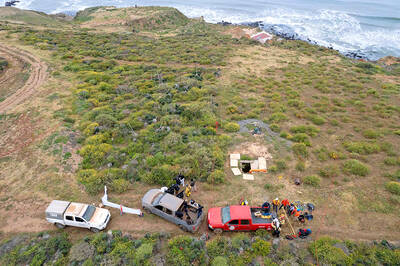
INTERNATIONAL PROBE: Australian and US authorities were helping coordinate the investigation of the case, which follows the 2015 murder of Australian surfers in Mexico Three bodies were found in Mexico’s Baja California state, the FBI said on Friday, days after two Australians and an American went missing during a surfing trip in an area hit by cartel violence. Authorities used a pulley system to hoist what appeared to be lifeless bodies covered in mud from a shaft on a cliff high above the Pacific. “We confirm there were three individuals found deceased in Santo Tomas, Baja California,” a statement from the FBI’s office in San Diego, California, said without providing the identities of the victims. Australian brothers Jake and Callum Robinson and their American friend Jack Carter

Le Tuan Binh keeps his Moroccan soldier father’s tombstone at his village home north of Hanoi, a treasured reminder of a man whose community in Vietnam has been largely forgotten. Mzid Ben Ali, or “Mohammed” as Binh calls him, was one of tens of thousands of North Africans who served in the French army as it battled to maintain its colonial rule of Indochina. He fought for France against the Viet Minh independence movement in the 1950s, before leaving the military — as either a defector or a captive — and making a life for himself in Vietnam. “It’s very emotional for me,”

The Chinese Communist Party’s (CCP) Central Committee is to gather in July for a key meeting known as a plenum, the third since the body of elite decisionmakers was elected in 2022, focusing on reforms amid “challenges” at home and complexities broad. Plenums are important events on China’s political calendar that require the attendance of all of the Central Committee, comprising 205 members and 171 alternate members with Chinese President Xi Jinping (習近平) at the helm. The Central Committee typically holds seven plenums between party congresses, which are held once every five years. The current central committee members were elected at the


 RSS
RSS