


Autopsies revealed fractures in the legs, hips and arms of Air France disaster victims, a Brazilian official said on Wednesday. Experts said those injuries — and the large pieces of wreckage pulled from the Atlantic — strongly suggest the plane broke up in the air.
There have been no visible signs of burning or charring on bodies or wreckage, though that doesn’t rule out an explosion somewhere outside the passenger cabin, crash experts said.
A spokesman for Brazilian medical examiners said that the fractures were found in autopsies on an undisclosed number of the 50 bodies recovered so far. The official spoke on condition he not be named due to department rules.
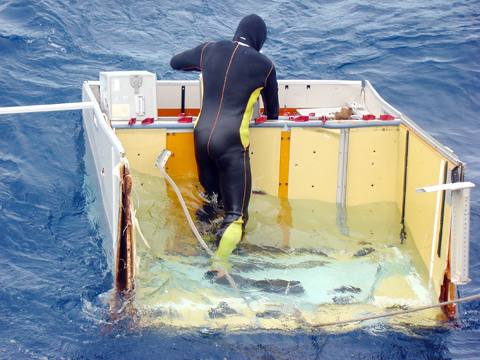
PHOTO: AP
“Typically, if you see intact bodies and multiple fractures — arm, leg, hip fractures — it’s a good indicator of a midflight break up,” said Frank Ciacco, a former forensic expert at the US National Transportation Safety Board. “Especially if you’re seeing large pieces of aircraft as well.”
The pattern of fractures was first reported on Wednesday by Brazil’s O Estado de S. Paulo newspaper, which cited unnamed investigators.
The paper also reported that some victims were found with little or no clothing, and had no signs of burns.
That lack of clothing could be significant, said Jack Casey, an aviation safety consultant in Washington, who is a former accident investigator.
“In an in-air break up like we are supposing here, the clothes are just torn away,” he said.
Casey also said multiple fractures are consistent with a midair breakup of the plane, which was cruising at about 10,500m when it went down.
“Getting ejected into that kind of windstream is like hitting a brick wall — even if they stay in their seats, it is a crushing effect,” Casey said. “Most of them were long dead before they hit the water would be my guess.”
When a jet crashes into water mostly intact — such as the Egypt Air plane that hit the Atlantic Ocean after taking off from New York in 1999 — debris and bodies are generally broken into small pieces, Ciacco said.
“When you’ve had impact in the water, there is a lot more fragmentation of the bodies. They hit the water with a higher force,” he said.
Lack of burn evidence would not necessarily rule out an explosion, said John Goglia, a former member of the US National Transportation Safety Board.
If something caused the lower fuselage to burn or explode, “passengers would not be exposed to any blast damage” and the plane would still disintegrate in flight,” Goglia said.
“These are scenarios that cannot be ruled out,” he said.
In Paris, Paul-Louis Arslanian, head of the French air accident investigation agency BEA, said search teams had recovered more than 400 pieces of debris — reason for “a little more optimism,” since it has helped narrow the search for the black boxes in a vast area of the mid-Atlantic.
“We are in a situation that is a bit more favorable than the first days,” Arslanian told a news conference at BEA headquarters outside Paris. “We can say there is a little less uncertainty, so there is a little more optimism.”
“[But] it is premature for the time being to say what happened,” he said.
Searchers from Brazil, France, and other countries are scanning the surface and depths of the Atlantic for signs of the Airbus A330 that crashed on May 31 after running into thunderstorms en route from Rio de Janeiro to Paris.
All 228 people aboard died.
Still missing are the plane’s flight data and voice recorders, thought to be deep under water.
French-chartered ships are trolling a search area with a radius of 80km, pulling US Navy underwater listening devices attached to 6,000m of cable. The black boxes send out an electronic tapping sound that can be heard up to 2km away, but these locator beacons will begin to fade after just two more weeks.

IDENTITY: A sex extortion scandal involving Thai monks has deeply shaken public trust in the clergy, with 11 monks implicated in financial misconduct Reverence for the saffron-robed Buddhist monkhood is deeply woven into Thai society, but a sex extortion scandal has besmirched the clergy and left the devout questioning their faith. Thai police this week arrested a woman accused of bedding at least 11 monks in breach of their vows of celibacy, before blackmailing them with thousands of secretly taken photos of their trysts. The monks are said to have paid nearly US$12 million, funneled out of their monasteries, funded by donations from laypeople hoping to increase their merit and prospects for reincarnation. The scandal provoked outrage over hypocrisy in the monkhood, concern that their status
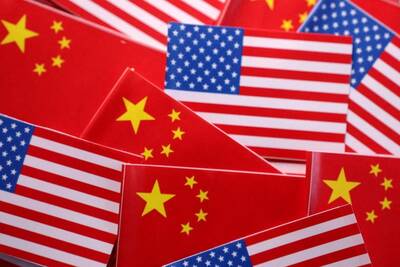
The United States Federal Communications Commission said on Wednesday it plans to adopt rules to bar companies from connecting undersea submarine communication cables to the US that include Chinese technology or equipment. “We have seen submarine cable infrastructure threatened in recent years by foreign adversaries, like China,” FCC Chair Brendan Carr said in a statement. “We are therefore taking action here to guard our submarine cables against foreign adversary ownership, and access as well as cyber and physical threats.” The United States has for years expressed concerns about China’s role in handling network traffic and the potential for espionage. The U.S. has

A disillusioned Japanese electorate feeling the economic pinch goes to the polls today, as a right-wing party promoting a “Japanese first” agenda gains popularity, with fears over foreigners becoming a major election issue. Birthed on YouTube during the COVID-19 pandemic, spreading conspiracy theories about vaccinations and a cabal of global elites, the Sanseito Party has widened its appeal ahead of today’s upper house vote — railing against immigration and dragging rhetoric that was once confined to Japan’s political fringes into the mainstream. Polls show the party might only secure 10 to 15 of the 125 seats up for grabs, but it is
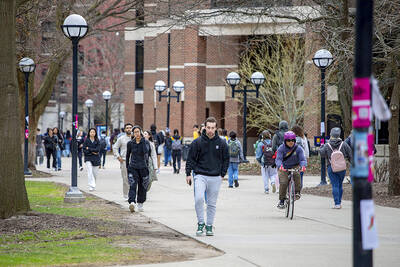
The US Department of Education on Tuesday said it opened a foreign funding investigation into the University of Michigan (UM) while alleging it found “inaccurate and incomplete disclosures” in a review of the university’s foreign reports, after two Chinese scientists linked to the school were separately charged with smuggling biological materials into the US. As part of the investigation, the department asked the university to share, within 30 days, tax records related to foreign funding, a list of foreign gifts, grants and contracts with any foreign source, and other documents, the department said in a statement and in a letter to


 RSS
RSS