


The tiny Pacific island nation that agreed to accept 13 Chinese Muslims from Guantanamo prison has offered itself as a safe haven before.
Palau, famed for lush tropical landscapes and spectacular diving, earlier agreed to take in former Khmer Rouge leader Pol Pot and rescued Afghan refugees, its president said on Saturday. But neither of those two deals panned out.
“It’s our age-old tradition to receive those in need whenever they somehow arrive on our shores,” Palauan President Johnson Toribiong said in an interview.
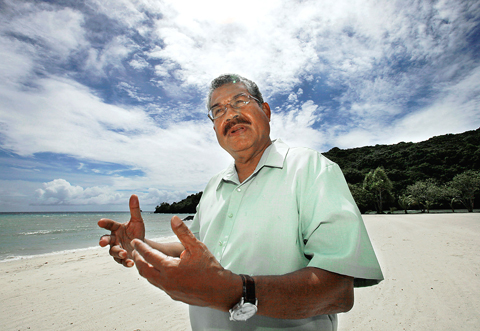
PHOTO: AP
Palau, a former US trust territory about 800km east of the Philippines, made headlines last week after agreeing to US President Barack Obama’s request to take the 13 Chinese Muslims, known as Uighurs, after other countries turned Washington down.
Toribiong, however, said their transfer was not a done deal and described the likelihood of their arrival as “50-50.” And even if they do arrive, it won’t be for another two or three months, he said.
“It’s still tentative, it’s not definite yet,” he said. “The two previous times, we agreed, but they didn’t come.”
The plan to temporarily move Pol Pot, the Cambodian dictator accused of genocide, to Palau before he faced an international tribunal never materialized because he died mysteriously in bed in April 1998, Toribiong said.
Several hundred Afghan refugees that Palau agreed to accept after they were rescued from a sinking boat near Australia in 2001 were sent instead to Nauru, another small South Pacific island.
Toribiong, interviewed at a beachfront resort, said he had never heard of the Uighurs until the US approached him earlier this month. He has sent four Palauan officials to Guantanamo Bay in Cuba to learn more about them.
Palau is one of the world’s smallest countries, with about 20,000 people scattered over 490km². Only nine of its 340 islands are inhabited.
Most residents work in tourism, construction, fishing and farming, leading modest lives in stark contrast to elsewhere the Uighurs would live, or what they would do.
The government will build houses for them if needed and offer orientation to the nation’s language and culture.
They will likely be confined to Palau since they do not have passports.
“If they come to Palau and become constructive, positive, friendly residents, it will be OK,” Toribiong said. “We have 445 Muslims living with us right now. We have no problems.”
About 30 percent of Palau’s inhabitants are foreigners, mainly Filipinos and Bangladeshis. The majority of the nation is Christian.
The US will pay for the Uighurs’ move to Palau.

HISTORIC: After the arrest of Kim Keon-hee on financial and political funding charges, the country has for the first time a former president and former first lady behind bars South Korean prosecutors yesterday raided the headquarters of the former party of jailed former South Korean president Yoon Suk-yeol to gather evidence in an election meddling case against his wife, a day after she was arrested on corruption and other charges. Former first lady Kim Keon-hee was arrested late on Tuesday on a range of charges including stock manipulation and corruption, prosecutors said. Her arrest came hours after the Seoul Central District Court reviewed prosecutors’ request for an arrest warrant against the 52-year-old. The court granted the warrant, citing the risk of tampering with evidence, after prosecutors submitted an 848-page opinion laying out
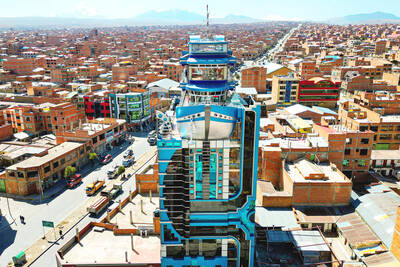
STAGNATION: Once a bastion of leftist politics, the Aymara stronghold of El Alto is showing signs of shifting right ahead of the presidential election A giant cruise ship dominates the skyline in the city of El Alto in landlocked Bolivia, a symbol of the transformation of an indigenous bastion keenly fought over in tomorrow’s presidential election. The “Titanic,” as the tallest building in the city is known, serves as the latest in a collection of uber-flamboyant neo-Andean “cholets” — a mix of chalet and “chola” or Indigenous woman — built by Bolivia’s Aymara bourgeoisie over the past two decades. Victor Choque Flores, a self-made 46-year-old businessman, forked out millions of US dollars for his “ship in a sea of bricks,” as he calls his futuristic 12-story
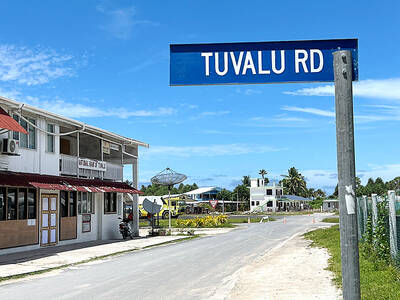
FORUM: The Solomon Islands’ move to bar Taiwan, the US and others from the Pacific Islands Forum has sparked criticism that Beijing’s influence was behind the decision Tuvaluan Prime Minister Feletei Teo said his country might pull out of the region’s top political meeting next month, after host nation Solomon Islands moved to block all external partners — including China, the US and Taiwan — from attending. The Pacific Islands Forum (PIF) leaders’ meeting is to be held in Honiara in September. On Thursday last week, Solomon Islands Prime Minister Jeremiah Manele told parliament that no dialogue partners would be invited to the annual gathering. Countries outside the Pacific, known as “dialogue partners,” have attended the forum since 1989, to work with Pacific leaders and contribute to discussions around

END OF AN ERA: The vote brings the curtain down on 20 years of socialist rule, which began in 2005 when Evo Morales, an indigenous coca farmer, was elected president A center-right senator and a right-wing former president are to advance to a run-off for Bolivia’s presidency after the first round of elections on Sunday, marking the end of two decades of leftist rule, preliminary official results showed. Bolivian Senator Rodrigo Paz was the surprise front-runner, with 32.15 percent of the vote cast in an election dominated by a deep economic crisis, results published by the electoral commission showed. He was followed by former Bolivian president Jorge “Tuto” Quiroga in second with 26.87 percent, according to results based on 92 percent of votes cast. Millionaire businessman Samuel Doria Medina, who had been tipped


 RSS
RSS