


A former US State Department official with top-secret security clearance and his wife have been arrested and charged with spying for Cuba for almost 30 years, US officials said on Friday.
Walter Kendall Myers, 72, and his wife Gwendolyn Steingraber Myers, 71, are accused of conspiracy to hand over classified information to Cuba, serving as an illegal agent for a foreign government and wire fraud, the Department of Justice said in a statement.
The Washington couple were arrested on Thursday after an undercover FBI sting operation for having allegedly passed on secrets for decades to Cuba via shortwave radio and in shopping carts.
If found guilty, the Myers face a maximum of 20 years in prison.
“The clandestine activity alleged in the charging documents, which spanned nearly three decades, is incredibly serious and should serve as a warning to any others in the US government who would betray America’s trust,” said David Kris, assistant attorney general for national security.
Myers first began working for the State Department in 1977 as a lecturer at the department’s Foreign Service Institute in Arlington, Virginia. But from 1988 to 1999 he began to work for its bureau of intelligence and research.
In 1985, he was given top-secret security clearance, which was then upgraded to a higher level in 1999.
By the time he retired, Myers was working as a senior Europe analyst for the department’s intelligence bureau and had daily access to classified information stored on computer databases, the Justice Department said.
A scan of his computer showed that from August 2006 until his retirement in October 2007 Myers had viewed more than 200 sensitive or classified intelligence reports on Cuba, which has been under a US embargo since 1962.
The couple were first recruited after Myers traveled to Cuba in 1978 at the invitation of the Cuban mission to the US in New York.
Six months later he was visited in his South Dakota home by a Cuban official from the mission and the couple allegedly agreed to spy for Cuba.
They were encouraged to seek a job in Washington at the State Department or CIA, the Justice Department said.
The couple would allegedly get encrypted messages from Cuba via shortwave radio, and Gwendolyn Myers, who worked as an analyst at a local bank, would pass on information to her contacts by exchanging shopping carts in stores because she said it was “easy enough to do,” it said.
Myers told the undercover FBI agent that he usually smuggled information out of the State Department by memorizing it or by taking notes.
“I was always pretty careful. I didn’t usually take documents out,” he told the operative who was pretending to be a Cuban intelligence officer.
Apart from being contacted via coded messages on shortwave radio, the couple traveled all over South America and the Caribbean to meet with Cuban agents.
They received medals from the Cuban government and apparently met with then-president Fidel Castro in 1995.
News of the arrests came as the administration of US President Barack Obama is seeking to open a new era of ties with South America and has lifted travel restrictions on the country.
“This should serve as a stark reminder that while some seek to entice the Castro regime into behaving like the rest of the free world, Havana only seeks to threaten and undermine US interests at every turn,” warned Ileana Ros-Lehtinen, the ranking Representative on the House Foreign Affairs Committee.
And Frank Calzon, from the Center for a Free Cuba agreed, saying the arrests were a wake-up call, which “should be a matter of great concern to the Congress because of the ongoing efforts by Cuban diplomats and others to influence the perception of both congressmen and senators about US Cuba policy.”
US Secretary of State Hillary Rodham Clinton has ordered a review of the case, and an assessment of the department’s security procedures.
US State Department spokesman Philip Crowley said the arrests were the culmination of a three-year joint investigation with the department’s security service and the FBI.
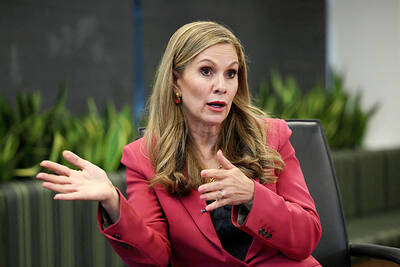
Australians were downloading virtual private networks (VPNs) in droves, while one of the world’s largest porn distributors said it was blocking users from its platforms as the country yesterday rolled out sweeping online age restriction. Australia in December became the first country to impose a nationwide ban on teenagers using social media. A separate law now requires artificial intelligence (AI)-powered chatbot services to keep certain content — including pornography, extreme violence and self-harm and eating disorder material — from minors or face fines of up to A$49.5 million (US$34.6 million). The country also joined Britain, France and dozens of US states requiring
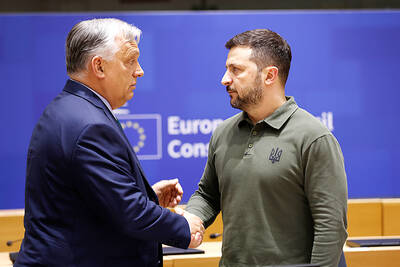
Hungarian authorities temporarily detained seven Ukrainian citizens and seized two armored cars carrying tens of millions of euros in cash across Hungary on suspicion of money laundering, officials said on Friday. The Ukrainians were released on Friday, following their detention on Thursday, but Hungarian officials held onto the cash, prompting Ukraine to accuse Hungary’s Russia-friendly government of illegally seizing the money. “We will not tolerate this state banditism,” Ukrainian Minister of Foreign Affairs Andrii Sybiha said. The seven detained Ukrainians were employees of the Ukrainian state-owned Oschadbank, who were traveling in the two armored cars that were carrying the money between Austria and
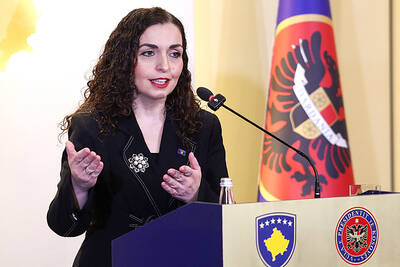
Kosovar President Vjosa Osmani on Friday after dissolving the Kosovar parliament said a snap election should be held as soon as possible to avoid another prolonged political crisis in the Balkan country at a time of global turmoil. Osmani said it is important for Kosovo to wrap up the upcoming election process and form functional institutions for political stability as the war rages in the Middle East. “Precisely because the geopolitical situation is that complex, it is important to finish this electoral process which is coming up,” she said. “It is very hard now to imagine what will happen next.” Kosovo, which declared

MORE BANS: Australia last year required sites to remove accounts held by under-16s, with a few countries pushing for similar action at an EU level and India considering its own ban Indonesia on Friday said it would ban social media access for children under 16, citing threats from online pornography, cyberbullying, online fraud and Internet addiction. “Accounts belonging to children under 16 on high-risk platforms will start to be deactivated, beginning with YouTube, TikTok, Facebook, Instagram, Threads, X, Bigo Live and Roblox,” Indonesian Minister of Communications and Digital Meutya Hafid said. “The government is stepping in so that parents no longer have to fight alone against the giants of the algorithm. Implementation will begin on March 28, 2026,” she said. The social media ban would be introduced in stages “until all platforms fulfill their


 RSS
RSS