

The remote town of Pio Duran, with its palm and thatch-roofed homes, had never known a decent road, while a decades-long communist insurgency lurks threateningly in the background.
So it comes as little surprise that, while they are accused by some of being “occupiers” in places like Iraq and Afghanistan, US Marines have been welcomed in the impoverished and sometimes dangerous central region of Bicol.
“This is Bicol, so [the insurgency] is an ever-present factor,” local mayor Roger Arandia said, referring to the 5,200-member New People’s Army (NPA). “But everyone needs a road.”
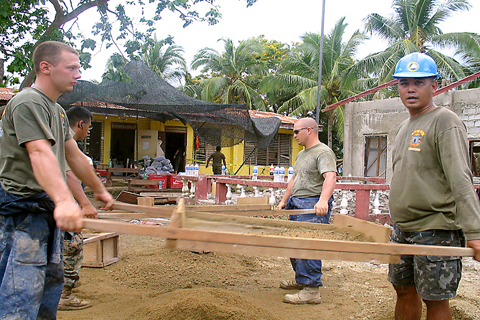
PHOTO: AFP
It is by no means on the scale of reconstruction efforts in the Middle East, for example, but the Marines are on a “hearts and minds” mission here that is winning them many friends locally — and inevitably drawing a few enemies too.
Aside from roads, they have rebuilt schools damaged by typhoons, treated 22,000 residents with various ailments and even given anti-rabies shots to pets in what is one of the nation’s poorest regions.
“I don’t get into the whys of an insurgency or anything. What I’m here to do is help people,” said Brigadier General Ronald Bailey, commander of a US Marine expeditionary brigade consisting of around 40 troops.
They form part of the more than 6,000 US soldiers involved in military exercises in Bicol, Luzon and Mindanao.
The non-combat segment allows Washington to dispense its largesse to earn goodwill in the former US colony’s poorest areas, which are typically troubled by insurgencies.
It took about a month to turn a 3km dirt track into a proper road linking Pio Duran to the coastal resort of Donsol, where most visitors to Bicol head, Marine Staff Sergeant Chad Anderson said.
The locals’ response was “outstanding. They appreciated it a lot,” said Anderson, from Maine.
But the threat from the NPA is never far away. They have warned they are prepared to attack the US forces, although there have been no reported direct assaults yet.
However, they have come close, wounding one local soldier who was part of a Philippine unit guarding the Marines as they built another road.
While the Americans have tried to avoid getting involved with the issue of the communist insurgency and say their role is to improve basic services for the locals, some Filipinos hope they will indirectly also be making it safer.
Building roads “enables the government to bring basic services, so naturally it has an immediate impact on the insurgency,” Philippine Defense Secretary Gilberto Teodoro said.
He said the rebellion has persisted for so long “because we have not been able to address it properly due to lack of manpower.”
US Ambassador to the Philippines Kristie Kenney would not rule out helping the government in Manila fight the rebels in Bicol.
“Right now we are very happy with where we are in our relationship,” Kenney said.

US President Donald Trump on Wednesday threatened to take action against the EU if it moves forward with European Commission President Ursula von der Leyen’s proposal to make Canada the bloc’s first associate member. “If they do that, if I think it’s at all a hostile act; I will put very serious tariffs or stop trading with Europe on many things,” Trump told reporters en route to an event in North Carolina, calling the proposal “laughable.” “If it’s a good intention, that’s fine. If it’s a bad intention, we’ll put very heavy tariffs on Europe,” he said. Von der Leyen made the proposal
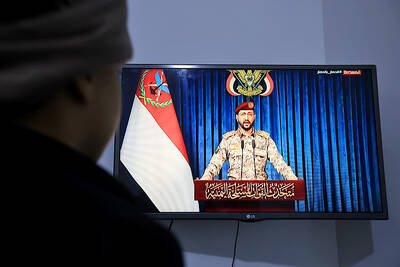
ON THE MOVE: Trump unexpectedly cut short a trip to return to the White House, while the State Department warned Americans to avoid travel to the Middle East The US on Saturday warned that hostilities between Saudi Arabia and Iran-backed Houthis could “escalate rapidly” after a missile attack targeted Riyadh for the first time since the Yemen conflict resumed. US President Donald Trump on Saturday cut short a weekend at Camp David, a secluded presidential complex in rural Maryland, to return unexpectedly to the White House. The White House gave no explanation for the early return, which comes as a new threshold was crossed in the conflict between Saudi Arabia and the Houthis, who control a large part of Yemen and are fighting government forces backed by a coalition led
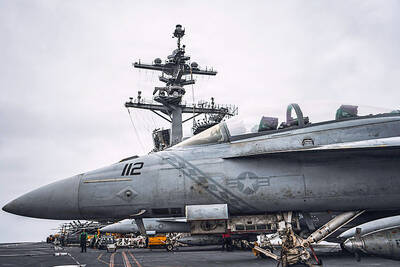
The US military came close to boarding a Chinese vessel in the Middle East earlier this year based on a flawed intelligence report prepared with the help of artificial intelligence (AI), CNN said on Friday. US intelligence indicated the ship was carrying nuclear weapons-related components, leading US forces to prepare to intercept it, the broadcaster reported, citing four anonymous sources familiar with the incident. However, the operation was called off after officials determined that an AI chatbot used by an analyst had misidentified the material the ship was carrying. The report was “entirely false,” but “almost started a war,” CNN quoted one source

World leaders gather in New York this week for the UN General Assembly, bracing for US President Donald Trump’s return to the rostrum for a second year running, with talks centering on the widening conflicts in the Middle East and Ukraine and the risks of artificial intelligence (AI). Nearly 130 heads of state meet with the post-World War II order under strain and with the UN itself struggling to remain relevant and weathering attacks from Trump, who has slashed the US’ contributions and withdrawn from dozens of UN bodies. Chinese President Xi Jinping (習近平), who last addressed the diplomatic jamboree via video


 RSS
RSS