


India’s marathon elections entered the home straight yesterday, with millions voting in a fourth round of polling that saw the two main parties going head to head in a number of key swing states.
The penultimate phase of the five-stage election also brought in the Muslim-majority Kashmir Valley — the cradle of the Kashmiri separatist movement where polls have long been snubbed as symbols of Indian rule.
A separatist boycott call and suffocating security meant early turnout in the Kashmiri summer capital Srinagar was almost non-existent, with the few voters far outnumbered by the thousands of soldiers and police on duty.
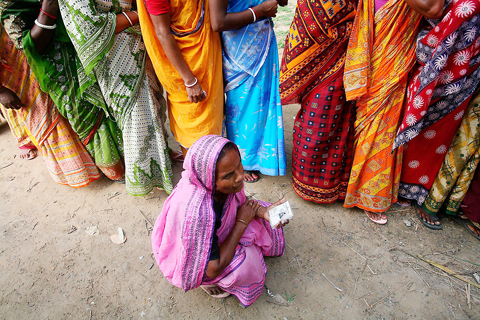
PHOTO: REUTERS
“We opened 45 minutes ago and haven’t seen a single voter,” said Showkat Ahmed, a poll observer at a school with three polling booths.
Yesterday’s voting encompassed the capital New Delhi, the neighboring states of Rajasthan and Haryana and five other states.
In the 2004 general elections, Congress won six of the seven seats up for grabs in Delhi, as well as nine of Haryana’s 10 seats. Its main rival, the Hindu nationalist Bharatiya Janata party (BJP), took 21 of the 25 seats in Rajasthan.
A significant swing in any of these races could have a major impact, with many observers predicting that just a handful of seats could separate the two parties once all the votes are counted.
India’s 714 million registered voters will decide a total of 543 parliamentary seats in what is touted as the largest democratic exercise in the world.
The election — staggered for reasons of logistics and security — began on April 16 and ends on Wednesday. Final results are expected three days later.
With the finish line now in sight and no clear winner expected, attention has already turned to the political horse-trading to come when parties scrabble for coalition partners.
Rahul Gandhi, heir to India’s most powerful political dynasty and the ruling Congress party’s star campaigner, set the tone on Tuesday when he extended an olive branch to his party’s estranged communist partners.
Analysts say Congress will struggle to stitch together a government without the communists, who withdrew their support from the ruling coalition last year to protest against the signing of a nuclear pact with the US.
Neither the Congress-led alliance nor the bloc headed by the BJP is seen as capable of securing an absolute majority.
The inevitable post-poll rush for more allies is expected to witness the emergence of a shaky, vulnerable coalition.
The new administration faces a sharp economic downturn after successive years of growth, as well as numerous foreign policy challenges that include the deteriorating situation in Pakistan.
In Srinagar, armored personnel carriers and riot police were posted at key intersections to prevent any repeat of violent anti-poll protests that had rocked the city in recent days.
A number of prominent separatist leaders who helped organize the demonstrations were under house arrest.
Kashmiri Chief Minister Omar Abdullah said his only responsibility was to ensure people had the opportunity to cast their ballots.
“As long as I can provide an environment where there is little or no violence and where people are free to come out and choose to vote or not to vote, that is as much as can be expected from me,” Abdullah said. “It’s not my job to force people to come out and vote.”
Many registered voters made it clear they had no intention of casting their ballots.
“None of us are going to vote,” said Mehak Fayaz, 21, one of a group of students studying at Kashmir University in Srinagar.
“New Delhi has been ruling us for years. There has been no difference in the curfews, custodial deaths, the army’s human rights violations,” Fayaz said.
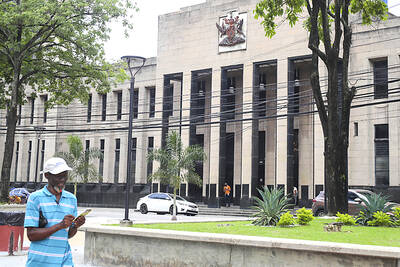
Trinidad and Tobago declared a new state of emergency on Friday after authorities accused a criminal network operating in prisons across the country of plotting to kill key government officials and attack public institutions. It is the second state of emergency to be declared in the twin-island republic in a matter of months. In December last year, authorities took similar action, citing concerns about gang violence. That state of emergency lasted until mid-April. Police said that smuggled cellphones enabled those involved in the plot to exchange encrypted messages. Months of intelligence gathering led investigators to believe the targets included senior police officers,
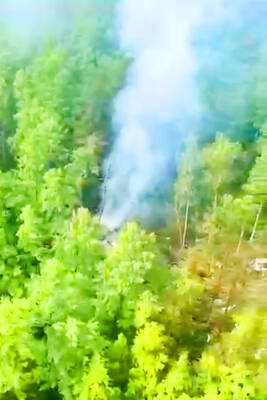
FOREST SITE: A rescue helicopter spotted the burning fuselage of the plane in a forested area, with rescue personnel saying they saw no evidence of survivors A passenger plane carrying nearly 50 people crashed yesterday in a remote spot in Russia’s far eastern region of Amur, with no immediate signs of survivors, authorities said. The aircraft, a twin-propeller Antonov-24 operated by Angara Airlines, was headed to the town of Tynda from the city of Blagoveshchensk when it disappeared from radar at about 1pm. A rescue helicopter later spotted the burning fuselage of the plane on a forested mountain slope about 16km from Tynda. Videos published by Russian investigators showed what appeared to be columns of smoke billowing from the wreckage of the plane in a dense, forested area. Rescuers in

A disillusioned Japanese electorate feeling the economic pinch goes to the polls today, as a right-wing party promoting a “Japanese first” agenda gains popularity, with fears over foreigners becoming a major election issue. Birthed on YouTube during the COVID-19 pandemic, spreading conspiracy theories about vaccinations and a cabal of global elites, the Sanseito Party has widened its appeal ahead of today’s upper house vote — railing against immigration and dragging rhetoric that was once confined to Japan’s political fringes into the mainstream. Polls show the party might only secure 10 to 15 of the 125 seats up for grabs, but it is
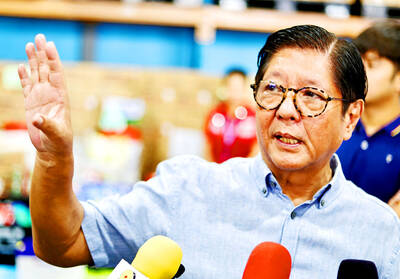
Philippine President Ferdinand Marcos Jr is to meet US President Donald Trump this week, hoping Manila’s status as a key Asian ally would secure a more favorable trade deal before the deadline on Friday next week. Marcos would be the first Southeast Asian leader to meet Trump in his second term. Trump has already struck trade deals with two of Manila’s regional partners, Vietnam and Indonesia, driving tough bargains in trade talks even with close allies that Washington needs to keep onside in its strategic rivalry with China. “I expect our discussions to focus on security and defense, of course, but also


 RSS
RSS