


Sri Lankan forces shelled a makeshift hospital in the war zone, killing 64 civilians despite a pledge to stop using heavy weapons in its battle with the Tamil Tigers, a rebel-linked Web site said.
A health official in the war zone confirmed the hospital was hit twice by artillery yesterday, though the official declined to say who was responsible. The military denied launching the attack.
Sri Lanka has come under increasing international pressure to halt its offensive against the rebels to safeguard the estimated 50,000 ethnic Tamil civilians trapped by the fighting.
The government, which has cornered the Tamil Tigers in a 5km-long coastal strip, has refused, but it did promise to stop launching artillery and airstrikes into the area.
ATTACKS
The TamilNet Web site said the government hit the makeshift hospital at Mullivaaykkaal twice on Saturday morning.
The attacks killed at least 64 patients and bystanders and wounded another 87, a government health official said.
The official, who said he was not certain of the source of the attack, declined to be identified because he was not authorized to speak to the media.
The attack killed a female volunteer doctor and wounded three medical workers, the Web site said.
Though the hospital is inside rebel-held territory, it is run by government doctors.
The government denied the army had shelled the war zone, saying soldiers were only using small arms in the fight to destroy the rebels.
“There is absolutely no truth in these reports,” Sri Lankan Foreign Minister Rohitha Bogollagama said.
ENVOY
Japanese peace envoy Yasushi Akashi, the latest high-profile diplomat to arrive in Sri Lanka in the past week, said he had heard recent reports of the renewed artillery attacks in the war zone, but he had no way to confirm them.
The government has barred journalists and aid workers from the war zone.
The government and rights groups, meanwhile, accused the rebels of holding the civilians as human shields.
The government air-dropped leaflets on the region on Friday, appealing to trapped civilians to flee across the front lines and promising to ensure their safety.
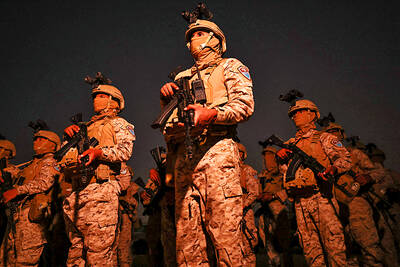
PRECARIOUS RELATIONS: Commentators in Saudi Arabia accuse the UAE of growing too bold, backing forces at odds with Saudi interests in various conflicts A Saudi Arabian media campaign targeting the United Arab Emirates (UAE) has deepened the Gulf’s worst row in years, stoking fears of a damaging fall-out in the financial heart of the Middle East. Fiery accusations of rights abuses and betrayal have circulated for weeks in state-run and social media after a brief conflict in Yemen, where Saudi airstrikes quelled an offensive by UAE-backed separatists. The United Arab Emirates is “investing in chaos and supporting secessionists” from Libya to Yemen and the Horn of Africa, Saudi Arabia’s al-Ekhbariya TV charged in a report this week. Such invective has been unheard of

US President Donald Trump on Saturday warned Canada that if it concludes a trade deal with China, he would impose a 100 percent tariff on all goods coming over the border. Relations between the US and its northern neighbor have been rocky since Trump returned to the White House a year ago, with spats over trade and Canadian Prime Minister Mark Carney decrying a “rupture” in the US-led global order. During a visit to Beijing earlier this month, Carney hailed a “new strategic partnership” with China that resulted in a “preliminary, but landmark trade agreement” to reduce tariffs — but

Chinese President Xi Jinping’s (習近平) purge of his most senior general is driven by his effort to both secure “total control” of his military and root out corruption, US Ambassador to China David Perdue said told Bloomberg Television yesterday. The probe into Zhang Youxia (張又俠), Xi’s second-in-command, announced over the weekend, is a “major development,” Perdue said, citing the family connections the vice chair of China’s apex military commission has with Xi. Chinese authorities said Zhang was being investigated for suspected serious discipline and law violations, without disclosing further details. “I take him at his word that there’s a corruption effort under
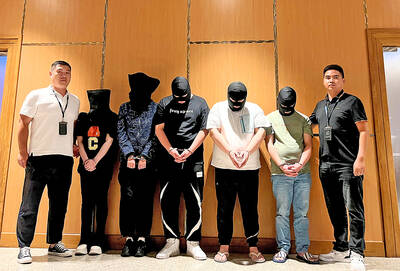
China executed 11 people linked to Myanmar criminal gangs, including “key members” of telecom scam operations, state media reported yesterday, as Beijing toughens its response to the sprawling, transnational industry. Fraud compounds where scammers lure Internet users into fake romantic relationships and cryptocurrency investments have flourished across Southeast Asia, including in Myanmar. Initially largely targeting Chinese speakers, the criminal groups behind the compounds have expanded operations into multiple languages to steal from victims around the world. Those conducting the scams are sometimes willing con artists, and other times trafficked foreign nationals forced to work. In the past few years, Beijing has stepped up cooperation


 RSS
RSS