


Australia’s deputy prime minister defended the government yesterday against suggestions it is too close to Beijing, calling the opposition’s attacks “absurd.”
Last week, Defense Minister Joel Fitzgibbon admitted that he had failed to declare two trips to China that were paid for by businesswoman Helen Liu, a Chinese-Australian property developer who is also a long-standing friend, as he is required to do under parliamentary rules.
Fitzgibbon apologized for failing to declare the trips, taken in 2002 and 2005 when he was an opposition lawmaker with a limited travel budget. Australian Prime Minister Kevin Rudd said he was displeased with Fitzgibbon but that he would keep his job.
But the opposition seized on the trips to question whether Rudd’s government is too close to Beijing. Last week, senior opposition lawmaker Joe Hockey told Seven Network television that he was “concerned about the pattern of behavior,” citing trips by several government officials to China.
Yesterday, Deputy Prime Minister Julia Gillard acknowledged that Fitzgibbon had made an error in judgment by not declaring the trips, but said the opposition’s attacks on the government’s China connections were ridiculous.
“This is all getting ... a little bit absurd,” Gillard told ABC television. “We now have the opposition carrying on as if there is some huge conspiracy here. That if you ever met a Chinese person, that if you’ve ever discussed an issue in relation to China, that if you’ve ever spoken a word of Mandarin, then apparently this is all some huge conspiracy against Australia’s national interest.”
Rudd, a Mandarin-speaking former diplomat to Beijing, and Treasurer Wayne Swan also took trips to Beijing sponsored by Chinese business interests before they were elected to government in 2007.
Both declared the trips.
China is Australia’s largest trading partner and Beijing’s demand for mineral resources such as iron ore helped fuel a 17-year economic boom that ended late last year with the global financial downturn.
Amid intense debate in Australia over moves by Chinese state-owned entities to buy into the country’s vast resource base.
Opposition leader Malcolm Turnbull has accused Prime Minister Kevin Rudd of acting like a “roving ambassador” for Beijing.
Finance Minister Lindsay Tanner said Turnbull was running a populist line he believed would resonate with sections of the Australian public.
“China has a vested interest in acquiring our natural resources at low prices,” Turnbull said. “The question is how much has Mr Fitzgibbon not told us.”
“It’s both absurd and it’s a blatant attempt by Malcolm Turnbull to play to latent antagonism toward China in the Australian populace,” Tanner told Sky News.

A humanoid robot that won a half-marathon race for robots in Beijing on Sunday ran faster than the human world record in a show of China’s technological leaps. The winner from Honor, a Chinese smartphone maker, completed the 21km race in 50 minutes and 26 seconds, said a WeChat post by the Beijing Economic-Technological Development Area, also known as Beijing E-Town, where the race began. That was faster than the human world record holder, Ugandan Jacob Kiplimo, who finished the same distance in about 57 minutes in March at the Lisbon road race. The performance by the robot marked a significant step forward

Four contenders are squaring up to succeed Antonio Guterres as secretary-general of the UN, which faces unprecedented global instability, wars and its own crushing budget crisis. Chile’s Michelle Bachelet, Argentina’s Rafael Grossi, Costa Rica’s Rebeca Grynspan and Senegal’s Macky Sall are each to face grillings by 193 member states and non-governmental organizations for three hours today and tomorrow. It is only the second time the UN has held a public question-and-answer, a format created in 2016 to boost transparency. Ultimately the five permanent members of the UN’s top body, the Security Council, hold the power, wielding vetoes over who leads the

An earthquake registering a preliminary magnitude of 7.7 off northern Japan on Monday prompted a short-lived tsunami alert and the advisory of a higher risk of a possible mega-quake for coastal areas there. The Cabinet Office and the Japan Meteorological Agency said there was a 1% chance for a mega-quake, compared to a 0.1% chance during normal times, in the next week or so following the powerful quake near the Chishima and Japan trenches. Officials said the advisory was not a quake prediction but urged residents in 182 towns along the northeastern coasts to raise their preparedness while continuing their daily lives. Prime
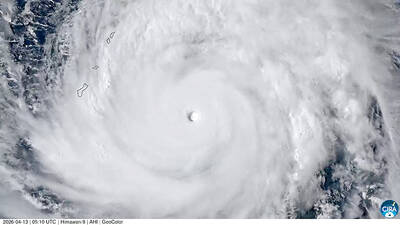
HAZARDOUS CONDITION: The typhoon’s sheer size, with winds extending 443km from its center, slowed down the ability of responders to help communities, an official said The US Coast Guard was searching for six people after losing contact with their disabled boat off the coast of Guam following Typhoon Sinlaku. The crew of the 44m dry cargo vessel, the US-registered Mariana, on Wednesday notified the coast guard that the boat had lost its starboard engine and needed assistance, Petty Officer 3rd Class Avery Tibbets said yesterday. The coast guard set up a one-hour communication schedule with the vessel, but lost contact on Thursday. A Coast Guard HC-130 Hercules aircraft was launched to search for the six people on board, but it had to return to Guam because of


 RSS
RSS