

The severed head of King Badu Bonsu II is going home to Ghana, about 170 years after it was hacked off in retaliation for the slayings of two Dutch emissaries whose skulls were hung from the tribal leader’s throne.
Bonsu’s head was discovered last year in a jar of formaldehyde at the Leiden University Medical Center’s anatomical collection by a Dutch author.
Ghana asked for it to be returned and the Dutch government asked the hospital to cooperate.
“It will go back to Ghana, where we assume it will be buried,” Dutch Education, Culture and Science Minister Ronald Plasterk said.
The hospital said in a statement Friday it is in talks with the Ghanaian embassy “to carefully prepare for the return of King Badu Bonsu II’s head.”
The hospital declined to give more details of the case, citing a “well-considered policy about our anatomic-historical collection.”
The decision to return it to Ghana is in line with similar moves by museums in recent years. Several British museums have returned the skulls and other bones of Australian Aborigines following lobbying by indigenous leaders.
Last year, the embassy urged the return for the king and his clan in the country’s Ashanti region.
“Without burial of the head, the deceased will be hunted in the afterlife. He’s incomplete,” Eric Odoi-Anim, a minister at the embassy, said at the time. “It’s also a stigma on his clan, on his kinsmen, and him being a [high-ranking] chief — this is even more serious.”
Prominent Dutch writer Arthur Japin told Dutch television he found the head while researching a historical novel.
“He’s got a little ring-beard, his eyes are closed as if he’s sleeping,” Japin said. “And my first thought was, this is not fitting.”
The Dutch established trading and slave posts in Ghana in the late 1500s and remained involved in the country until late in the 19th century.
Japin said the head was taken by major general Jan Verveer in retaliation for Bonsu’s killing of two Dutch emissaries, whose heads were then displayed as trophies.
Plasterk said the decision to repatriate the head was not difficult, as the head no longer served any scientific or cultural purpose.

Japan has started its first nationwide survey of animal cafes amid concerns over animal welfare, hygiene and public health, a government official said, bringing greater scrutiny to the popular but lightly regulated sector. The desktop survey, which began this month, will examine the number of facilities, the types of animals they house and the conditions they are held in, and how visitors interact with the animals. Exotic animal cafes, where visitors can interact with species ranging from otters to owls and marmots, have become popular attractions for Japanese and foreign tourists. However, researchers say some facilities keep threatened species, raising

STRAIN ON TIES: The police arrested a 20-year-old man who matched the description of a suspect caught on CCTV leaving a hotel in Naha with the victim’s belongings A US Marine stationed on Japan’s southern island of Okinawa was arrested on suspicion of the murder of a Japanese woman, police said yesterday. The suspect “killed the 39-year-old woman at a hotel in Naha and stole her wallet on Saturday,” a local police spokesman said. US Ambassador George Glass posted on social media that he had spoken with Japan’s foreign ministry and Okinawa’s governor to offer “our sincere condolences and pledging full cooperation as the investigation continues.” Japanese Prime Minister Sanae Takaichi called the crime “exceptionally brutal and vicious” on X. The government has urged the US “to provide maximum cooperation
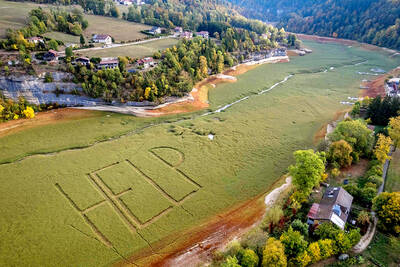
The picturesque Lac des Brenets between France and Switzerland has dried up after a record-breaking hot summer, leaving locals crying out for help to save the lake. Indeed, the words “HELP” and “SOS” have been scratched out in the weeds now flourishing on the exposed lake bed. The drought has ruined pleasure boat tourism, while some question whether the lake will ever return to enduring full health. “It’s absolutely heartbreaking,” said historian David Favre, who lives in Les Brenets. “As children, we used to spend all our summers swimming at the beach, having fun by the water, diving, jumping in and sometimes even

A US lawmaker has called on Starbucks to close its first stores in Xinjiang, China, calling it a “morally bankrupt decision” to do business in a region where Uighurs face repression. China denies widespread accusations about abuses of the Uighurs, a mainly Muslim people, saying its policies there were aimed at combating terrorism, separatism and religious extremism. Starbucks opened its first two stores this week in Xinjiang’s capital, Urumqi, including one at the city centre’s grand bazaar and a second at its international airport. John Moolenaar, chairman of the Select Committee on China of the House of Representatives, called on Starbucks to “immediately


 RSS
RSS