


Thai Prime Minister Abhisit Vejjajiva admitted in an interview with CNN yesterday that there had been instances of authorities pushing Rohingya boat people back to sea, contradicting earlier denials by the Thai military that abuses had been committed.
“It’s not exactly clear whose work it is,” Abhisit told CNN. “All the authorities say it’s not their policy, but I have reason to believe otherwise. I will certainly hold the guilty parties accountable, once I find out who is responsible.”
The Thai prime minister last month ordered an investigation into accusations that almost 1,000 Rohingya refugees had been pushed out to sea in 30 boats without engines and sufficient food supplies in December.
Tales of abuse by Thai Navy personnel emerged after hundreds of the Rohingya boat people were rescued in the territorial waters of Indonesia and India. Some 500 of the boat people pushed out to sea are still missing and feared drowned.
The Rohingya, from Myanmar’s Arakan State, have been denied citizenship in Myanmar and Bangladesh. Myanmar’s junta claims the Muslim minority originated from Bangladesh.
Persecuted and denied job opportunities and the right to own land in Myanmar, hundreds of thousands of Rohingya have fled to Bangladesh where they live in refugee camps.
Thousands of Rohingya men have paid smugglers to take them to Thailand and Malaysia in search of work.
Thailand’s military regards the Rohingya as a security threat, fearing they will join the separatist movement in the majority Muslim deep South, where almost 3,300 people have died in clashes and revenge killings over the past five years.
The Thai government has proposed talks between the concerned countries — Bangladesh, India, Indonesia, Malaysia, Myanmar and Thailand — to find a long-term solution to the refugee problem.
The Rohingya issue is expected to be discussed on the sidelines of the upcoming ASEAN summit from Feb. 27 to March 1 at the Hua Hin beach resort, 130km southwest of Bangkok.

An American scientist convicted of lying to US authorities about payments from China while he was at Harvard University has rebuilt his research lab in Shenzhen, China, to pursue technology the Chinese government has identified as a national priority: embedding electronics into the human brain. Charles Lieber, 67, is among the world’s leading researchers in brain-computer interfaces. The technology has shown promise in treating conditions such as amyotrophic lateral sclerosis and restoring movement in paralyzed people. It also has potential military applications: Scientists at the Chinese People’s Liberation Army have investigated brain interfaces as a way to engineer super soldiers by boosting

Indonesian police have arrested 13 people after shocking images of alleged abuse against small children at a daycare center went viral, sparking outrage across the nation, officials said on Monday. Police on Friday last week raided Little Aresha, a daycare center in Yogyakarta on Java island, following a report from a former employee. CCTV footage circulating on social media showed children, most younger than two, lying on the floor wearing only diapers, their hands and feet bound with rags. The police have confirmed that the footage is authentic. Police said they also found 20 children crammed into a room just 3m by 3m. “So

A highway bomb attack in a restive region of southwestern Colombia on Saturday killed 14 people and injured at least 38, the latest spate of violence ahead of next month’s presidential election. Authorities blamed the attack in the Cauca department — a conflict-ridden, coca-growing region — on dissidents of the now-disbanded FARC guerrilla army, who have been sowing violence across the country. “Those who carried out this attack ... are terrorists, fascists and drug traffickers,” Colombian President Gustavo Petro said on social media. “I want our very best soldiers to confront them,” he added. The leftist leader blamed the bombing
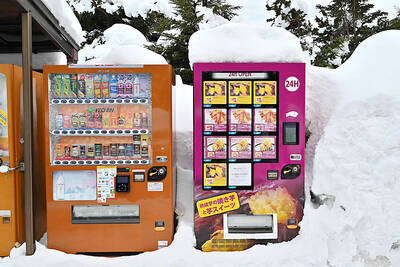
From post offices and parks to stations and even the summit of Mount Fuji, Japan’s vending machines are ubiquitous, but with the rapid pace of inflation cooling demand for their drinks, operators are being forced to rethink the business. Last month beverage giant DyDo Group Holdings announced it would remove about 20,000 vending machines — about 7 percent of their stock nationwide — by January next year, to “reconstruct a profitable network.” Pokka Sapporo Food & Beverage, based in Nagoya, also said last month it would sell its 40,000-machine operation to Osaka-based Lifedrink Co. “The strength of the vending machine


 RSS
RSS