


Global armament and aerospace firms are flocking to India which is offering rich pickings in military contracts worth tens of billions of dollars despite an economic slowdown.
The hardware-hungry military says it cannot cut defense spending despite the slowdown in India which is suffering the knock-on effects of the global financial crisis.
“Yes, there’s the economic turmoil but India’s defense programs will continue as before,” Indian Defense Production Secretary Pradeep Kumar said.
“There’s no scaling down of the modernization of the armed forces,” he said, announcing 303 international firms would hawk their wares at an air show to be held in Bangalore, the hub of India’s aerospace industry, from Wednesday through Sunday.
India, the biggest weapons buyer among emerging countries, has imported military hardware worth US$28 billion since 2000.
It has earmarked another US$30 billion to be spent by next year that includes US$12 billion on 126 fighter jets for which six global aeronautical giants are in the running.
Nuclear-armed India says it is “fast-tracking” all defense procurement negotiations amid heightened tensions with Pakistan following the massacre last November of 165 people in Mumbai by 10 gunmen that New Delhi says were helped by “official Pakistani agencies.”
Leading the pack of international companies at the show will be Germany and France, with 31 firms each. Twenty-six British, 24 Russian and 22 US firms will also be at the show along with 289 Indian defense firms, organizers said.
“India’s rapidly growing aerospace and defense industry offers significant opportunities for growth and productivity,” said Ian Thomas, India president of US giant Boeing, a frontrunner for the 126-warplane deal.
Lockheed Martin is also in competition for the world’s richest fighter aircraft contract in 16 years. And the US-based firm hopes to replace India’s fleet of Soviet-era military transport planes, having last year secured an initial deal worth nearly US$1 billion for six Hercules aircraft.
“We do know that the Indian air force’s transport capabilities are gradually diminishing … and that they have to do something about it soon,” Lockheed India’s chief executive officer Douglas Hartwick said.
Lockheed grabbed the US$962 million Indian Air Force deal for six Hercules transport planes last March, but Boeing last month trumped that with a US$2.1 billion contract to sell eight surveillance aircraft to the navy.
“We’re in the process of acquiring whatever more assets we require as the government has sanctioned practically all that we are asking for,” Air Chief Marshal Fali Major said.
The military plans to buy 700 helicopters worth US$3.5 billion by 2018.
US-based Bell Helicopter, which will attend the show, said it was aiming to double its figure of 100 civilian helicopters sold to India.

An American scientist convicted of lying to US authorities about payments from China while he was at Harvard University has rebuilt his research lab in Shenzhen, China, to pursue technology the Chinese government has identified as a national priority: embedding electronics into the human brain. Charles Lieber, 67, is among the world’s leading researchers in brain-computer interfaces. The technology has shown promise in treating conditions such as amyotrophic lateral sclerosis and restoring movement in paralyzed people. It also has potential military applications: Scientists at the Chinese People’s Liberation Army have investigated brain interfaces as a way to engineer super soldiers by boosting
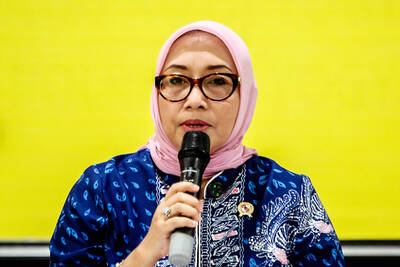
Indonesian police have arrested 13 people after shocking images of alleged abuse against small children at a daycare center went viral, sparking outrage across the nation, officials said on Monday. Police on Friday last week raided Little Aresha, a daycare center in Yogyakarta on Java island, following a report from a former employee. CCTV footage circulating on social media showed children, most younger than two, lying on the floor wearing only diapers, their hands and feet bound with rags. The police have confirmed that the footage is authentic. Police said they also found 20 children crammed into a room just 3m by 3m. “So
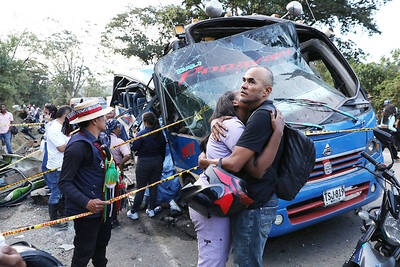
A highway bomb attack in a restive region of southwestern Colombia on Saturday killed 14 people and injured at least 38, the latest spate of violence ahead of next month’s presidential election. Authorities blamed the attack in the Cauca department — a conflict-ridden, coca-growing region — on dissidents of the now-disbanded FARC guerrilla army, who have been sowing violence across the country. “Those who carried out this attack ... are terrorists, fascists and drug traffickers,” Colombian President Gustavo Petro said on social media. “I want our very best soldiers to confront them,” he added. The leftist leader blamed the bombing
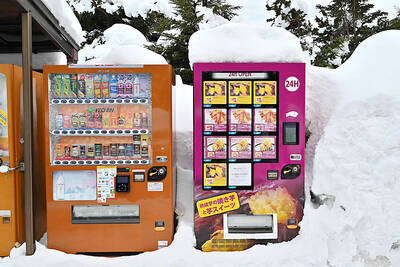
From post offices and parks to stations and even the summit of Mount Fuji, Japan’s vending machines are ubiquitous, but with the rapid pace of inflation cooling demand for their drinks, operators are being forced to rethink the business. Last month beverage giant DyDo Group Holdings announced it would remove about 20,000 vending machines — about 7 percent of their stock nationwide — by January next year, to “reconstruct a profitable network.” Pokka Sapporo Food & Beverage, based in Nagoya, also said last month it would sell its 40,000-machine operation to Osaka-based Lifedrink Co. “The strength of the vending machine


 RSS
RSS