


Some Zimbabwe opposition leaders are unhappy with a complicated deal that sees Zimbabwean President Robert Mugabe relinquishing some power, officials said yesterday.
Two officials said the breakthrough gives opposition leader Morgan Tsvangirai control of the government and the police force that has been terrorizing the opposition.
Mugabe would control defense forces under the deal agreed on Thursday night after three months of tortured negotiations.
The two officials said Tsvangirai broke a deadlock by proposing a Council of State made up of Mugabe and two of his party’s deputies, and Tsvangirai and two of his deputies.
Two officials said Tsvangirai will be in charge of the Cabinet and Mugabe will be in charge of the Council.
The Council of State — which acts as an overseer of the Cabinet’s activities — is important since it gives Mugabe a significant role in government. This apparently led him to compromise and broke a deadlock in the talks.
Mugabe will have no veto powers on the Council, though its role remains unclear. However, two other officials said some opposition leaders are unhappy about the complicated deal.
Five officials spoke yesterday on condition of anonymity because of a media blackout.
Under the deal, the opposition Movement for Democratic Change (MDC) gets most seats in the Cabinet, 16 to 15 for Mugabe’s Zimbabwe African National Union-Patriotic Front (ZANU-PF). Tsvangirai’s party gets eight deputy ministries, Mugabe’s six and one goes to a breakaway opposition faction led by Arthur Mutambara.
The officials said the deal is detailed in a lengthy and complicated document that will take all weekend to prepare.
One official said the deal includes disbanding the southern African nation’s feared Central Intelligence Organization, which like the police comes under the mantle of the Ministry of Home Affairs, and replacing it with a smaller, more efficient National Security Authority.
It should be signed on Monday in Harare in the presence of South African President Thabo Mbeki and other regional presidents who mandated Mbeki to negotiate the peace agreement for the Southern African Development Community.
Mbeki was the man of the hour after clinching the hard-won power-sharing deal yesterday.
Welcoming Thursday’s agreement, UN Secretary-General Ban Ki-moon praised Mbeki’s “tireless efforts to help them [the Zimbabwean leaders] reach it.”
“He [Ban] hopes that this agreement will pave the way for a durable peace and recovery in the country and contribute to rapid improvement in the welfare and human rights of the people of Zimbabwe, who have suffered too long,” the UN chief’s office said in a statement.
South Africa’s ruling African National Congress, which is led by Mbeki’s rival Jacob Zuma, also described the deal as a “remarkable achievement” for Mbeki.
Analysts and Western observers reacted with caution however, saying the “devil would be in the detail.”
Western powers have said they would only support a government in which Tsvangirai was in charge.
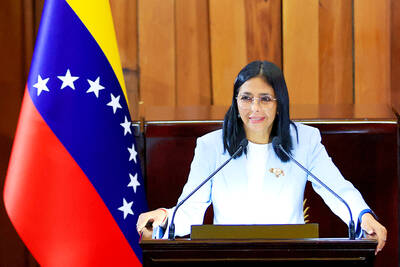
VAGUE: The criteria of the amnesty remain unclear, but it would cover political violence from 1999 to today, and those convicted of murder or drug trafficking would not qualify Venezuelan Acting President Delcy Rodriguez on Friday announced an amnesty bill that could lead to the release of hundreds of prisoners, including opposition leaders, journalists and human rights activists detained for political reasons. The measure had long been sought by the US-backed opposition. It is the latest concession Rodriguez has made since taking the reins of the country on Jan. 3 after the brazen seizure of then-Venezuelan president Nicolas Maduro. Rodriguez told a gathering of justices, magistrates, ministers, military brass and other government leaders that the ruling party-controlled Venezuelan National Assembly would take up the bill with urgency. Rodriguez also announced the shutdown
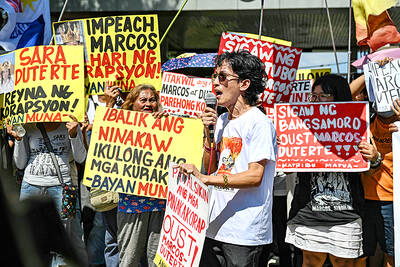
Civil society leaders and members of a left-wing coalition yesterday filed impeachment complaints against Philippine Vice President Sara Duterte, restarting a process sidelined by the Supreme Court last year. Both cases accuse Duterte of misusing public funds during her term as education secretary, while one revives allegations that she threatened to assassinate former ally Philippine President Ferdinand Marcos Jr. The filings come on the same day that a committee in the House of Representatives was to begin hearings into impeachment complaints against Marcos, accused of corruption tied to a spiraling scandal over bogus flood control projects. Under the constitution, an impeachment by the
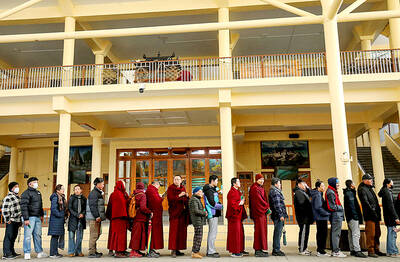
Exiled Tibetans began a unique global election yesterday for a government representing a homeland many have never seen, as part of a democratic exercise voters say carries great weight. From red-robed Buddhist monks in the snowy Himalayas, to political exiles in megacities across South Asia, to refugees in Australia, Europe and North America, voting takes place in 27 countries — but not China. “Elections ... show that the struggle for Tibet’s freedom and independence continues from generation to generation,” said candidate Gyaltsen Chokye, 33, who is based in the Indian hill-town of Dharamsala, headquarters of the government-in-exile, the Central Tibetan Administration (CTA). It

A Virginia man having an affair with the family’s Brazilian au pair on Monday was found guilty of murdering his wife and another man that prosecutors say was lured to the house as a fall guy. Brendan Banfield, a former Internal Revenue Service law enforcement officer, told police he came across Joseph Ryan attacking his wife, Christine Banfield, with a knife on the morning of Feb. 24, 2023. He shot Ryan and then Juliana Magalhaes, the au pair, shot him, too, but officials argued in court that the story was too good to be true, telling jurors that Brendan Banfield set


 RSS
RSS