


It should have been a poignant reunion when Bob and Bruce Bogle met their maker at Stonehenge — but they just stared blankly ahead. But then it was quite hard to recognize the student perpetrators of an outrageous stunt among the gray-haired, or bald, retired professionals assembled among the stones.
They last all met up at dawn on an icy day in February 1966 — and have kept the secret of that meeting ever since.
“We never put any money in the collecting box when we went in over the fence all those years ago, so we were a bit worried about owning up,” Martin Bergs, a retired chemist, said.
Now it can be told: the infamous 1966 Bogle invasion of Stonehenge, a story that went around the world, was a Manchester student rag-week publicity stunt that went spectacularly wrong since nobody outside the gang of plotters had the faintest clue what it was all about.
All the world knew 42 years ago was that staff arrived to find the ancient monument invaded by 16 life-size wooden stick men. Each had painted Beatles moptop hair, a name on their skinny chest and clutched curious implements. Bruce, Bob, Boris Bogle and their brothers stood, sat or — having blown over in the wind despite cord supports and sacks of sand weights — sprawled on the stones like students sleeping off a heavy night.
Before the horrified caretakers gathered them up and burned them, Austin Underwood, a local school teacher, arrived and photographed the Bogles in situ — images that appeared in many UK national papers.
The perpetrators waited confidently for the world to get the joke. The Bogles were the University of Manchester rag-week symbol. It featured on neckties, and the name was lent to a gruesome rag-week tradition, an 87km walk, usually done in brutally bad weather, called the Bogle Stroll.
But nobody did get the joke. To their amazement their Bogles were interpreted as everything from fascist to druidic to occult symbols. And by then there had been such outrage over another Manchester rag-week stunt, when students kidnapped an eagle from London Zoo, that they were afraid to own up. Ever.


Through the noise of rushing papers and whirring belts at a print factory in Kyoto, two creators watch their photo essay come to life in broadsheet form — part of an effort to win new audiences in the age of artificial intelligence (AI). Despite the decline of the publishing industry, self-publication and handmade “zine” magazines are growing in popularity in Japan, reflecting the nation’s enduring love of paper in the digital era. While speaking to Agence France-Presse at the plant, his hands black with ink, one of the creators, Kazuma Obara, said: “I think [paper] is a medium that engages all five
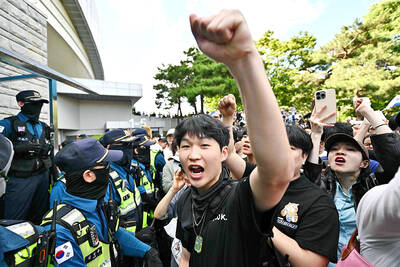
‘ABSURD MISTAKE’: The election commission said that there had been a failure to anticipate turnout after 14 polling stations ran short of ballot papers South Korean riot police yesterday cleared protesters from a Seoul polling station after a 35-hour blockade sparked by a shortage of ballot papers during local elections earlier this week. Wednesday’s election was the first nationwide vote since South Korean President Lee Jae-myung took office following the ouster of Yoon Suk-yeol over his short-lived martial law declaration. Lee’s ruling Democratic Party swept most races, but failed to flip the crucial Seoul mayoral seat. The South Korean National Election Commission apologized, blaming a failure to anticipate turnout after 14 polling stations in Seoul ran short of ballot papers. Some polling stations stayed open until 10pm to

France experienced its hottest spring on record, the French weather service said on Tuesday, after an exceptional early heat wave that also broke highs for the season in England and Wales. Meteo-France said the average nationwide temperature over March to May was 13.8°C — about 1.7°C above the norm, and surpassing records set in 2011 and 2020. “The warmest spring since records began in 1900,” it said in a bulletin. All three months were warmer than average, but the onset of an “unprecedented heatwave” late last month pushed the mercury to highs typically seen at the height of the summer. “Our country had never

A Sherpa guide was found crawling to base camp on Mount Everest a week after he went missing and was reunited with his family, who had given up hope he would return. Dawa Sherpa was last seen on Friday last week descending the mountain, but he did not reach base camp even though his client did. The pair were among the last climbers on the mountain as the climbing season came to an end and the route was dismantled. Dawa was located by a cleaning crew on Thursday morning as he was crawling down the snowy slopes around the Khumbu Icefall, just above


 RSS
RSS