


India’s foreign secretary was to travel to Pakistan yesterday to kickstart the stagnant peace process, marking the government’s first contact with the new civilian leadership, officials said.
Shivshankar Menon is to meet his Pakistani counterpart Salman Bashir on today for a review of the four rounds of talks between the two nuclear-armed rivals that have been held since January 2004, diplomats said.
The talks will focus on “terrorism, levels of infiltration” by Islamic rebels into India “and ways to build on the peace process” after no serious contacts of more than a year, an Indian foreign ministry official said.
“It will also prepare the ground for talks between the two foreign ministers on Wednesday,” said the official, who asked not to be named.
This week’s talks will be the first high-level contact between the two sides since February last year, when Indian Foreign Minister Pranab Mukherjee traveled to Pakistan.
“At the talks, we will see what exactly the new government has in mind,” said the Indian foreign ministry official.
While ties have improved, the rivals have made no significant progress on their key dispute — the status of the divided Himalayan region of Kashmir, which both hold in part and claim in full.
“The dialogue process has contributed so meaningfully to the improvement of relations over the last four years. India is ready to carry the process forward,” reports quoted Menon as saying ahead of his departure.
Kashmir has been the trigger for two of their three wars since 1947, and the Indian part of the region has been rocked by an insurgency since 1989. New Delhi accuses Islamabad of supporting the rebellion, a charge Pakistan denies.
“The real issue is to find out who is in charge, assess the situation in Pakistan, to see whether the leadership is ready to move forward or not,” Singapore-based security analyst C. Raja Mohan said by phone.
Once New Delhi is able to gauge the positions of Pakistan’s new government “then there are many things that can be done to carry the peace process forward,” he said.
Kanwal Sibal, India’s former top diplomat, agreed that the “political situation in Pakistan was fluid” after nine ministers from former prime minister Nawaz Sharif’s Pakistan Muslim League-Nawaz pulled out of the country’s six-week-old coalition government earlier this month.
“Things were a little more positive from our point of view when the visit was announced. But now, with the political developments in Pakistan, the rift within coalition, there is no clarity on the internal situation,” he said, expressing doubts on whether “talking to a government at odds with itself would be productive.”

Hungarian authorities temporarily detained seven Ukrainian citizens and seized two armored cars carrying tens of millions of euros in cash across Hungary on suspicion of money laundering, officials said on Friday. The Ukrainians were released on Friday, following their detention on Thursday, but Hungarian officials held onto the cash, prompting Ukraine to accuse Hungary’s Russia-friendly government of illegally seizing the money. “We will not tolerate this state banditism,” Ukrainian Minister of Foreign Affairs Andrii Sybiha said. The seven detained Ukrainians were employees of the Ukrainian state-owned Oschadbank, who were traveling in the two armored cars that were carrying the money between Austria and
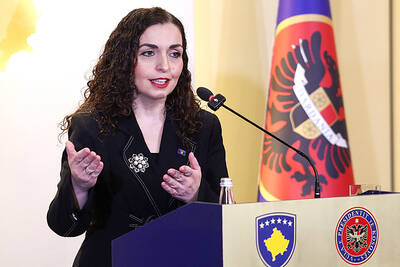
Kosovar President Vjosa Osmani on Friday after dissolving the Kosovar parliament said a snap election should be held as soon as possible to avoid another prolonged political crisis in the Balkan country at a time of global turmoil. Osmani said it is important for Kosovo to wrap up the upcoming election process and form functional institutions for political stability as the war rages in the Middle East. “Precisely because the geopolitical situation is that complex, it is important to finish this electoral process which is coming up,” she said. “It is very hard now to imagine what will happen next.” Kosovo, which declared

MORE BANS: Australia last year required sites to remove accounts held by under-16s, with a few countries pushing for similar action at an EU level and India considering its own ban Indonesia on Friday said it would ban social media access for children under 16, citing threats from online pornography, cyberbullying, online fraud and Internet addiction. “Accounts belonging to children under 16 on high-risk platforms will start to be deactivated, beginning with YouTube, TikTok, Facebook, Instagram, Threads, X, Bigo Live and Roblox,” Indonesian Minister of Communications and Digital Meutya Hafid said. “The government is stepping in so that parents no longer have to fight alone against the giants of the algorithm. Implementation will begin on March 28, 2026,” she said. The social media ban would be introduced in stages “until all platforms fulfill their
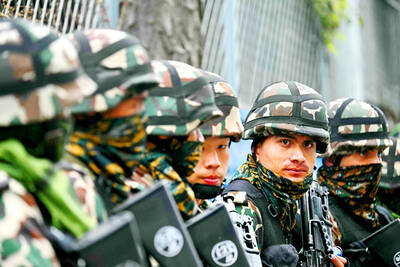
Counting was under way in Nepal yesterday, after a high-stakes parliamentary election to reshape the country’s leadership following protests last year that toppled the government. Key figures vying for power include former Nepalese prime minister K. P. Sharma Oli, rapper-turned-mayor Balendra Shah, who is bidding for the youth vote, and newly elected Nepali Congress party leader Gagan Thapa. In Kathmandu’s tea shops and city squares, people were glued to their phones, checking results as early trends flashed up — suggesting Shah’s centrist Rastriya Swatantra Party (RSP) was ahead. Nepalese Election Commission spokesman Prakash Nyupane said the counting was ongoing “in a peaceful manner”


 RSS
RSS