


Former British Prime Minister Margaret Thatcher spent the night in a London hospital for a series of medical checks and returned home yesterday.
Thatcher, her arm held by a hospital staff member, waved to photographers before ducking into a Jaguar car outside St. Thomas's Hospital in south London, where she had been taken after feeling faint. She waved again as she stepped into her central London home a few minutes later.
The 82-year-old former Conservative leader had felt unwell during dinner with friends near the House of Lords in central London, said her private secretary, Mark Worthington, and her daughter, Carol.
Carol Thatcher said her mother was hospitalized as a precaution.
"Very wisely, at her age and with a history of little strokes, they decided to err on the side of caution," she said. "But it's good news today. She is doing well."
Britain's first female prime minister, nicknamed "the Iron Lady," has appeared in public less and less frequently after doctors banned her from addressing large audiences in 2002.
She has suffered a series of minor strokes, which figures close to her say have affected her short-term memory.
A hospital spokeswoman said in a statement: "We can confirm that Baroness Thatcher has been admitted to St Thomas' Hospital and is expected to remain in hospital overnight for observation."
"Her condition is stable and she is speaking to the medical staff who are caring for her," the statement said.
A spokeswoman for the Conservative Party, which she led from 1975 to 1990, said: "We have been in touch with her office and we wish her well."
Thatcher forced through sweeping changes during her premiership between 1979 and 1990, advocating individualism and the breakdown of Britain's class system.
At home Thatcher is a divisive figure, hailed by the right, who say she revived the economy by clamping down on trade unions and crushing a major strike by northern English miners protesting pit closures in 1985.
But others accuse her of heavyhandedness and intransigence, saying her reforms helped to unpick the fabric of society, particularly in the traditional manufacturing heartlands such as northern England.
She forged a close personal and political relationship with US president Ronald Reagan in the Cold War stand-off with the Soviet Union.
Her popularity soared when she sent troops to the Falkland Islands in 1982 after Argentina's invasion and Britain secured victory in two months.
She survived a bomb planted by the Irish Republican Army during the Conservative Party's annual conference in Brighton, southern England, in 1984, which came close to killing her and her ministers.
Ultimately, though, it was her perceived inflexibility that brought her down -- her resistance to closer European ties was a key trigger to a revolt within the Conservatives, which led to John Major taking over from her in 1990.
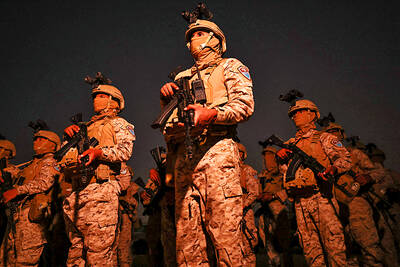
PRECARIOUS RELATIONS: Commentators in Saudi Arabia accuse the UAE of growing too bold, backing forces at odds with Saudi interests in various conflicts A Saudi Arabian media campaign targeting the United Arab Emirates (UAE) has deepened the Gulf’s worst row in years, stoking fears of a damaging fall-out in the financial heart of the Middle East. Fiery accusations of rights abuses and betrayal have circulated for weeks in state-run and social media after a brief conflict in Yemen, where Saudi airstrikes quelled an offensive by UAE-backed separatists. The United Arab Emirates is “investing in chaos and supporting secessionists” from Libya to Yemen and the Horn of Africa, Saudi Arabia’s al-Ekhbariya TV charged in a report this week. Such invective has been unheard of
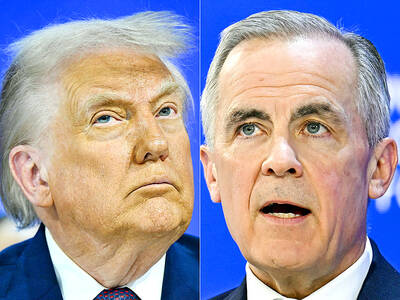
US President Donald Trump on Saturday warned Canada that if it concludes a trade deal with China, he would impose a 100 percent tariff on all goods coming over the border. Relations between the US and its northern neighbor have been rocky since Trump returned to the White House a year ago, with spats over trade and Canadian Prime Minister Mark Carney decrying a “rupture” in the US-led global order. During a visit to Beijing earlier this month, Carney hailed a “new strategic partnership” with China that resulted in a “preliminary, but landmark trade agreement” to reduce tariffs — but
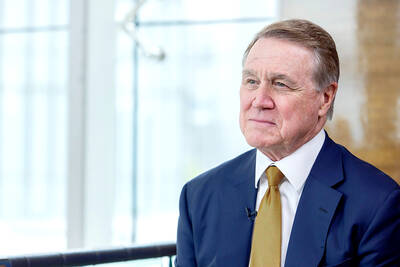
Chinese President Xi Jinping’s (習近平) purge of his most senior general is driven by his effort to both secure “total control” of his military and root out corruption, US Ambassador to China David Perdue said told Bloomberg Television yesterday. The probe into Zhang Youxia (張又俠), Xi’s second-in-command, announced over the weekend, is a “major development,” Perdue said, citing the family connections the vice chair of China’s apex military commission has with Xi. Chinese authorities said Zhang was being investigated for suspected serious discipline and law violations, without disclosing further details. “I take him at his word that there’s a corruption effort under
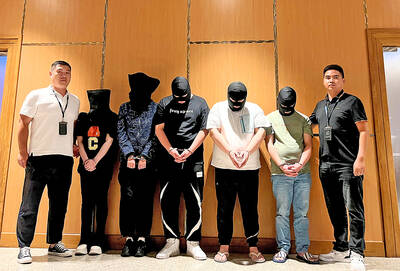
China executed 11 people linked to Myanmar criminal gangs, including “key members” of telecom scam operations, state media reported yesterday, as Beijing toughens its response to the sprawling, transnational industry. Fraud compounds where scammers lure Internet users into fake romantic relationships and cryptocurrency investments have flourished across Southeast Asia, including in Myanmar. Initially largely targeting Chinese speakers, the criminal groups behind the compounds have expanded operations into multiple languages to steal from victims around the world. Those conducting the scams are sometimes willing con artists, and other times trafficked foreign nationals forced to work. In the past few years, Beijing has stepped up cooperation


 RSS
RSS