


A Malaysian scientist says she has discovered a cheap way to turn discarded rice husks into a high-tech material that could play a key role in reducing carbon emissions, protect buildings from bomb blasts and make airplanes lighter.
Aerogel, the lightest solid known to man, was invented in 1931 by a US scientist, but its high cost has limited its use.
Halimaton Hamdan, a University of Cambridge-trained chemistry professor, says her process cuts the cost of producing aerogel by 80 percent, making it so affordable that it could become a commonplace material with widespread use.
Her process is experimental and several years away from commercial use. The Malaysian government is funding a US$62.5 million project at Halimaton's university in the southern town of Skudai to try to demonstrate that it can be produced on a large scale.
Halimaton said 100g would cost US$60 to make, compared with US$300 for conventional methods.
The greatest potential lies in coating walls of homes with aerogel, Halimaton says, which could dramatically reduce the need for both heating and air conditioning. Aerogel provides 37 times more effective insulation than traditional fiberglass, said ICE Circle, a British nonprofit group that promotes new technologies to fight climate change.
"I hope one day this product will be used by a variety of industries and benefit mankind," Halimaton said in her one-story laboratory at Universiti Teknologi Malaysia.
Scientific colleagues say her work is promising.
She "seems to have found a miracle solution" to make aerogel cheaply, said Vincent Blech, a scientist at the National Museum of Emerging Science and Innovation in Tokyo.
Dieter Freude, a physics professor at the University of Leipzig in Germany who is familiar with Halimaton's work, said it constituted "an exciting breakthrough."
Nicknamed "frozen smoke" because of its cloudy appearance, aerogel is made from silica, the basic ingredient in sand, and is 99 percent air by volume. The result is a nearly weightless and translucent material.
What makes aerogel so attractive is the combination of light weight with incredible strength and insulating properties.
Aerogel can withstand mechanical pressure 2,000 times its own weight, making it suitable for bombproof panels. Aerogel can also absorb oil spills and pollutants in the air.
Halimaton has dubbed her product "Maerogel" -- Malaysian aerogel.
At a British invention convention last year, she was discovered by ICE Circle founder Renu Mehta, who encouraged Halimaton to try to develop the product commercially.
"It should feature prominently in strategies to reduce greenhouse gas carbon emissions," Mehta said.
It took Halimaton seven years to perfect the system.
"I knew it was going to work. It was only a matter of time before I found a way to do it," she said. "As a scientist you lose sleep over a problem. You keep thinking how it can work. And at the spur of the moment, the answer comes to you."
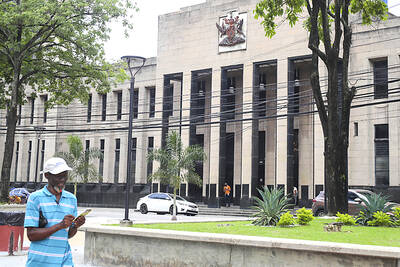
Trinidad and Tobago declared a new state of emergency on Friday after authorities accused a criminal network operating in prisons across the country of plotting to kill key government officials and attack public institutions. It is the second state of emergency to be declared in the twin-island republic in a matter of months. In December last year, authorities took similar action, citing concerns about gang violence. That state of emergency lasted until mid-April. Police said that smuggled cellphones enabled those involved in the plot to exchange encrypted messages. Months of intelligence gathering led investigators to believe the targets included senior police officers,
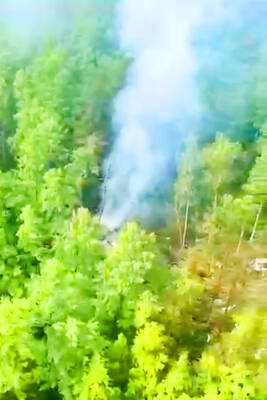
FOREST SITE: A rescue helicopter spotted the burning fuselage of the plane in a forested area, with rescue personnel saying they saw no evidence of survivors A passenger plane carrying nearly 50 people crashed yesterday in a remote spot in Russia’s far eastern region of Amur, with no immediate signs of survivors, authorities said. The aircraft, a twin-propeller Antonov-24 operated by Angara Airlines, was headed to the town of Tynda from the city of Blagoveshchensk when it disappeared from radar at about 1pm. A rescue helicopter later spotted the burning fuselage of the plane on a forested mountain slope about 16km from Tynda. Videos published by Russian investigators showed what appeared to be columns of smoke billowing from the wreckage of the plane in a dense, forested area. Rescuers in
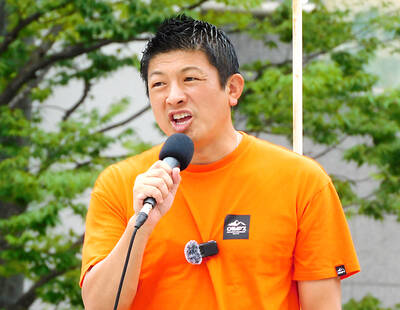
A disillusioned Japanese electorate feeling the economic pinch goes to the polls today, as a right-wing party promoting a “Japanese first” agenda gains popularity, with fears over foreigners becoming a major election issue. Birthed on YouTube during the COVID-19 pandemic, spreading conspiracy theories about vaccinations and a cabal of global elites, the Sanseito Party has widened its appeal ahead of today’s upper house vote — railing against immigration and dragging rhetoric that was once confined to Japan’s political fringes into the mainstream. Polls show the party might only secure 10 to 15 of the 125 seats up for grabs, but it is

Philippine President Ferdinand Marcos Jr is to meet US President Donald Trump this week, hoping Manila’s status as a key Asian ally would secure a more favorable trade deal before the deadline on Friday next week. Marcos would be the first Southeast Asian leader to meet Trump in his second term. Trump has already struck trade deals with two of Manila’s regional partners, Vietnam and Indonesia, driving tough bargains in trade talks even with close allies that Washington needs to keep onside in its strategic rivalry with China. “I expect our discussions to focus on security and defense, of course, but also


 RSS
RSS