


Former Khmer Rouge leader Ieng Sary, one of five top cadres facing Cambodia's genocide tribunal, remained hospitalized yesterday after being rushed from prison the day before, court officials said.
The regime's 82-year-old former foreign minister, who is charged with war crimes and crimes against humanity, was hospitalized on Monday after he began urinating blood, said Ang Udom, his lawyer.
The emergency was just the latest in a series of health scares suffered by possible tribunal defendants -- all of whom are elderly and frail -- and again raised fears that death could come before the trials for those accused of of past atrocities.
"All five defendants are old. They have spent years living in the jungle," said Reach Sambath, spokesman for the UN-backed tribunal, adding that Ieng Sary's condition was improving but that he was still in hospital.
"The doctors are very serious about their health, especially Ieng Sary ... of the five, he is the biggest cause for concern," he said.
It was Ieng Sary's second time being hospitalized in as many weeks. He was brought in for medical attention late last month due to a chronic heart problem, Reach Sambath said earlier.
His lawyer has said that Ieng Sary's health has deteriorated since his arrest in November. Tribunal judges have also been sometimes forced to halt interviews with another suspect, Nuon Chea, because of health concerns.
Up to 2 million people died of starvation and overwork, or were executed during the 1975 to 1979 rule of the Khmer Rouge, which dismantled modern Cambodian society in its effort to forge a radical agrarian utopia.

PRECARIOUS RELATIONS: Commentators in Saudi Arabia accuse the UAE of growing too bold, backing forces at odds with Saudi interests in various conflicts A Saudi Arabian media campaign targeting the United Arab Emirates (UAE) has deepened the Gulf’s worst row in years, stoking fears of a damaging fall-out in the financial heart of the Middle East. Fiery accusations of rights abuses and betrayal have circulated for weeks in state-run and social media after a brief conflict in Yemen, where Saudi airstrikes quelled an offensive by UAE-backed separatists. The United Arab Emirates is “investing in chaos and supporting secessionists” from Libya to Yemen and the Horn of Africa, Saudi Arabia’s al-Ekhbariya TV charged in a report this week. Such invective has been unheard of

US President Donald Trump on Saturday warned Canada that if it concludes a trade deal with China, he would impose a 100 percent tariff on all goods coming over the border. Relations between the US and its northern neighbor have been rocky since Trump returned to the White House a year ago, with spats over trade and Canadian Prime Minister Mark Carney decrying a “rupture” in the US-led global order. During a visit to Beijing earlier this month, Carney hailed a “new strategic partnership” with China that resulted in a “preliminary, but landmark trade agreement” to reduce tariffs — but

Chinese President Xi Jinping’s (習近平) purge of his most senior general is driven by his effort to both secure “total control” of his military and root out corruption, US Ambassador to China David Perdue said told Bloomberg Television yesterday. The probe into Zhang Youxia (張又俠), Xi’s second-in-command, announced over the weekend, is a “major development,” Perdue said, citing the family connections the vice chair of China’s apex military commission has with Xi. Chinese authorities said Zhang was being investigated for suspected serious discipline and law violations, without disclosing further details. “I take him at his word that there’s a corruption effort under
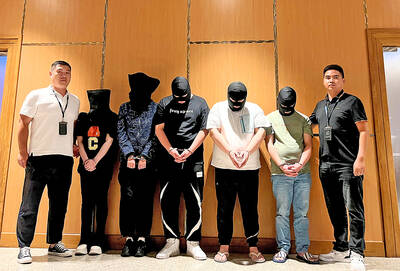
China executed 11 people linked to Myanmar criminal gangs, including “key members” of telecom scam operations, state media reported yesterday, as Beijing toughens its response to the sprawling, transnational industry. Fraud compounds where scammers lure Internet users into fake romantic relationships and cryptocurrency investments have flourished across Southeast Asia, including in Myanmar. Initially largely targeting Chinese speakers, the criminal groups behind the compounds have expanded operations into multiple languages to steal from victims around the world. Those conducting the scams are sometimes willing con artists, and other times trafficked foreign nationals forced to work. In the past few years, Beijing has stepped up cooperation


 RSS
RSS