


A candy bar, a wallet, even a pair of baggy pants can draw deadly police gunfire.
The killing of a hairbrush-brandishing teenager last week was the latest instance of police shootings in which officers reacted to what they erroneously feared was a weapon. It has revived debate over the use of force, perceptions of threats and police training.
"We have cases like that all over the country where it can be a wallet, a cellphone, a can of Coca-Cola and officers have fired the weapon," said Scott Greenwood, a Cincinnati attorney who has worked on police use-of-force cases across the country and who is a general counsel for the American Civil Liberties Union.
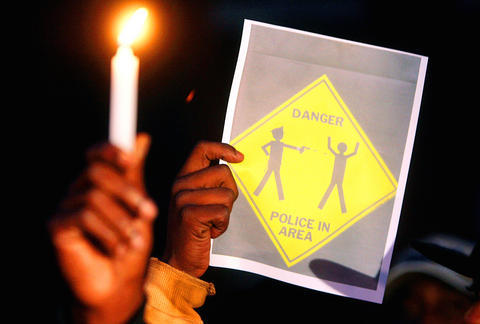
PHOTO: AP
"It does not necessarily mean it was excessive use of force," he said. "However, those types of incidents do give rise to greater suspicion on the part of the public about how police use force and they call into question the training departments are using to train officers to perceive and respond to threats."
The New York Police Department (NYPD) says the officers who fired 20 shots at 18-year-old Khiel Coppin on Nov. 12 were justified in their use of force. The mentally ill teenager approached officers outside his mother's home with a black object in his hand -- the hairbrush -- and ignored orders to stop.
The officers were responding to an emergency call in which Coppin could be heard in the background saying he had a gun. But in a second emergency call Coppin's mother told the operator her son was not armed, and after officers arrived she repeated that to them.
"Why did the police not heed the warnings ... that her son was unarmed?" said Paul Wooten, the family's attorney. "Why was it necessary for the overwhelming use of deadly force? Five police officers, 20 shots, eight hits. Is there no proportionality?"
Last year, NYPD officers fired 50 bullets at three unarmed men in a car, killing Sean Bell on his wedding day and seriously wounding his two friends. Three officers are scheduled for trial in February.
In 1999, four New York City undercover officers fired 41 shots at West African immigrant Amadou Diallo, striking him 19 times, when the 22-year-old man reached for his wallet while standing in an apartment building vestibule. The officers said they thought Diallo was reaching for a gun.
The 2001 Cincinnati police killing of Timothy Thomas -- the 15th black resident to die at police hands since 1995 -- led to the city's worst civil unrest since the assassination of Martin Luther King. Thomas was unarmed, but was reaching to pull up his baggy pants while he was being chased.
In that case, as in other police shootings, the officer who fired said his actions were triggered by fear for his own safety.
At least 64 US law enforcement officers have been killed by gunshots this year, according to the National Law Enforcement Memorial Fund.
Andre Burgess was walking down a New York street in 1997 when an undercover federal agent shot him in the thigh, saying he thought the foil-wrapped Three Musketeers candy bar in his hand was a gun.
Violent confrontations between police and suspects occur daily in big cities, and officers must often make snap judgments on the use of force.
On Sunday, officers in the New York City borough of Brooklyn shot two people who they believed were dangerous; one was a suspect in a stabbing who police said advanced on officers with a broken bottle.
"Just because a subject has something unidentifiable in his or her hands, that's never an automatic justification for the use of deadly force," Greenwood said.
However, "If someone is carrying around a toy pistol we don't expect the police to know it's a toy," he said.
Despite the Bell and Coppin deaths, police officials say that statistics show the NYPD has become more restrained: Officers fired 540 shots last year, down 13 percent from 616 in 2005. In 1996, the total was 1,292. So far this year, members of the 36,000-officer department have killed 10 people. Last year, the total was 13 people, up from nine in 2005, and in 1996 it was 30.

Kouri Richins, a Utah mother who published a children’s book about grief after the death of her husband is to serve a life sentence for his murder without the possibility of parole, a judge ruled on Wednesday. Richins was convicted in March of aggravated murder for lacing a cocktail given to her husband, Eric Richins, with five times the lethal dose of fentanyl at their home near Park City in 2022. A jury also found her guilty of four other felonies, including insurance fraud, forgery and attempted murder for trying to poison her husband weeks earlier on Feb. 14, 2022, with a
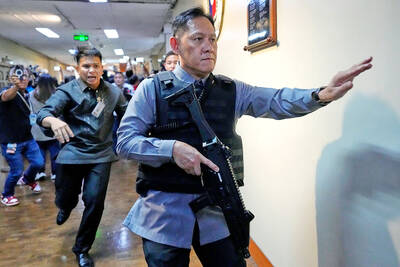
DELA ROSA CASE: The whereabouts of the senator, who is wanted by the ICC, was unclear, while President Marcos faces a political test over the senate situation Philippine authorities yesterday were seeking confirmation of reports that a top politician wanted by the International Criminal Court (ICC) had fled, a day after gunfire rang out at the Philippine Senate where he had taken refuge fearing his arrest. Senator Ronald “Bato” dela Rosa, the former national police chief and top enforcer of former Philippine president Rodrigo Duterte’s “war on drugs,” has been under Senate protection and is wanted for crimes against humanity, the same charges Duterte is accused of. “Several sources confirmed that the senator, Senator Bato, is no longer in the Senate premises, but we are still getting confirmation,” Presidential
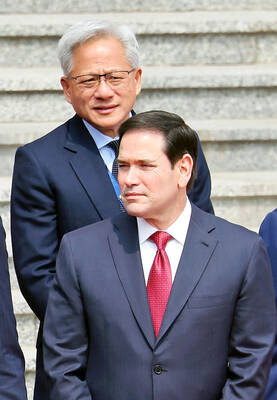
HELP DENIED? The US Department of State said that the Cuban leadership refuses to allow the US to provide aid to Cubans, ‘who are in desperate need of assistance’ US Secretary of State Marco Rubio on Wednesday said that Cuba’s leadership must change, as Washington renewed an offer of US$100 million in aid if the communist nation agrees to cooperate. Cuba has been suffering severe economic tumult led by an energy shortage that plunged 65 percent of the country into darkness on Tuesday. Cuba’s leaders have blamed US sanctions, but Rubio, a Cuban American and critic of the government established by Fidel Castro, said the system was to blame, including corruption by the military. “It’s a broken, nonfunctional economy, and it’s impossible to change it. I wish it were different,” he told
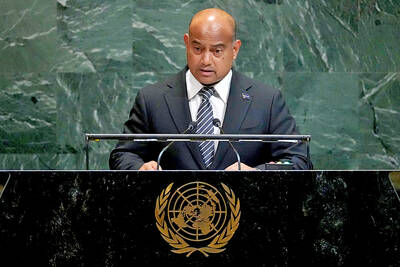
Nauru said it would hold a referendum to change its official name, described as a colonial relic from a time when “foreign tongues” mangled the native language. Nauru would change its name to Naoero to “more faithfully honor our nation’s heritage, our language and our identity,” Nauruan President David Adeang said in a statement on Tuesday. The Pacific island nation’s native language is Dorerin Naoero, which is spoken by the vast majority of its approximately 10,000 inhabitants. “Nauru emerged because Naoero could not be properly pronounced by foreign tongues, and was changed not by our choice, but for convenience,” the government said in


 RSS
RSS