


North Korea is cooperating well with US experts in disabling its nuclear program, US Secretary of State Condoleezza Rice and her South Korean counterpart said on Wednesday.
"So far, so good, I would say," Rice told reporters, flanked by South Korean Foreign Minister Song Min-soon.
"The reports from the experts in the field is that the cooperation is going well," she said in her first remarks on the subject since the operation began on Monday at the Yongbyon complex.
Song added that the disablement process "was going in the right direction" but stressed the importance of moving from the disablement phase to dismantlement.
`COOPERATIVE'
US State Department official Sung Kim, who heads the nine-strong team overseeing the operation, on Tuesday described the North as having been "very cooperative."
He added: "I think we are off to a good start. I hope to achieve all the disablement, at least this phase of disablement, by December 31."
The North's action to roll back its atomic program, after half a century of research and development, follows a February six-nation accord under which it will receive major aid and diplomatic benefits for full denuclearization.
YONGBYON
A disablement priority is the reactor at Yongbyon, the source of the plutonium used in the communist state's nuclear test in october last year. Kim said there had also been some work at the other two main facilities, a reprocessing plant and a fuel fabrication plant.
The North shut down the reactor in July. Disablement, scheduled for completion by year-end, aims to make it and other facilities unusable for at least a year while talks on total denuclearization continue.
Pyongyang will receive energy aid worth hundreds of millions of dollars in return for disablement and a full declaration of all its nuclear programs, including a suspected highly enriched uranium project.
If the North goes on next year to dismantle the plants and give up its plutonium stockpile and nuclear weapons, it can expect normalized relations with Washington and a peace pact to replace the 1950-1953 Korean War armistice.
A US envoy also urged South Korea to take into account human rights abuses in North Korea in its diplomacy with the communist neighbor as Pyongyang disables its nuclear arsenal, according to the transcript of a speech released in Washington on Wednesday.
Seoul, which pursues a "sunshine policy" of engagement with Pyongyang, for the first time last year voted for a UN resolution condemning the North's rights abuses, a move which angered the communist regime.
"This was a key development, and we hope South Korea will continue to take into account issues of human rights and governance when formulating policy toward its neighbor," deputy US special envoy for human rights in North Korea Christian Whiton said.
CONCERN
Last year's UN resolution, which passed 91-21 with 60 abstentions, expressed serious concern at reports of "torture, public executions, extrajudicial and arbitrary detention, the absence of due process and the rule of law, the imposition of the death penalty for political reasons, the existence of a large number of prison camps and the extensive use of forced labor" in North Korea.
Pyongyang called South Korea's support for the resolution "treacherous" and warned that ties could be strained.
"With North Korea, there is so much attention paid to the nuclear issue that often human rights gets only a passing mention," Whiton said in remarks at the Transatlantic Institute in Brussels on Tuesday.
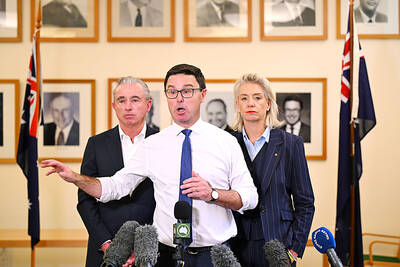
BACKLASH: The National Party quit its decades-long partnership with the Liberal Party after their election loss to center-left Labor, which won a historic third term Australia’s National Party has split from its conservative coalition partner of more than 60 years, the Liberal Party, citing policy differences over renewable energy and after a resounding loss at a national election this month. “Its time to have a break,” Nationals leader David Littleproud told reporters yesterday. The split shows the pressure on Australia’s conservative parties after Prime Minister Anthony Albanese’s center-left Labor party won a historic second term in the May 3 election, powered by a voter backlash against US President Donald Trump’s policies. Under the long-standing partnership in state and federal politics, the Liberal and National coalition had shared power
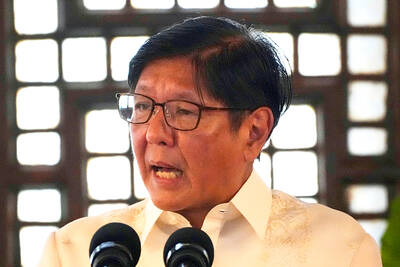
NO EXCUSES: Marcos said his administration was acting on voters’ demands, but an academic said the move was emotionally motivated after a poor midterm showing Philippine President Ferdinand Marcos Jr yesterday sought the resignation of all his Cabinet secretaries, in a move seen as an attempt to reset the political agenda and assert his authority over the second half of his single six-year term. The order came after the president’s allies failed to win a majority of Senate seats contested in the 12 polls on Monday last week, leaving Marcos facing a divided political and legislative landscape that could thwart his attempts to have an ally succeed him in 2028. “He’s talking to the people, trying to salvage whatever political capital he has left. I think it’s

CONTROVERSY: During the performance of Israel’s entrant Yuval Raphael’s song ‘New Day Will Rise,’ loud whistles were heard and two people tried to get on stage Austria’s JJ yesterday won the Eurovision Song Contest, with his operatic song Wasted Love triumphing at the world’s biggest live music television event. After votes from national juries around Europe and viewers from across the continent and beyond, JJ gave Austria its first victory since bearded drag performer Conchita Wurst’s 2014 triumph. After the nail-biting drama as the votes were revealed running into yesterday morning, Austria finished with 436 points, ahead of Israel — whose participation drew protests — on 357 and Estonia on 356. “Thank you to you, Europe, for making my dreams come true,” 24-year-old countertenor JJ, whose

Polish presidential candidates offered different visions of Poland and its relations with Ukraine in a televised debate ahead of next week’s run-off, which remains on a knife-edge. During a head-to-head debate lasting two hours, centrist Warsaw Mayor Rafal Trzaskowski, from Polish Prime Minister Donald Tusk’s governing pro-European coalition, faced the Eurosceptic historian Karol Nawrocki, backed by the right-wing populist Law and Justice party (PiS). The two candidates, who qualified for the second round after coming in the top two places in the first vote on Sunday last week, clashed over Poland’s relations with Ukraine, EU policy and the track records of their


 RSS
RSS