


AFP, BAIDOA, Somalia
Somali Prime Minister Ali Mohamed Gedi resigned yesterday following a long-running feud with the president, who accused him of failing to deal effectively with a violent Islamist insurgency in the capital.
Gedi personally handed his resignation to President Abdullahi Ahmed Yusuf, a top presidential aide said on condition of anonymity.
"The two of them discussed the future of the nation for a while" at the president's office in Baidoa, a town which houses parliament and is located some 250km from the capital Mogadishu, the aide said.
Gedi had been expected to resign in a speech to a special session of parliament later yesterday.
"The whole idea is to pave the way for the smooth running of a new government," said one official from Gedi's office. "Gedi does not want to become a liability."
Gedi, 55, took the helm of the transitional federal government in November 2004 but has often been at loggerheads with Yusuf, with both men coming from Somalia's two main, rival clans.
"The prime minister and the president, with the help of friendly countries, have reached a deal to end the political confusion," a close aide to Yusuf said.
Yusuf had been pushing parliament to oust Gedi for failing to end the Islamist-led insurgency in Mogadishu, draft a new constitution and bolster the nation's federal government.
Gedi arrived in Baidoa yesterday after spending several days holed up at the Sheraton hotel in Addis Ababa, apparently in last-ditch consultations to save his job.
Critics blame him for being behind the decision to invite Ethiopian forces into Somalia to help rescue the struggling interim government in its battle against an Islamist militia.
The Islamist administration, which had controlled large parts of the country, was defeated earlier this year, and remnants of the movement and tribal allies have waged a guerrilla conflict in the capital Mogadishu.
One of main sources of opposition to Gedi's government has come from his own Hawiye clan, which is dominant in Mogadishu and is the largest in the country.
Yusuf is from what has now become the breakaway northern state of Puntland and comes from the rival Darod clan, the country's second largest.
"We are in a system where there are no longer any institutional rules ... and serious shortcomings in the transitional charter," a senior official from Gedi's office said on condition of anonymity.
"The premier wants a democratic, secular and transparent state ... Now we're headed towards a ... state run by a predatory family," the official said.
The nation of 10 million has lacked an effective government since the 1991 ouster of dictator Mohamed Siad Barre touched off a fierce internal conflict that has defied more than a dozen peace initiatives.
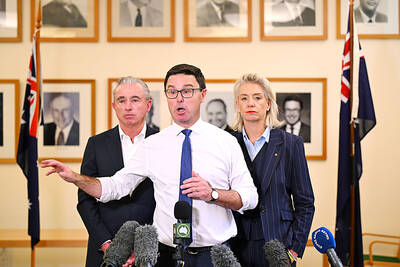
BACKLASH: The National Party quit its decades-long partnership with the Liberal Party after their election loss to center-left Labor, which won a historic third term Australia’s National Party has split from its conservative coalition partner of more than 60 years, the Liberal Party, citing policy differences over renewable energy and after a resounding loss at a national election this month. “Its time to have a break,” Nationals leader David Littleproud told reporters yesterday. The split shows the pressure on Australia’s conservative parties after Prime Minister Anthony Albanese’s center-left Labor party won a historic second term in the May 3 election, powered by a voter backlash against US President Donald Trump’s policies. Under the long-standing partnership in state and federal politics, the Liberal and National coalition had shared power

NO EXCUSES: Marcos said his administration was acting on voters’ demands, but an academic said the move was emotionally motivated after a poor midterm showing Philippine President Ferdinand Marcos Jr yesterday sought the resignation of all his Cabinet secretaries, in a move seen as an attempt to reset the political agenda and assert his authority over the second half of his single six-year term. The order came after the president’s allies failed to win a majority of Senate seats contested in the 12 polls on Monday last week, leaving Marcos facing a divided political and legislative landscape that could thwart his attempts to have an ally succeed him in 2028. “He’s talking to the people, trying to salvage whatever political capital he has left. I think it’s

CONTROVERSY: During the performance of Israel’s entrant Yuval Raphael’s song ‘New Day Will Rise,’ loud whistles were heard and two people tried to get on stage Austria’s JJ yesterday won the Eurovision Song Contest, with his operatic song Wasted Love triumphing at the world’s biggest live music television event. After votes from national juries around Europe and viewers from across the continent and beyond, JJ gave Austria its first victory since bearded drag performer Conchita Wurst’s 2014 triumph. After the nail-biting drama as the votes were revealed running into yesterday morning, Austria finished with 436 points, ahead of Israel — whose participation drew protests — on 357 and Estonia on 356. “Thank you to you, Europe, for making my dreams come true,” 24-year-old countertenor JJ, whose

UNSCHEDULED VISIT: ‘It’s a very bulky new neighbor, but it will soon go away,’ said Johan Helberg of the 135m container ship that run aground near his house A man in Norway awoke early on Thursday to discover a huge container ship had run aground a stone’s throw from his fjord-side house — and he had slept through the commotion. For an as-yet unknown reason, the 135m NCL Salten sailed up onto shore just meters from Johan Helberg’s house in a fjord near Trondheim in central Norway. Helberg only discovered the unexpected visitor when a panicked neighbor who had rung his doorbell repeatedly to no avail gave up and called him on the phone. “The doorbell rang at a time of day when I don’t like to open,” Helberg told television


 RSS
RSS