


Russian President Vladimir Putin showed up late, but brought flowers for German Chancellor Angela Merkel at a meeting where the two were to deal with tough issues, such as more sanctions against Iran over its nuclear program and independence for Kosovo.
Putin showed up more than two hours behind schedule on Sunday night after being delayed by bad weather in Moscow and got a warm greeting from Merkel at a restaurant in Hattenheim outside Wiesbaden in southwest Germany.
"We are glad that the president is here. It snowed in Moscow and here there are clear starry skies," Merkel said.
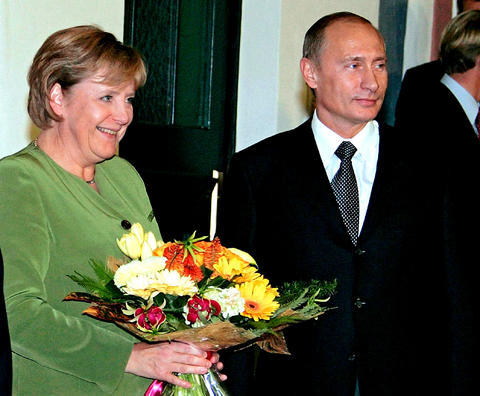
PHOTO: AP
The two were to address a Russian-German forum in Wiesbaden's historic Kurhaus resort yesterday.
One major topic on the agenda is what Merkel in her Saturday podcast stressed as "the necessity of new sanctions" against Iran -- a source of potential friction with Russia, which is skeptical about efforts in the UN Security Council to impose a third set of sanctions against Tehran for its refusal to halt its uranium enrichment program.
Putin is then scheduled to head for Iran, which has defied the US and other governments over the issue. Last week, the Russian leader said he saw no "objective data" proving that Iran is pursuing nuclear weapons.
In Moscow, a Kremlin spokeswoman said on Sunday that Putin had been told of a plot to assassinate him during his visit to Iran this week. The spokeswoman, who spoke on condition of anonymity, refused further comment.
Interfax news agency, citing a source in Russia's security services, said suicide terrorists had been trained to carry out the assassination. Mohammad Ali Hosseini, a spokesman for Iran's foreign ministry, denied any such plot had been uncovered, and he characterized the news as disinformation spread by adversaries hoping to spoil Russian-Iranian relations.
Merkel and Putin held a Russia-EU summit earlier this year that ended on a sour note after Russian authorities prevented opposition leader Garry Kasparov from traveling to Samara, Russia, for a protest rally near the summit site. Putin said Russia and Europe were partners "like it or not.''
The Wiesbaden meeting is rife with potential for similar friction, taking place against the background of the campaign for December parliamentary elections in Russia and speculation about Putin's role in politics after his second presidential term ends next year. His assertive stance toward the West has helped boost his popularity at home.
Merkel must balance needing Russia as a key oil and gas supplier and partner on foreign policy questions such as Iran and Kosovo against European dismay at Russia's human-rights record. Russian officials have said they will raise their opposition to US plans to place 10 interceptor missiles in Poland to counter possible missile attacks from Iran.
Russia opposes plans by Western countries to give Kosovo independence from Serbia, its traditional ally. The province, where the population is 90 percent ethnic Albanian, has been under UN administration since a 1999 NATO-led air war to end a Serbian crackdown on ethnic Albanian rebels.
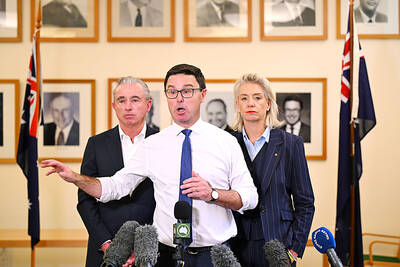
BACKLASH: The National Party quit its decades-long partnership with the Liberal Party after their election loss to center-left Labor, which won a historic third term Australia’s National Party has split from its conservative coalition partner of more than 60 years, the Liberal Party, citing policy differences over renewable energy and after a resounding loss at a national election this month. “Its time to have a break,” Nationals leader David Littleproud told reporters yesterday. The split shows the pressure on Australia’s conservative parties after Prime Minister Anthony Albanese’s center-left Labor party won a historic second term in the May 3 election, powered by a voter backlash against US President Donald Trump’s policies. Under the long-standing partnership in state and federal politics, the Liberal and National coalition had shared power
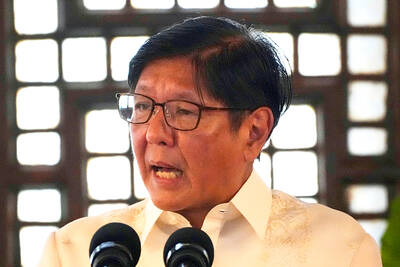
NO EXCUSES: Marcos said his administration was acting on voters’ demands, but an academic said the move was emotionally motivated after a poor midterm showing Philippine President Ferdinand Marcos Jr yesterday sought the resignation of all his Cabinet secretaries, in a move seen as an attempt to reset the political agenda and assert his authority over the second half of his single six-year term. The order came after the president’s allies failed to win a majority of Senate seats contested in the 12 polls on Monday last week, leaving Marcos facing a divided political and legislative landscape that could thwart his attempts to have an ally succeed him in 2028. “He’s talking to the people, trying to salvage whatever political capital he has left. I think it’s
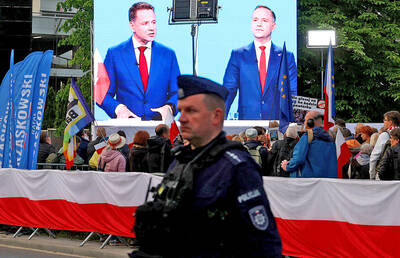
Polish presidential candidates offered different visions of Poland and its relations with Ukraine in a televised debate ahead of next week’s run-off, which remains on a knife-edge. During a head-to-head debate lasting two hours, centrist Warsaw Mayor Rafal Trzaskowski, from Polish Prime Minister Donald Tusk’s governing pro-European coalition, faced the Eurosceptic historian Karol Nawrocki, backed by the right-wing populist Law and Justice party (PiS). The two candidates, who qualified for the second round after coming in the top two places in the first vote on Sunday last week, clashed over Poland’s relations with Ukraine, EU policy and the track records of their
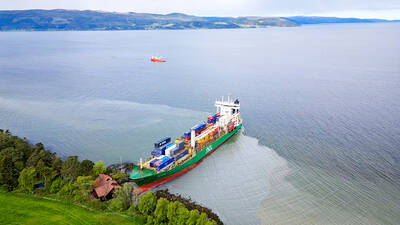
UNSCHEDULED VISIT: ‘It’s a very bulky new neighbor, but it will soon go away,’ said Johan Helberg of the 135m container ship that run aground near his house A man in Norway awoke early on Thursday to discover a huge container ship had run aground a stone’s throw from his fjord-side house — and he had slept through the commotion. For an as-yet unknown reason, the 135m NCL Salten sailed up onto shore just meters from Johan Helberg’s house in a fjord near Trondheim in central Norway. Helberg only discovered the unexpected visitor when a panicked neighbor who had rung his doorbell repeatedly to no avail gave up and called him on the phone. “The doorbell rang at a time of day when I don’t like to open,” Helberg told television


 RSS
RSS