


Before they leave for Iraq, thousands of troops with the 101st Airborne Division line up at laptop computers to take a test: basic math, matching numbers and symbols, and identifying patterns. They press a button quickly to measure response time.
It is all part of a fledgling army program that records how soldiers' brains work when healthy, giving doctors baseline data to help diagnose and treat the soldiers if they suffer a traumatic brain injury -- the signature injury of the Iraq war.
"This allows the army to be much more proactive," said Lieutenant Colonel Mark McGrail, division surgeon for the 101st. "We don't want to wait until the soldier is getting out of the army to say, `But I've had these symptoms.'"
The mandatory brain-function tests are starting with the 101st at Fort Campbell and are expected to spread to other military bases in the next couple of months. Commanders at each base will decide whether to adopt the program.
The tests provide a standard, objective measurement for each soldier's reaction time, their short-term memory and other cognitive skills. That data would be used when the soldiers come home to identify mild brain trauma that can often go unnoticed and untreated.
One group wants to ensure the army does not use the results to deny treatment by claiming that soldiers' problems came from pre-existing conditions.
"We certainly think these tests should not be used to reduce the responsibility that the army has to treat the soldiers who have served," said Jason Forrester, director of policy for Veterans for America.
About 7,500 Fort Campbell soldiers have completed the tests, said Robert Schlegel, a University of Oklahoma researcher who administers the 10-minute exams to soldiers as they file quickly through a testing center.
One question asks soldiers to memorize patterns on the screen and then identify them later among several different patterns. Other questions require soldiers to match numbers and symbols, or complete simple addition and subtraction problems.
"Everybody functions a bit differently in terms of how quickly they react to things, how well they process things and remember things and so forth," Schlegel said.
Brain injuries caused by explosions have become some of the most common combat wounds suffered in Iraq. Thirty percent of soldiers taken to Walter Reed Army Medical Center since 2003 suffered traumatic brain injuries, according to the Defense and Veterans Brain Injury Center.
The brain-injury center, which has seven facilities around the country, has seen 2,669 patients between 2003 and this year. But doctors believe many less obvious brain-injury cases go undetected.
Sergeant Adam Wyatt, 22, has been close to 20 to 30 blasts from homemade bombs, rocket-propelled grenades or mortar fire during his last two deployments. But he's never been directly hit.
"The initial shock is a little disorienting," Wyatt said. "Your first thought is seeing if anyone is wounded and suppressing enemy fire."

Through the noise of rushing papers and whirring belts at a print factory in Kyoto, two creators watch their photo essay come to life in broadsheet form — part of an effort to win new audiences in the age of artificial intelligence (AI). Despite the decline of the publishing industry, self-publication and handmade “zine” magazines are growing in popularity in Japan, reflecting the nation’s enduring love of paper in the digital era. While speaking to Agence France-Presse at the plant, his hands black with ink, one of the creators, Kazuma Obara, said: “I think [paper] is a medium that engages all five
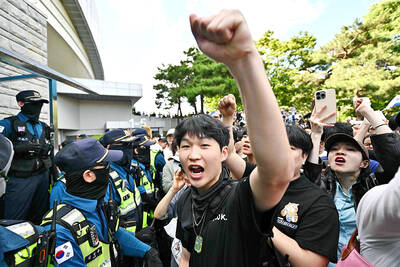
‘ABSURD MISTAKE’: The election commission said that there had been a failure to anticipate turnout after 14 polling stations ran short of ballot papers South Korean riot police yesterday cleared protesters from a Seoul polling station after a 35-hour blockade sparked by a shortage of ballot papers during local elections earlier this week. Wednesday’s election was the first nationwide vote since South Korean President Lee Jae-myung took office following the ouster of Yoon Suk-yeol over his short-lived martial law declaration. Lee’s ruling Democratic Party swept most races, but failed to flip the crucial Seoul mayoral seat. The South Korean National Election Commission apologized, blaming a failure to anticipate turnout after 14 polling stations in Seoul ran short of ballot papers. Some polling stations stayed open until 10pm to

Australian researchers have trained lab-grown brain cells on a silicon computer chip to play the 1990s shooter game Doom and said they are just scratching the surface of what the neurons could be capable of doing. It is the science-fiction work of biotech boffins at Cortical Labs, who researched and developed the technology that harnesses the workings of the brain’s networking system. Each so-called “biological computer” contains about 200,000 living human brain cells, grown from stem cells that were harvested from blood donations. Having mastered the simple computer game Pong, where a paddle is moved up and down to send a ball

France experienced its hottest spring on record, the French weather service said on Tuesday, after an exceptional early heat wave that also broke highs for the season in England and Wales. Meteo-France said the average nationwide temperature over March to May was 13.8°C — about 1.7°C above the norm, and surpassing records set in 2011 and 2020. “The warmest spring since records began in 1900,” it said in a bulletin. All three months were warmer than average, but the onset of an “unprecedented heatwave” late last month pushed the mercury to highs typically seen at the height of the summer. “Our country had never


 RSS
RSS