


An Afghan police officer leaned over a tray laden with pistachios and cubes of chilled watermelon to make his point to NATO's supreme commander.
"The enemy are attacking with machine guns and rocket launchers and we can reply only with rifles," Colonel Sayad Yakub Khan said. "We don't have the capacity to respond."
Even in relatively prosperous parts of Afghanistan spared the worst of the violence that has curbed economic development, the mission to reconstruct the war-shattered country faces a raft of problems nearly six years after the Taliban regime were toppled.
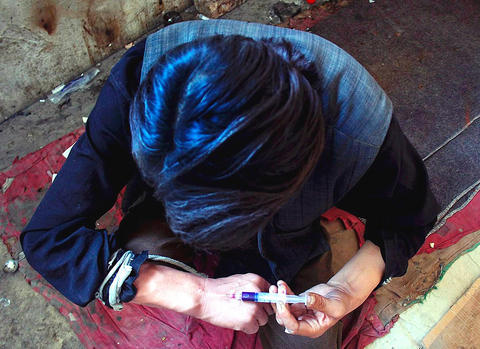
PHOTO: EPA
NATO chiefs report progress in combating a resurgent Taliban, yet an ineffective Afghan police force, spiraling drugs production and criticism of the military alliance over rising civilian deaths all present major headaches to the Western-backed mission to stabilize the country.
"It's like three-dimensional chess in a dark room and you have gloves on," is how General John Craddock -- the commander of all NATO operations, including the 40,000 allied troops in Afghanistan -- described NATO's task during a visit to the country last week.
The discontented Afghan police officer was speaking in northwestern Faryab Province, which borders Turkmenistan and is relatively peaceful and prosperous, far from the Taliban's heartlands in the south where NATO units clash daily with the insurgents.
Local officials praise NATO troops for helping open schools, pave roads and boosting the local economy. Yet recent months have seen a resurgence of attacks by insurgents infiltrating from the south. Targets include police posts, alliance troops and local civilians working with international development efforts, officials said.
Craddock said that NATO would stand by the local authorities and told Khan he pressed allied governments to provide more equipment to the Afghan army and police.
Getting more NATO training teams to embed with the Afghan army was his top priority, Craddock said.
Insurgent violence in Afghanistan is at its highest level since US forces invaded the country in 2001 to oust the hard-line Islamic Taliban rulers, who harbored al-Qaeda leaders blamed for planning the attacks in the US on Sept. 11, 2001.
The focus of the violence has been in the southern and eastern provinces, but the insurgents are increasingly using Iraq-style tactics, such as roadside bombs, suicide attacks and kidnappings to hit foreign and Afghan targets around the country. In May, a Finnish soldier was killed and four Norwegians injured in normally quiet Maymana.
Craddock acknowledged NATO was caught by surprise by the strength of Taliban resistance since his troops moved into the south a year ago.
"When we took over the south I don't think that NATO, or the coalition, realized the extent of the Taliban resurgence there," he said. "There weren't many [international] forces there. That became a safe haven. NATO moved in, stirred up a hornets' nest and we're still feeling that."
He says NATO troops -- mostly from Britain, Canada, the US and the Netherlands -- are making progress, thwarting Taliban attempts to seize control of significant territory in the south.
However, commanders on the ground in southern Afghanistan complain that they can chase the Taliban out of particular districts but sometimes don't have the manpower to hold the ground.
The number of NATO troops has doubled over the past year, but that was largely because several thousand US forces already in Afghanistan were transferred to NATO command.
Several NATO nations including Spain, Turkey and Germany refuse to send troops to the southern battlefields.
Speaking privately in Kabul, several senior officials complained about shortages of troops and equipment.
One British official based in Kandahar said there was a "dire need" for more helicopters.
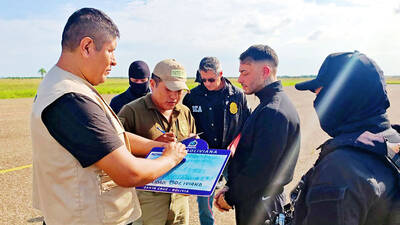
KINGPIN: Marset allegedly laundered the proceeds of his drug enterprise by purchasing and sponsoring professional soccer teams and even put himself in the starting lineups Notorious Latin American narco trafficker Sebastian Marset, who eluded police for years, was handed over to US authorities after his arrest on Friday in Bolivia. Marset, a Uruguayan national who was on the US most-wanted list, was passed to agents of the US Drug Enforcement Administration at Santa Cruz airport in Bolivia, then put on a US airplane, Bolivian state television showed. “The arrest and deportation were carried out pursuant to a court order issued by the US justice system,” Bolivian Minister of Government Marco Antonio Oviedo told reporters. The alleged kingpin was arrested in an upscale neighborhood of Santa
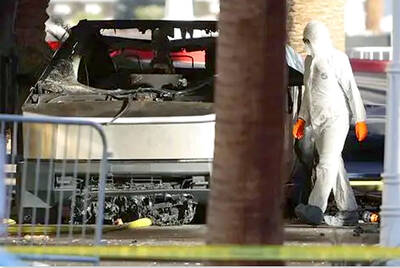
ACTIONABLE ADVICE: The majority of chatbots tested provided guidance on weapons, tactics and target selections, with Perplexity and Meta AI deemed to be the least safe From school shootings to synagogue bombings, leading artificial intelligence (AI) chatbots helped researchers plot violent attacks, according to a study published on Wednesday that highlighted the technology’s potential for real-world harm. Researchers from the nonprofit watchdog Center for Countering Digital Hate and CNN posed as 13-year-old boys in the US and Ireland to test 10 chatbots, including ChatGPT, Google Gemini, Perplexity, Deepseek and Meta AI. Eight of the chatbots assisted the make-believe attackers in more than half the responses, providing advice on “locations to target” and “weapons to use” in an attack, the study said. The chatbots had become a “powerful accelerant for
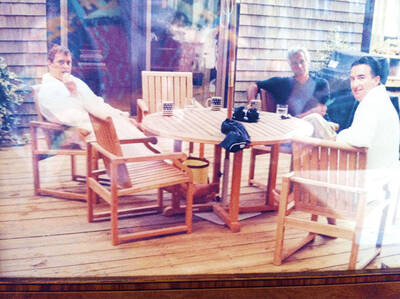
SCANDAL: Other images discovered earlier show Andrew bent over a female and lying across the laps of a number of women, while Mandelson is pictured in his underpants A photograph of former British prince Andrew and veteran politician Peter Mandelson sitting in bathrobes alongside late sex offender Jeffrey Epstein was unearthed on Friday in previously published documents. The image is believed to be the first known photograph of the two men with Epstein. They are currently engulfed in scandal in the UK over their ties to their mutual friend. The undated photograph, first reported by ITV News, shows King Charles III’s disgraced brother and former British ambassador to the US sitting barefoot outside on a wooden deck. They appear to have mugs with a US flag on them
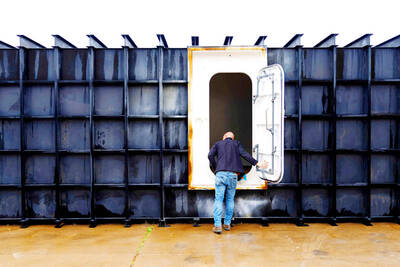
Since the war in the Middle East began nearly two weeks ago, the telephone at Ron Hubbard’s bomb shelter company in Texas has not stopped ringing. Foreign and US clients are rushing to buy his bunkers, seeking refuge in case of air raids, nuclear fallout or apocalypse. With the US and Israel pounding Iran, and Tehran retaliating with strikes across the region, Hubbard has seen demand for his product soar, mostly from Gulf nation customers in Bahrain, Qatar, Kuwait and the United Arab Emirates. “You can imagine how many people are thinking: ‘I wish I had a bomb shelter,’” Hubbard, 63, said in


 RSS
RSS