


Russia will accept a partition of Serbia's Kosovo province if that is what both Belgrade and Kosovo's ethnic Albanian majority agree to, Russian Foreign Minister Sergei Lavrov said yesterday.
Asked if Russia would accept Kosovo's partition, Lavrov said:
"Negotiations are continuing with the mediation of the troika of Russia, the European Union and the United States. The aim is to help the sides reach an agreement, and we will support whatever it is on which they reach agreement."
"But the aim of the mediators is to help the sides to reach agreement .... and not to force a particular solution on them," Lavrov told reporters at a briefing.
Russia opposes a Western-backed plan to grant Kosovo independence from Serbia. The troika format was created after Moscow had blocked the independence plan in the UN.
The EU's delegate to the troika said this month a partition of Kosovo could be contemplated if both sides agreed to it, but Russia had not made its position on the issue public.
On Thursday, Kosovar Prime Minister Agim Ceku vowed to declare independence if a final push for a diplomatic settlement between now and Dec. 10 doesn't result in statehood.
Ceku's ultimatum reflected the growing impatience among Kosovo's ethnic Albanians, who make up 90 percent of the province's 2 million people and are tired of waiting for a formal break from Serbia.
Serbia's minister for Kosovo, Slobodan Samardzic, said he offered Kosovo's leadership broad autonomy that would give it ``more powers than it ever had in its history.''
But Ceku said Albanians would settle for nothing short of full independence -- and would declare it if a Dec. 10 UN deadline passes without a negotiated deal.
Ceku's warning drew an immediate response in Belgrade, where Serbian Prime Minister Vojislav Kostunica urged the international community not to let Kosovo break away.
"The Serbian government will annul any act of unilateral independence," he said on Thursday.
EU envoy Wolfgang Ischinger said yesterday that the chances of an agreement on Kosovo between Serbs and Albanians are slim and the EU must not split over how to deal with the consequences in December if negotiations fail.

Crowds in Bangladesh are flocking to snap photographs with an unlikely social media star — an albino buffalo with flowing blond hair nicknamed “Donald Trump” that is due to be sacrificed within days. Owner Zia Uddin Mridha, 38, said his brother named the 700kg bull over its flowing helmet of hair resembling the signature look of the US president. “My younger brother picked this name because of the buffalo’s extraordinary hair,” he said at his farm in Narayanganj, just outside the capital, Dhaka. Mridha said that a constant stream of curious visitors — social media fans, onlookers and children — have come throughout
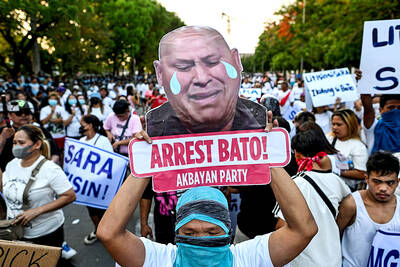
The Philippines said it has asked the country’s Supreme Court to allow it to arrest former Philippine president Rodrigo Duterte’s chief drug war enforcer to stand trial in an international tribunal. The International Criminal Court (ICC) last week unsealed an arrest warrant against Philippine Senator Ronald dela Rosa, accusing him along with Duterte and other “coperpetrators” of the “crime against humanity of murder.” Dela Rosa briefly sought refuge in the Philippine Senate last week while asking the Philippine Supreme Court to stop an ongoing attempt by government agents to arrest him. “By his own conduct, he has placed himself outside the protection of

The researchers in Ireland looked at their computer screen, marveling at a medieval book tracked down in a Roman library. They flipped through its digitized pages and found their sought-after treasure: the oldest surviving English poem. “We were extremely surprised. We were speechless. We couldn’t believe our eyes when we first saw that,” said Elisabetta Magnanti, a visiting research fellow at Trinity College Dublin’s school of English. The poem was also within the main body of Latin text, she said, calling it “extraordinary.” Composed in Old English by a Northumbrian agricultural worker in the 7th century, Caedmon’s Hymn appears within some copies of

BIGGER ROLE: Beijing has said it maintains an impartial stance on the war in Ukraine, but by training Russian troops, China is far more involved than previously known China’s armed forces secretly trained about 200 Russian military personnel in China late last year, and some have since returned to fight in Ukraine, according to three European intelligence agencies and documents seen by Reuters. While China and Russia have held a number of joint military exercises since Moscow’s full-scale invasion of Ukraine in 2022, Beijing has repeatedly said that it is neutral in the conflict and presents itself as a peace mediator. The covert training sessions, which predominantly focused on the use of drones, were outlined in a dual-language Russian-Chinese agreement signed by senior Russian and Chinese officers in Beijing on


 RSS
RSS