


In a Moscow where the gap between rich and poor grows more visible every day, there is one feature of life here that brings city dwellers of all incomes together: ice-cold summer showers.
For three weeks every summer, Moscow neighborhoods have their hot water shut off one by one, forcing residents of Russia's glitzy capital to resort to some fairly primitive remedies.
"We decided not to invest in a water-heater for just three weeks. I heat water in pots, it's no big deal. We've always lived with these shut-offs," said Tatyana Orlova, 57, a resident of the upscale Sretenka street.
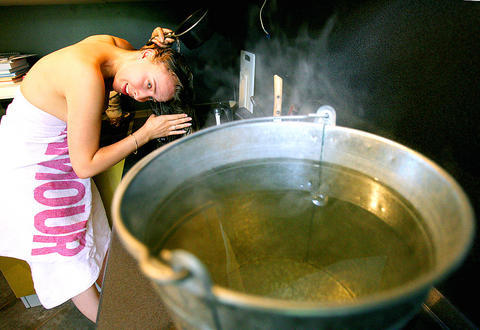
PHOTO: AFP
For decades, the same dreaded sign has appeared in apartment lobbies -- once beginning "Comrade resident!" now simply "Dear resident!" -- warning of the coming shut-off, eternally attributed to "preventive measures."
"Since 1930, we have had a centralized water heating system, and it's what we have today," said Alexander Popenskov, spokesman for the Moscow Integrated Power Company (MIPC), the city-owned company that manages the system.
Centralized water heating systems -- and the summer chills that come from annual renovation they need -- are a feature of city living throughout the former Soviet Union.
Over the decades, city residents have gotten used to improvising.
Irina Orlova, Tatyana's daughter, bathes at friends' houses in neighborhoods across the city that have not had their water shut off.
Other Muscovites time their vacations to coincide with the shut-offs, which are widely advertised in newspapers and online, or make more frequent visits to the city's many public bathhouses.
The summer cold snap has made its way into popular culture as well. Soviet-era urban legends abound with stories of people electrocuting themselves by trying to heat their baths with cables. Today the cold water jokes make the rounds on the Internet.
"It turns out that the ministry of health and social development is the sponsor of the summer hot water shut-offs," starts one joke on the Web site www.anekdot.ru. "Toughening us up is the health part. And the trips to see relatives who haven't had their water shut off yet -- that's the social development."
The real reason for the phenomenon, authorities say, is the annual work needed to combat wear and tear on the centralized systems from the hot water piped through them all year.
MIPC spokesman Popenskov said most of Moscow's hot water pipes were installed in the 1970s and 1980s, and have long since passed their anticipated lifespan of 10 years or less.
The mayor's office has launched a vast rehabilitation project to replace more than 10,000km of pipes, "the distance from Moscow to Tokyo," he said.
The five-year project should cost 1.5 billion dollars.
Popenskov said that 300km of particularly dilapidated pipes -- already 40 years old -- will be replaced this summer.
And if any rugged soul will be sad to see the long tradition of cold-water summers pass, they should not fear: Popenskov said the renovation project would not end hot-water shut-offs, only shorten them by a few days.
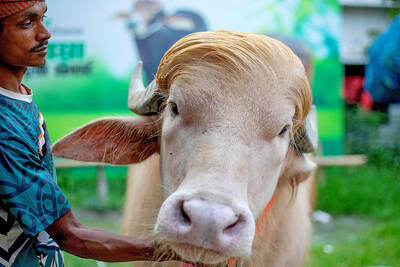
Crowds in Bangladesh are flocking to snap photographs with an unlikely social media star — an albino buffalo with flowing blond hair nicknamed “Donald Trump” that is due to be sacrificed within days. Owner Zia Uddin Mridha, 38, said his brother named the 700kg bull over its flowing helmet of hair resembling the signature look of the US president. “My younger brother picked this name because of the buffalo’s extraordinary hair,” he said at his farm in Narayanganj, just outside the capital, Dhaka. Mridha said that a constant stream of curious visitors — social media fans, onlookers and children — have come throughout

It began as a satirical online project. Now millions of young people in India are flocking to it as an outlet for their frustration. A parody political party called the Cockroach Janta Party, with the insect as its symbol, has exploded across India’s social media by turning absurdist humor into protest. Memes and short videos mocking corruption, joblessness and political dysfunction have flooded social media sites, where millions of users are embracing the cockroach — known for its ability to survive harsh conditions — as a tongue-in-cheek symbol of endurance. The online movement’s rise has been unusually rapid. The Cockroach Janta Party (CJP)
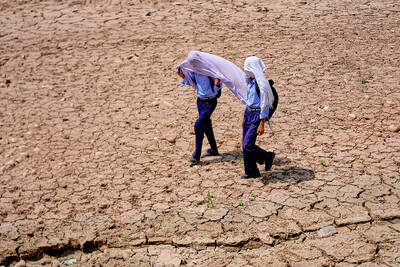
HOTTER: While Indians are accustomed to summer heat, climate change has caused northwestern India to warm faster than other parts of the country, an academic said Roads and markets have emptied during afternoons and some farmers have switched to nighttime work to avoid scorching temperatures as a heat wave grips large parts of India. The India Meteorological Department forecast maximum temperatures for yesterday of about 45°C in the capital, New Delhi, where authorities have opened temporary “cooling zones” to help people cope. The weather department warned that conditions would likely persist across several northern regions in the coming days, with temperatures staying well above seasonal averages. Authorities urged people to stay indoors during the hottest hours and take precautions against heat-related illnesses. India declares a heat wave whenever maximum temperatures

SPEAKING OUT: After Siranudh Scott’s allegations surfaced, celebrities and public figures took to social media to share their own experiences of sexual misconduct and abuse A high-profile alleged sexual abuse case within a wealthy Thai beer brewing family has prompted a wave of painful accounts from survivors of unconnected abuse in the conservative nation. Siranudh Scott, a member of the billionaire Thai family that founded the ubiquitous Singha beer brand, posted an emotional video this month accusing his elder brother Sunit of repeatedly abusing him when he was a teenager. Sunit, who is in his 30s, later denied the allegations in a video posted online, but Singha parent Boonrawd dismissed him from his executive role with the company on Tuesday last week. “I felt I needed to speak


 RSS
RSS