


Winding through rice paddies and lazily blowing its whistle along bubbly creeks, a two-car train in rural northern Japan is the latest entrant in the battle against global warming.
Following its runaway success with hybrid cars, Japan is bringing the world hybrid trains. Regular passenger runs are set to begin tomorrow on a short mountain route, the first time a diesel-electric hybrid train will be put into commercial service.
"It's part of our efforts to be green," Yasuaki Kikuchi, a spokesman for East Japan Railway, said on Friday during an exclusive trial run.
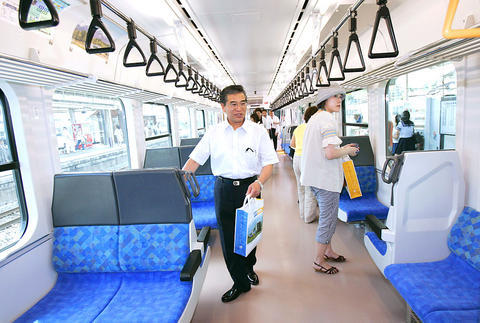
PHOTO: AP
Compared to cars, trains are a relatively small contributor to global warming. In the US, railways contribute just 4 percent of transportation-related emissions of carbon dioxide, the main greenhouse gas blamed for global warming.
But the popularity of hybrid cars, such as Toyota Motor's best-selling Prius, is helping to boost interest in hybrid trains. Railway companies around the world, including Amtrak in the US and Germany's Deutsche Bahn, are working on or investigating the technology.
Cost remains a hurdle. The Japanese train, which boosts fuel efficiency by 20 percent and reduces emissions by up to 60 percent, runs nearly ?200 million (US$1.7 million), twice as much as a standard train, Kikuchi said.
The Kiha E200, as it is known, is equipped with a diesel engine, two electric motors under each of its cars and lithium ion batteries on the roof.
With the word "hybrid" splashed in silver across its side, the otherwise normal-looking train rolls quietly out of the Nakagomi station, powered by its four electric motors.
The diesel engine only kicks in with a rumble when needed to climb a hill or if the batteries run low.
The batteries are recharged when the train slows down. After the power is switched off, the motors continue to turn for a while, and that energy -- wasted in a non-hybrid train -- is used to recharge the batteries.
Besides the usual buttons and dials, the conductor also has a touch-panel monitor. Arrows show which way energy is flowing, connecting boxes that represent the engine, generator, motor and battery, busily changing direction every few minutes. Whether cars or trains, hybrids delicately balance the two sources of power, relying on a computer to minimize waste.
The Kiha E200, which seats 46 and can hold 117 people including standees, is debuting on a line that runs about once an hour on a 79km route through a mountain resort area.
East Japan Railway will gather data on fuel consumption, which is expected to vary with different passenger loads; maintenance needs and whether the power holds up for heating in winter, company engineer Mitsuyoshi Yokota said.
In North America, Railpower Technologies has developed a hybrid train called the Green Goat for moving freight cars in a rail yard.
But industry efforts are focused on developing cleaner fuels for non-hybrid trains, said Allen Schaeffer, executive director of the Diesel Technology Forum, a trade association representing engine and equipment manufacturers.
"Here in the US, we're not really looking at hybrid technology as replacing the main locomotive," he said.
Hybrid trains, long viewed as impracticable as it's cumbersome to get various parts to work together, are catching on thanks to hybrid cars, said Makoto Arisawa, an ecology professor and train expert at Keio University in Tokyo.
"Maybe we can't expect too much from a railway this small," he said. "For the technology to be effective, it must become more widespread."
That didn't stop Hitomi Shimizu, 29, who runs a nearby inn, from showing up at the station to get a snapshot of herself with the train.
"I'm so proud of being part of a community with a train that's gentle to the environment," she said.

SPEAKING OUT: After Siranudh Scott’s allegations surfaced, celebrities and public figures took to social media to share their own experiences of sexual misconduct and abuse A high-profile alleged sexual abuse case within a wealthy Thai beer brewing family has prompted a wave of painful accounts from survivors of unconnected abuse in the conservative nation. Siranudh Scott, a member of the billionaire Thai family that founded the ubiquitous Singha beer brand, posted an emotional video this month accusing his elder brother Sunit of repeatedly abusing him when he was a teenager. Sunit, who is in his 30s, later denied the allegations in a video posted online, but Singha parent Boonrawd dismissed him from his executive role with the company on Tuesday last week. “I felt I needed to speak

A Hong Kong astronaut is to join a Chinese space mission for the first time as part of a three-person crew launching today, as Beijing edges closer to its goal of landing people on the moon. The Tiangong space station — crewed by teams of three astronauts that are typically rotated every six months — is the crown jewel of China’s space program, boosted by billions in state investment in a bid to catch up with the US and Russia. The Shenzhou-23 mission is to blast off at 11:08pm from the Jiuquan Satellite Launch Center in northwestern China, carrying three astronauts to

UPGRADED ALERT: The risk inside DR Congo is now considered ‘very high,’ while neighboring countries face a ‘high’ threat as the outbreak continues, the WHO said Ebola is spreading faster than responders can track it in eastern Congo, where health workers managed to follow up with barely one in five identified contacts in a single day. Authorities in the Democratic Republic of the Congo (DR Congo) reported 83 confirmed infections, 746 suspected cases and 1,603 identified contacts as of Thursday, but health workers were able to follow up on only 342 contacts that day — about 21 percent of the total under monitoring — data released by the DR Congo Ministry of Public Health on Friday showed. The figures suggest the response is falling behind the outbreak itself,

SEEKING ORDER: Rodrigo Paz said that ‘anyone who wants to destroy the nation will have to deal with this president and the full force of the constitution’ Bolivian President Rodrigo Paz on Wednesday said that the nation was at a “breaking point” after nearly a month of protests that have caused shortages of food, fuel and medicine. Paz, who took office six months ago amid the worst economic crisis there in four decades, is battling a groundswell of fury over his policies. The political capital, La Paz, has been besieged by low-income workers and members of the indigenous majority calling for his resignation. “The country needs order and is reaching breaking point,” the 58-year-old said at a public event in La Paz, renewing his appeal for dialogue. On Tuesday, the Bolivian


 RSS
RSS