


The US military is seeking to improve conditions for Guantanamo Bay detainees by offering more recreation and activities, including a weekly movie night for the best-behaved, the commander of the detention center said on Tuesday.
A year after three suicides and a riot prompted a security overhaul, the military hopes to provide "increased mental stimulation" with expanded recreation areas, Navy Rear Admiral Mark Buzby said.
"There are certainly benefits to giving them outlets other than sitting in their cell or sitting in their recreation cell for hours at a time with nothing else to exercise their mind or think about other than their situation," Buzby said.
The easing of conditions marks a new course on discipline at Guantanamo, where the US holds about 375 men on suspicion of terrorism or links to al-Qaeda or the Taliban.
Last year, the military took steps to "harden" the detention center and make it more secure after a riot in Camp 4, a communal living area reserved for the best-behaved detainees, and the suicides of three detainees in another prison camp.
Defense attorneys said the new measures are unlikely to ease the desperation of men who have been held without charges on the US Naval base for more than five years in many cases.
"These Band-Aid measures are going to do nothing to help alleviate the hopelessness and despair that many of our clients are fighting," said Marc Falkoff, a law professor who represents 18 of the detainees.
Buzby said the military could consider changes now because Guantanamo is smaller than it was a year ago, after about 100 detainees were released, and there are generally fewer discipline problems now -- although one detainee died in an apparent suicide on May 30.
The immediate changes are in Camp 4, a communal section reserved for detainees who are considered the most compliant. In recent weeks, the military started allowing detainees to watch sports events such as soccer matches and preapproved programs such as nature documentaries and episodes of Deadliest Catch, a Discovery Channel series about crab fishing crews.
Until then, detainees did not have access to television except when interrogators offered it as a reward.
Authorities also built a new classroom inside Camp 4 so detainees -- some of whom are illiterate -- could more easily study Pashto and Arabic, with one leg manacled to the floor.
They have also begun looking for an English teacher.
The roughly 45 detainees in Camp 4 sleep in dorm-like rooms and can spend up to 19 hours a day outside. They were also recently allowed a vegetable garden.
Most detainees are in Camps 5 and 6, maximum-security facilities where they are confined alone in solid-wall cells.
In Camp 6, the newest prison, military officials said they are cutting windows into the high concrete wall of the outdoor recreation area and They are expanding it so more can go outside at one time.
They are expanding the recreation area of Camp 5, the facility generally reserved for detainees who are considered the least compliant or of the greatest intelligence value.
The expansion of the recreation areas, which Buzby said will cost less than US$750,000, is expected to be finished later this year.
Lawyers for the detainees have complained that detainees in Camps 5 and 6 are so isolated that they have become deeply depressed, an allegation that the military denies.
"I hope that learning about these `improvements' will help the public understand how harsh our clients' lives have been for more than five years," Falkoff said by e-mail.

HISTORIC: After the arrest of Kim Keon-hee on financial and political funding charges, the country has for the first time a former president and former first lady behind bars South Korean prosecutors yesterday raided the headquarters of the former party of jailed former South Korean president Yoon Suk-yeol to gather evidence in an election meddling case against his wife, a day after she was arrested on corruption and other charges. Former first lady Kim Keon-hee was arrested late on Tuesday on a range of charges including stock manipulation and corruption, prosecutors said. Her arrest came hours after the Seoul Central District Court reviewed prosecutors’ request for an arrest warrant against the 52-year-old. The court granted the warrant, citing the risk of tampering with evidence, after prosecutors submitted an 848-page opinion laying out
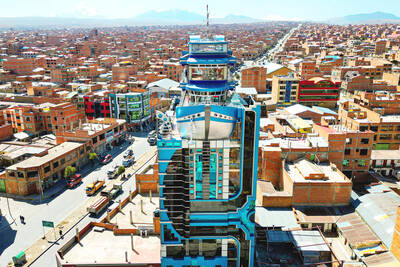
STAGNATION: Once a bastion of leftist politics, the Aymara stronghold of El Alto is showing signs of shifting right ahead of the presidential election A giant cruise ship dominates the skyline in the city of El Alto in landlocked Bolivia, a symbol of the transformation of an indigenous bastion keenly fought over in tomorrow’s presidential election. The “Titanic,” as the tallest building in the city is known, serves as the latest in a collection of uber-flamboyant neo-Andean “cholets” — a mix of chalet and “chola” or Indigenous woman — built by Bolivia’s Aymara bourgeoisie over the past two decades. Victor Choque Flores, a self-made 46-year-old businessman, forked out millions of US dollars for his “ship in a sea of bricks,” as he calls his futuristic 12-story
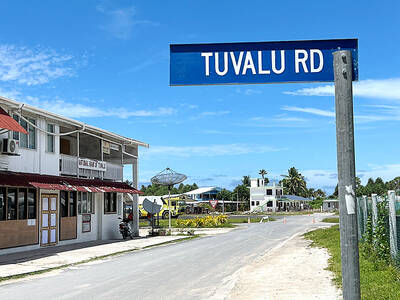
FORUM: The Solomon Islands’ move to bar Taiwan, the US and others from the Pacific Islands Forum has sparked criticism that Beijing’s influence was behind the decision Tuvaluan Prime Minister Feletei Teo said his country might pull out of the region’s top political meeting next month, after host nation Solomon Islands moved to block all external partners — including China, the US and Taiwan — from attending. The Pacific Islands Forum (PIF) leaders’ meeting is to be held in Honiara in September. On Thursday last week, Solomon Islands Prime Minister Jeremiah Manele told parliament that no dialogue partners would be invited to the annual gathering. Countries outside the Pacific, known as “dialogue partners,” have attended the forum since 1989, to work with Pacific leaders and contribute to discussions around

END OF AN ERA: The vote brings the curtain down on 20 years of socialist rule, which began in 2005 when Evo Morales, an indigenous coca farmer, was elected president A center-right senator and a right-wing former president are to advance to a run-off for Bolivia’s presidency after the first round of elections on Sunday, marking the end of two decades of leftist rule, preliminary official results showed. Bolivian Senator Rodrigo Paz was the surprise front-runner, with 32.15 percent of the vote cast in an election dominated by a deep economic crisis, results published by the electoral commission showed. He was followed by former Bolivian president Jorge “Tuto” Quiroga in second with 26.87 percent, according to results based on 92 percent of votes cast. Millionaire businessman Samuel Doria Medina, who had been tipped


 RSS
RSS