


Asian governments need to do more to combat people trafficking as children are increasingly victims of the illicit multibillion dollar global trade, an international forum was told yesterday.
Despite national laws and international conventions against the crime, enforcement has been largely lacking, Bruce Reed, regional representative of the International Organization for Migration, told the Combating Trafficking forum in Manila.
"Trafficking in persons has become a serious challenge to governments and policy makers in the region," he said.
"Cases of trafficking are reported daily and no country is immune from the phenomenon," he said.
Reed told the forum that while many victims were trafficked within Asia there was an "increasing trend" of them being shipped to Europe and Africa.
Many of the victims are trafficked for sexual or labor exploitation, while others end up begging or forced into marriage.
Others end up being trafficked for organ harvesting.
The profile of the victims too has been constantly changing, he said.
"Victims are becoming younger. Children are increasingly caught up in the process and Southeast Asia is particularly characterised by high rates of child migration," Reed said, although he admitted that statistics were difficult to come by.
Poverty at home has also led to a dramatic increase in international migration, with 30 million Asians living outside their countries and in environments where they were vulnerable to abuse, Reed said.
Governments however have failed to change their migration policies that often remain "rigid and inflexible."
The lack of legal migration channels creates opportunities for illegal recruiters or intermediaries.
Anders Lisborg, the International Labor Organization's (ILO) program officer for trafficking and child labor, said human trafficking was closely linked to forced labor which could have been addressed by international conventions.
"Trafficking is often possible because of a lack of application and enforcement of such labor standards — both in countries of origin and destination," he said.
A study published by the Filipino advocacy group Visayan Forum Foundation, which also cited ILO figures, said there were at least 12.3 million people worldwide trapped in conditions of forced labor and slavery.
The majority of them are exploited by private businesses while some 2.5 million are victims of trafficking.
Every year, private enterprises earn some US$44.3 billion from forced labor, with some US$31.6 billion coming from trafficking operations, the study said.
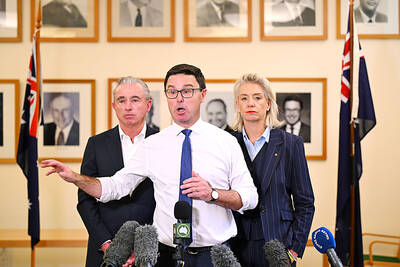
BACKLASH: The National Party quit its decades-long partnership with the Liberal Party after their election loss to center-left Labor, which won a historic third term Australia’s National Party has split from its conservative coalition partner of more than 60 years, the Liberal Party, citing policy differences over renewable energy and after a resounding loss at a national election this month. “Its time to have a break,” Nationals leader David Littleproud told reporters yesterday. The split shows the pressure on Australia’s conservative parties after Prime Minister Anthony Albanese’s center-left Labor party won a historic second term in the May 3 election, powered by a voter backlash against US President Donald Trump’s policies. Under the long-standing partnership in state and federal politics, the Liberal and National coalition had shared power

NO EXCUSES: Marcos said his administration was acting on voters’ demands, but an academic said the move was emotionally motivated after a poor midterm showing Philippine President Ferdinand Marcos Jr yesterday sought the resignation of all his Cabinet secretaries, in a move seen as an attempt to reset the political agenda and assert his authority over the second half of his single six-year term. The order came after the president’s allies failed to win a majority of Senate seats contested in the 12 polls on Monday last week, leaving Marcos facing a divided political and legislative landscape that could thwart his attempts to have an ally succeed him in 2028. “He’s talking to the people, trying to salvage whatever political capital he has left. I think it’s

CONTROVERSY: During the performance of Israel’s entrant Yuval Raphael’s song ‘New Day Will Rise,’ loud whistles were heard and two people tried to get on stage Austria’s JJ yesterday won the Eurovision Song Contest, with his operatic song Wasted Love triumphing at the world’s biggest live music television event. After votes from national juries around Europe and viewers from across the continent and beyond, JJ gave Austria its first victory since bearded drag performer Conchita Wurst’s 2014 triumph. After the nail-biting drama as the votes were revealed running into yesterday morning, Austria finished with 436 points, ahead of Israel — whose participation drew protests — on 357 and Estonia on 356. “Thank you to you, Europe, for making my dreams come true,” 24-year-old countertenor JJ, whose

Polish presidential candidates offered different visions of Poland and its relations with Ukraine in a televised debate ahead of next week’s run-off, which remains on a knife-edge. During a head-to-head debate lasting two hours, centrist Warsaw Mayor Rafal Trzaskowski, from Polish Prime Minister Donald Tusk’s governing pro-European coalition, faced the Eurosceptic historian Karol Nawrocki, backed by the right-wing populist Law and Justice party (PiS). The two candidates, who qualified for the second round after coming in the top two places in the first vote on Sunday last week, clashed over Poland’s relations with Ukraine, EU policy and the track records of their


 RSS
RSS