


Human rights group Amnesty International has urged members to push Singapore's government to grant clemency to a 21-year-old Nigerian scheduled to be executed next week for drug trafficking.
Amnesty International issued an "urgent action appeal" on Friday to its members around the world to ask the Singapore government to spare the life of Amara Tochi Iwuchukwu and for a moratorium on all executions in Singapore.
Iwuchukwu is to be executed on Friday at Singapore's Changi Prison after the Southeast Asian country's president rejected his clemency appeal, according to a statement from Nigeria's non-governmental Civil Liberties Organization (CLO).
Iwuchukwu was arrested at Singapore's airport in November 2004 after arriving from Dubai with 100 capsules containing 727g of heroin, estimated by authorities to be worth S$1.5 million (US$970,000).
Singapore has some of the world's harshest drug laws, including a mandatory death penalty for anyone found guilty of trafficking more than 15g of heroin.
At the time of his arrest, Iwuchukwu told narcotics officers the pills were African herbs that he was supposed to give to a sick friend. He also told officers that he came to try out for soccer teams playing in the country's Singapore League.
Amnesty International's appeal suggested that the judge who convicted Iwuchukwu "appears to have accepted that he might not have realized the substance he was carrying was heroin."
The verdict said that a "Mr Smith" gave Tochi the pills to transport, according to Amnesty International.
Reasonable doubt
Amnesty quoted the verdict as saying: "There was no direct evidence that he knew the capsules contained diamorphine [heroin]. There was nothing to suggest that Smith [who gave Tochi the pills to transport] had told him they contained diamorphine, or that [Tochi] had found that out of his own."
Court officials were not available for comment yesterday.
The group asked its members to immediately send letters, e-mails and faxes to Singapore's prime minister, deputy prime minister and attorney general in an effort to stop the execution.
CLO, the Nigerian human rights group, has urged Nigeria's government to intervene.
The Nigerian High Commission in Singapore helped Iwuchukwu file the appeal for presidential clemency and is in regular contact with his family in Nigeria, a consular officer said on Friday on condition of anonymity, citing protocol.
Also convicted and on death row in the same case is Okele Nelson Malachy, 35, a stateless African who Amnesty said is reportedly from South Africa.
Singapore's strict drug laws made international headlines -- and caused an outcry in Australia -- in December 2005 when the city-state executed a 25-year-old Australian heroin trafficker despite numerous appeals from the Canberra government.
Amnesty International says Singapore is believed to have the world's highest per capita execution rate.
The country's leaders say the tough laws and penalties are an effective deterrent against crimes that ruin lives.

HISTORIC: After the arrest of Kim Keon-hee on financial and political funding charges, the country has for the first time a former president and former first lady behind bars South Korean prosecutors yesterday raided the headquarters of the former party of jailed former South Korean president Yoon Suk-yeol to gather evidence in an election meddling case against his wife, a day after she was arrested on corruption and other charges. Former first lady Kim Keon-hee was arrested late on Tuesday on a range of charges including stock manipulation and corruption, prosecutors said. Her arrest came hours after the Seoul Central District Court reviewed prosecutors’ request for an arrest warrant against the 52-year-old. The court granted the warrant, citing the risk of tampering with evidence, after prosecutors submitted an 848-page opinion laying out
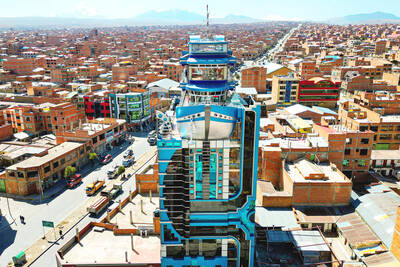
STAGNATION: Once a bastion of leftist politics, the Aymara stronghold of El Alto is showing signs of shifting right ahead of the presidential election A giant cruise ship dominates the skyline in the city of El Alto in landlocked Bolivia, a symbol of the transformation of an indigenous bastion keenly fought over in tomorrow’s presidential election. The “Titanic,” as the tallest building in the city is known, serves as the latest in a collection of uber-flamboyant neo-Andean “cholets” — a mix of chalet and “chola” or Indigenous woman — built by Bolivia’s Aymara bourgeoisie over the past two decades. Victor Choque Flores, a self-made 46-year-old businessman, forked out millions of US dollars for his “ship in a sea of bricks,” as he calls his futuristic 12-story
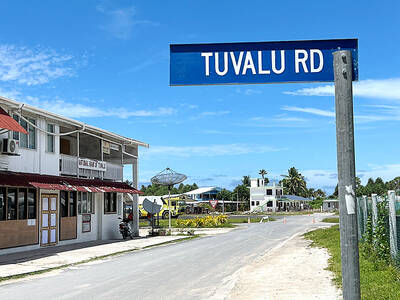
FORUM: The Solomon Islands’ move to bar Taiwan, the US and others from the Pacific Islands Forum has sparked criticism that Beijing’s influence was behind the decision Tuvaluan Prime Minister Feletei Teo said his country might pull out of the region’s top political meeting next month, after host nation Solomon Islands moved to block all external partners — including China, the US and Taiwan — from attending. The Pacific Islands Forum (PIF) leaders’ meeting is to be held in Honiara in September. On Thursday last week, Solomon Islands Prime Minister Jeremiah Manele told parliament that no dialogue partners would be invited to the annual gathering. Countries outside the Pacific, known as “dialogue partners,” have attended the forum since 1989, to work with Pacific leaders and contribute to discussions around

END OF AN ERA: The vote brings the curtain down on 20 years of socialist rule, which began in 2005 when Evo Morales, an indigenous coca farmer, was elected president A center-right senator and a right-wing former president are to advance to a run-off for Bolivia’s presidency after the first round of elections on Sunday, marking the end of two decades of leftist rule, preliminary official results showed. Bolivian Senator Rodrigo Paz was the surprise front-runner, with 32.15 percent of the vote cast in an election dominated by a deep economic crisis, results published by the electoral commission showed. He was followed by former Bolivian president Jorge “Tuto” Quiroga in second with 26.87 percent, according to results based on 92 percent of votes cast. Millionaire businessman Samuel Doria Medina, who had been tipped


 RSS
RSS